The Mezunian

Die Positivität ist das Opium des Volkes, aber der Spott ist das Opium der Verrückten

Mises Daily Got Logic Wrong, Yet ‘Gain

Why write an article on a subject you know nothing about?

Why not? It never stopped Mises Daily from writing ’bout economics.

You walked into that 1, guys.

Anyway, some philosopher named Amia Srinivasan @ the New York Times made the mistake o’ taking laissez-faire libertarianism seriously & civilly asked ’bout their many logical inconsistencies as good moderate liberals always do. The Mises Institute Mises Daily, parroted by the Mises Institute, as every narcissistic political group that views themselves as the greatest victims in the world, take this as further evidence o’ the mainstream media’s irrational hatred o’ the 1 true economic system. This time that charge is led by David Gordon in The New York Times Got Libertarianism Wrong Yet Again.

What Srinivasan does is compare 2 laissez-faire libertarians—1 who was so anal that he himself used the term Utopian in his book, showing that even he knew he was full o’ shit—& 1 who tries to temper his crazy religion with some acknowledgement o’ reality. These comparisons are common ’mong good moderate liberals: much as there’s the “civil” or “rational” Republican as opposed to the loud-mouthed louts liberals are used to getting misspelled death threats from, there is the dream o’ the laissez-faire libertarian who doesn’t type his posts from a subterranean cave.

I disagree with her claim that either o’ them might be rational, but that’s not the topic now. What is is Gordon’s illiteracy:

It isn’t just that he finds it “difficult to say” that you deserve what you get in the market. He doesn’t say it at all. […] In his account, you get what you are entitled to, a very different matter.

Thesaurus.com & Oxford disagree:
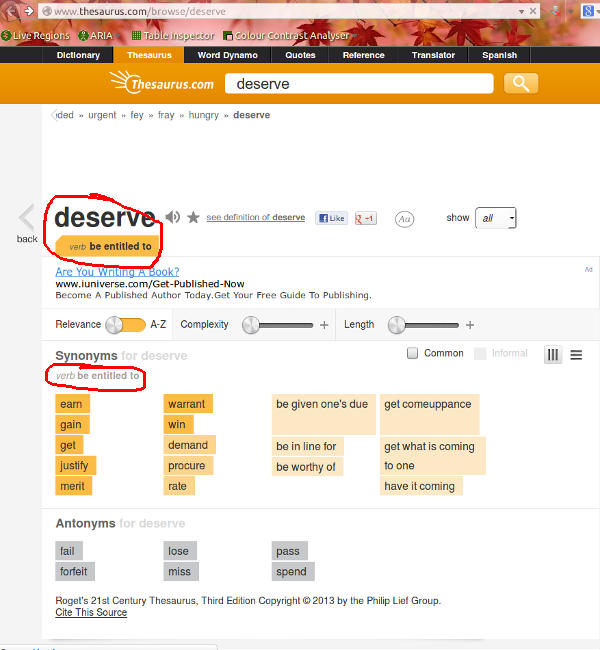
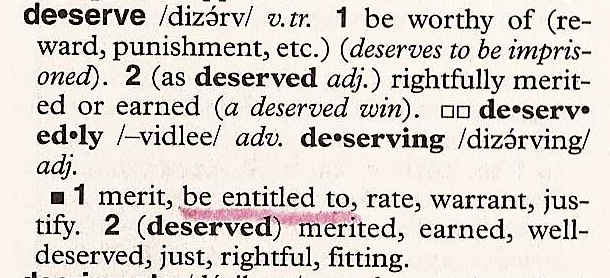
Deserve: verb: to be entitled to.
Deserve: 1. be worthy of (reward, punishment, etc.) (deserves to be imprisoned). 2 (as deserved adj.) rightfully merited or earned (a deserved win). Synonyms: 1. merit, be entitled to, rate, warrant, justify. 2 (deserved) merited, earned, well-deserved, just, rightful, fitting.

Gordon tries to distinguish these terms by defining the former as “patterned” & Nozick’s as “historical,” despite neither o’ these having any relevance to these terms. Nor does he describe what he means. It’s clear that Srinivasan’s examples o’ people being poor or rich due to luck are based on the past, & thus just as historical as whatever Nozick’s beliefs are—’less Gordon doesn’t understand what that word means, either.

The example he gives offers no further understanding, either: someone needs a kidney, someone else has 1 ideal for the picking. Should the latter be forced to give it up? He connects this to income, despite many significant differences. He acknowledges that these are morally arbitrary, but nevertheless insists that to redistribute income or kidneys would be wrong ’cause they’re “entitled to them.” He doesn’t answer why or how this doesn’t fall under Srinivasan’s problem.

Furthermore, the income example is flawed, since it’s not intrinsically connected to one’s body & can be redistributed without even touching its owner. If 1 loiterer’s on ’nother’s property, she is not coercing him in any way; in contrast, if the latter does force her to leave, he is using coercion. Only in laissez-faire libertarians’ arbitrary definitions for “coercion,” “freedom,” or “entitled property” is this different; & they have no cause to complain if one refuses to accept their arbitrary definitions.

The question to ask is, if property control—& that’s what it is, the control over others’ use o’ certain property, regardless o’ what they want to call it—is not based on merit, what is it based on? In order for the market to be defended as an objectively just mechanism for distributing property—’bove the public’s opinion or other consequentialist concerns—then it must have an objective measure o’ value to compare it to. If not, then market economics is nonfalsifiable & unscientific—an economic theology.

His linguistic blunders continue:

He does not hold that “any exchange between two people in the absence of direct physical compulsion by one party against the other (or the threat thereof) [is] necessarily free.” He does say that if you face severely limited options, and your predicament comes about because others have acted within their rights, your choice is still voluntary. This is a rather more nuanced claim, a matter that escapes Srinivasan’s attention.

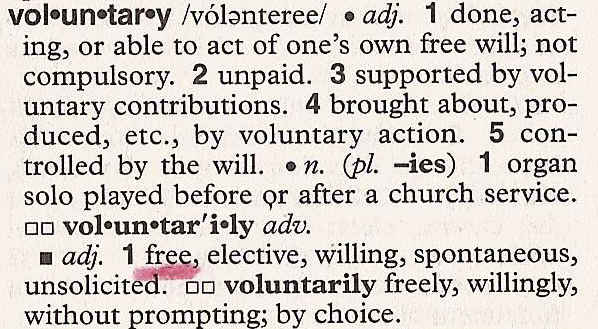
No it isn’t: it’s the same thing. Free & voluntary mean the same thing. If one is not necessarily free then, by definition, their actions are not voluntary. I turn to Oxford & Thesaurus.com ’gain:
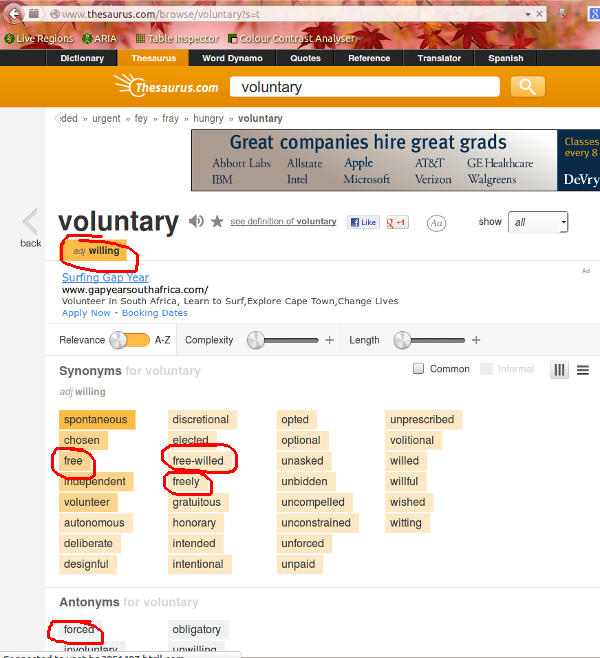
Voluntary: adj. willing, free, free-willed, freely.
Voluntary: 1. done, acting, or able to act of one's own free will; not compulsory. 2 unpaid. 3 supported by voluntary contributions. 4 brough about, produced, etc., by voluntary action. 5 controlled by the will. Synonyms: 1. free, elective, willing, spontaneous, unsolicited.

What annoys me most ’bout Austrian-schoolers is that relying on deductive reasoning would require godly-perfect logical thinking for a brilliant linguist—keeping in mind that praxeology bases its strength purely on the words it’s based on, rejecting math as well. So it’s shocking how linguistically ignorant Austrian-schoolers are. Or a’least their readers are: Gordan could be intentionally using Orwellian language for propaganda purposes.

He complains ’bout Srinivasan’s confusion, which shows a lack o’ self-awareness, considering the word-twisting he uses. If New York Times writers get libertarianism wrong, it can probably be attributed to self-proclaimed libertarians being so bad @ ’splaining themselves. I mean, this is the New York Times we’re talking ’bout: the same newspaper that has writers who outright brag ’bout how they can’t read. When even I in my ivory tower—that’s what I call my room in my mother’s basement, by the way—can’t understand how A can be A & not A @ the same time, how can you blame them?

Nowhere does Nozick say that the structure of libertarian rights exhausts morality.

Personal anecdote: I just recently started reading an excellent book called To the Point: A Dictionary of Concise Writing that mocks the use o’ vague academicspeak in political writing as a way to evade clear truth. I bring it up ’cause this article has convinced me o’ its writer’s accuracy.

What is the “structure of libertarian rights” & what does he mean by “exhausting” morality? That it only handles some aspects o’ morality, & not all? Then how does it handle morality in other aspects that contradict it? That’s why rational philosophies do “exhaust morality.”

Rather, rights tell us when force or its threat may be permissibly used.

Right. As all rights in all moral systems do. Thank you for reiterating that right-libertarianism is a philosophy & not a study o’ beetle mating habits.

It is not at all the case that anything you are free to do, according to this structure of rights, is morally permissible.

Petty critique, but doesn’t “according to this structure of rights” sound cultish?

Speaking o’ Orwellian language: So Libertarian morals do not simply allow you to do morally just actions… but also immoral actions? Should we add “Injustice is Just” to the Ministry of Truth’s list o’ slogans?

Srinivasan’s whole purpose is to criticize laissez-faire libertarianism’s lack o’ moral coherency. You are acknowledging it yourself. Is that what his argument is? “Yes, but it’s not s’posed to be morally correct”? Then what value does it have as an ethical system. Or does Gordon think “morals” & “ethics” are different, too? (Spoiler alert: they’re not.)

Neither is it the case that moral obligation is confined to freely chosen commitments[.]

So he acknowledges that laissez-faire libertarianism is, in fact, authoritarian in that it forces you to do things gainst your will.

[A]gain, Srinivasan wrongly conflates moral obligations and enforceable obligations.

Probably ’cause she can’t psychically guess what you mean by the latter. Is he describing what one is physically capable o’ doing in a “might makes right” way? ’Cause if he is, with his defense o’ that & his downplaying o’ pesky morals, he seems to be describing nihilism mo’ than laissez-faire libertarianism.

I must confess, with the all o’ the acknowledgements o’ laissez-faire libertarianism’s lack o’ ethics, I suspect Gordon may secretly be a leftist who snuck into the Mises Compound in an attempt to bring it down from the inside. That’s the only explanation for why these arguments are so bad.

While Gordon accuses Srinivasan o’ conflating synonyms, he appears to be unable to understand why someone writing on morality would be obsessing over moral obligations. How absurd o’ her.

Srinivasan goes on to reject Nozick’s claim that a “minimal state” is redistributive. I’d complain ’bout a so-called libertarian using the weaselly term “minimal state” to shroud their hypocritical view on when coercion is useful—when it benefits them—& when it isn’t—when it benefits the poor.

Gordon gives 3 reasons why this isn’t true:

People are not forced to pay for the minimal state, though they would find it in their in their interest to do so[.]

A consistent theme: the true difference ’tween laissez-faire libertarianism & authoritarianism is that the latter is a’least honest, while the former plays word games like this to hide its authoritarian nature. Like a mob boss, Gordon says, “Theoretically you don’t have to support our government; but if you don’t, well, I’d hate to see what happens to you…”

[A]nd the monopoly prices charged by the dominant agency really are redistributive, not just seemingly so.

Gordon offers no evidence. He literally just says, “It is so. So there.

Further, the minimal state does not arise entirely through free bargaining. The Dominant Protective Association prohibits other agencies and independents from imposing risky decision procedures on its clients.

The bullying commies…

It’s unfortunate that the Mises Institute didn’t select someone with a better knowledge o’ libertarianism to write ’bout it. But the article, replete with errors as it is, may do some good: it may bring the incoherency o’ libertarian ideas to the attention o’ readers who otherwise might not have realized them. After all:

As Quine once said after Nozick had complained to him of a negative review, I think by Carlin Romano, of Philosophical Explanations, “Every knock a boost.”

I concur. “Every knock a boost”! Thank you, Quine: a great fortune-cookie writer is you.

Addendum:

David Gordon’s totally a leftist. I bet that Resurrecting Marx, though seeming to be an attack gainst him, is his way o’ sneaking his vile Marxism into the pure Church o’ the Market. I’m on to you.
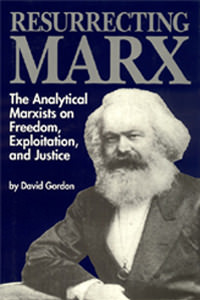
Book cover for Resurrecting Marx depicting bearded Marx leering at you.

Look @ that cover. Marx looks so disappointed. “You spent your money on this? Truly?”

Can the ’analytical Marxists’ save Marx from himself. Gordon says no way.

To be fair, Gordon does make a good point: it’s hard to save someone when they’ve been dead for over a century. & if resurrection is the goal, Marxists should know that they need a’least a gallon o’ bourgeois blood for the sacrifice to succeed.

Addendum 2:

Hilariously, there’s a tiny disclaimer @ the bottom o’ the article that says, “Note: The views expressed in Daily Articles on Mises.org are not necessarily those of the Mises Institute.” If this article is evidence o’ the quality o’ “Daily Articles,” then ’twas wise to specify this.


Posted in No News Is Good News, Politics

$

Ma, can I please borrow a $?
I swear I’ll pay it back ‘ventually.

Just 1 mo’ $;
I swear this’ll get me on my feet.

I know it’s been taking a while,
but if you give me just a few mo’ $s,
I swear I can pay you back with interest ‘ventually.

Boy, it’s time you learned how to cut your losses.

PLYK!

Posted in Crazy, Poetry

Duh… Is that How Politics Works?

Right-libertarians generally hold a simplistic interpretation o’ reality—’specially economic reality—largely based on Western traditions, safely unhindered in a world where the debate is whether capitalism is awesome or “too much freedom.”

Thus, it’s no huge surprise when I read Randall Halcombe’s “Joseph Stiglitz on Crony Capitalism” @ the official church o’ Mises, the Mises Economics Blog1, which reads like a middle-schooler’s attempt to discuss the political economy:

Although Joseph Stiglitz has a reputation as one of the most prominent defenders of big government…

I always thought Karl Marx had that reputation, but never mind. I’m sure Stiglitz scoffs @ the pure “anarchy” present in “Marxist-Leninist” states like North Korea.

It does appear to me that throughout the political spectrum, from left to right, there is a substantial consensus that government is the cause of many of the problems people perceive.

It’s shocking that problems in a political system might be caused by the organization that manages said political system. If Halcombe had taken only a minute to think ’bout it, he might’ve realized that opposition to too much capitalism—& especially it in general—in a capitalist country presupposes criticism o’ the government that maintains said capitalist system. I don’t know what logic exists in the belief that the US would be better off if ’twere socialist—or whatever alternative one wants—but that the government need not change to be, you know, socialist. It’d be quite a creative solution: change the political system without changing it @ all!

To be fair, I have to remember that right-libertarians are used to debating liberals; so this “solution” has likely been encountered in debates many times before.

The disagreement is over how to solve those problems.

(Slaps forehead.) So that’s the rub. I was so sure that with the left & right agreeing on the government needing to change in some way—a terribly specific diagnosis—they’d surely agree on how. We were so close to bringing that bipartisan Utopia dwelling in the Third Way’s fever dreams to fruition!

He goes on to explain how Stiglitz criticizes income inequality, caused by the “negative impact o’ government”—which isn’t equivalent to “too much impact.” He further connects Stiglitz to right economists through their criticism o’ cronyism, carefully ignoring the vital role the market plays in causing cronyism (I’ll delve in this later in this article).

I am encouraged to see that people throughout the political spectrum, from Stiglitz to Stockman to Schweizer, recognize government power as the source o’ many o’ our contemporary problems.

As we all know, Stiglitz is right there with Bakunin & Kropotkin on the far left.

& just ’cause you found some other guys in your li’l club who call themselves right-wing doesn’t mean they represent a significant role in the general movement. I can just imagine Mitch McConnel with his arm in mid-stretch to grab his cash from MoldyFumes, inc.2, only to stop with his pupils dilated & his hands grasping his hair, screaming, “No! I can’t! What would the famous Stockman & Schweizer think?”

Those on the left see more government, and better government, as the remedy to poor government policies, which seems counter-intuitive.

Sigh. This is the equivalent o’ a 3rd-grader’s attempt to describe leftism & fails. There’s no such thing as “mo’ government,” ’less one means “mo’ people in government,” which is, indeed, what those further on the left want: direct democracy. If the government exists, it exists, whether it uses police force to maintain 1 resource distribution or ’nother, or whether it chooses to ignore resource distribution entirely (note: never heard o’ a market defender backing this last choice). Only supporting government when it defends one’s riches, but not when it actually expects compensation for that, isn’t “libertarian”; it’s just narcissistic.

Why would we think a bigger government would work better than the government mess we already have?

1. Nobody calls for “bigger” government, ’cause that’s not a real thing. That’s an abstract label people on the right made-up.

The only way that argument makes sense is if we’re arguing ’tween splitting up the US or not. That’s not the discussion @ all, so Halcombe’s clearly mixing his words up.

2. The current government mess has nothing to do with the government being “too big.” If one’s belief is that the problem with the US’s economy is the rich being too powerful, then obviously the problem is that the government prefers the rich—that is what Stiglitz was actually saying. I don’t know why Halcombe had to complicate it with this abstract nonsense.

Stiglitz has already explained how all the incentives lean toward making government more responsive to the elite, at the expense of the masses.

& this is caused by either income inequality—which can only be fixed by income redistribution—or a lack o’ sufficient laws gainst excess lobbying. The solution to both requires “mo’ government” in the right-libertarian argot; hence Stiglitz’s diagnosis.

I don’t think Halcombe understands the implications o’ this point—though, to be fair, Stiglitz may not, either, considering his claim that “[i]t doesn’t have to be this way.” Think: the incentives make government corrupt. That’s the opposite o’ what Halcombe is arguing: rather than just the government corrupting the market, this shows that the market corrupts the government.

If anything, this shows that pure laisssez-faire is self-defeating: the economic inequality it’ll create will also create unequal influence over government, giving the rich superior control over the majority—as already happens now. If some o’ them benefit from cronyism—& some do, which is why they push for it—then they will have the superior means to make that goal become legal reality. Thus, laissez-faire naturally creates the very cronyism that s’posedly violates it.

That’s the paradoxical nature o’ power: power itself is all that can prevent other power. That’s what a “power vacuum” is: when there’s no power structure, there’s nothing to stop some other group from taking power. Thus, a lack o’ government intervention, rather than making society freer, only allows them to be defacto replaced by rich citizens who are not so shy ’bout using their economic advantages to enforce their own power. If anything, the imaginary “less government” solution is what’s counter-intuitive.

That also ’splains why the problem with cronyism is far deeper than just there not being ’nough “wise” economists like Stiglitz who somehow figured out that US politics & economics is corrupt—not unlike a 50-year-old finally learning that Santa Claus isn’t real. The very same cronyism gives those that benefit from it superior power over government, thus making it difficult to change it in any way that goes gainst what they want—which is said cronyism. It’s cyclical, with the market corrupting the government corrupting the market corrupting the government, & so on. This is why said cronyism is not new, but goes far back into US history—& will surely continue to thrive, regardless o’ the paper-spined promises o’ such benign capitalists as Stiglitz.

But if we agree that government has caused many of the problems we all see–all of us from the political left to right–then we are part-way toward finding a solution that we all agree would fix those problems. My thought is: eliminate what we all agree is the cause.

You know, I’ve just realized that there actually is something that laissez-faire libertarians who want a capitalist society without government & moderate liberals who want a capitalist society without cronyism & poverty can both agree they oppose: brutal reality.

1 This time I did read the book being discussed—& I must confess that I was able to understand it perfectly, & thus with a tear in my eye, I am unable to accept the kind o’ street cred that Douthat has proven himself to hold.

2 They’re truly some obnoxiously “ironic” marketing company.

Posted in No News Is Good News, Politics

Laughing

It’s better to die laughing.
That’s why I’m always laughing.

Heheheh.

Posted in Crazy, Poetry

IT’S A SECRET TO NOBODY

You remember those websites that look as if they were made in the late 90s—when the height o’ sexiness was beveled table borders—spouting ’bout the conspiracies “nobody” in the “liberal” media will tell you—but I will! Well, it’s good to see that Careerealism’s taking good inspiration.

O, & unsurprisingly, this article is just here so the author can peddle videos.

By the way, do we live in some Kafkaesque nightmare or is that just the fantasies o’ Careerealism’s writers? Why are these employers so obsessed with every li’l detail o’ how you act—’stead o’, you know, the quality o’ your work or knowledge—just so they can latch onto 1 like a Job Nazi, “No job for you!” & then they refuse to tell anyone their shibboleth—probably for fear that the spies will sneak through their screening process. Ha! They’re not looking for employees: they’re looking for recruits into their conspiracy group!

We can all thank Careerealism for their hard-hitting report on cracking the Employer Cabal. True fucking Deep Throats, they are!

See, look @ this bitter dose o’ reality:

Reality check: Those who are failing to make a good first impression get put in the “no” pile and are never contacted again [emphasis mine].

1 fuck up & you’re blacklisted from the guild for life. Apparently nowadays having a “smelly physical appearance”1—whatever that is—is the modern equivalent o’ being caught as a card-carrying communist.

This is like a marketer-fundamentalist version o’ those overly Christian children’s books from the Victorian era:

You may not like what you read, but the good news is with a little attention and practice, all of them can be improved upon. So, ask yourself, “Am I guilty of the following?”

All true! I am a filthy beast & need the Jesus o’ marketing to cleanse me o’ my clammy handshakes.

By the way, her lists look less like something that actually required thought, & mo’ like an exercise in creating Ad Libs. If there was an 11th tip, it’d surely be, “Your hand gestures are too slow/too fast/too medium/too sexy/too handy.”

& then she says it all comes down to attitude. Presumably, the videos she made are just her showing you various poses you can try out, such as crossing your arms & tilting your upper body with your chin held up like you hip kids with your backward caps & Super Nintendos.

1Your physical appearance is disheveled/outdated/sloppy/smelly/overpowering (i.e. too much perfume) [emphasis mine].”

Posted in Yuppy Tripe

Pro Theme Design!

So, I was searching for a WordPress-widget-making tutorial that wasn’t just the author throwing code in your face & telling you to paste it without saying what any o’ it does when I saw this splendid page @ “Pro Theme Design”:

Now, you’re probably thinking, “Wow, this code’s garbage; it cuts off in the middle o’ functions just like that. That’ll almost certainly cause errors.

But that’s not where the stupidity arrives. Here is:

There’s no design mo’ professional than making it impossible to tell 1 element from ’nother. Note that the textbox is so tall, you have to scroll far down to see that & know that a textbox exists @ all.

By the way, you could probably ascertain by these screen shots that this tutorial, too, simply throws code @ you without explaining what it does.

Posted in Programming, Web Design

It Took Six Whole Revisions to Perfect this Vital Info

Where would I be without Six Revisions to give me the snoop on all of the truly important web design trends. For instance, while CSS-Tricks wasted their time telling you how to optimize table space using CSS-translate to rotate long row headers—as if that’s important, phhh, nerds—Six Revisions told us ’bout all of the portfolio websites that put huge images of cluttered workstations as their backgrounds.

Gube thinks this is good, and I agree: ’fore I hire web designers, I always ensure they have sloppy home organization.

But my favorite example is the one near the top:

Nothing inspires confidence like text that’s near-impossible to read. Looks like GroveMade—or however they style their insipid brand name—needs to start hitting those color theory books ’gain.

Addendum:

What’s also professional is a website that takes eons to load & are unintuitive to use. That’s 1 thing ’bout web design: they always find new ways to inconvenience users.

Posted in Web Design

How to Impact Your Digits Onto a Character-Creator to Instantiate Articles without Effort

I couldn’t help noticing the general dreadfulness o’ business-oriented blogs, & decided to take the time to critique a particularly trite 1 with a particularly vacuous title, “How to Activate Your Network As a Recent Grad” by a website called “Careerealism,” whose name’s so hideous, it makes me want to weep every time I read it.

Networking is awkward – period. I used to stand around tabletops with resumes and home-printed business cards in my shiny new “work bag,” eager to find just one person to connect with that would lead me to my first job.

I can’t understand how harassing random patrons could possibly cause awkward situations.

I had to convince myself not to walk out of almost every event I attended. I knew there was this thing called networking and I needed to do it if I wanted to secure a job.

This is the tritest article opening ever: “I used to be dumb like you, but then I learned that _____ involves mo’ than just ______.”

Like you, I thought I earned my right to have a career.

I can’t stand writers who assume the reader is as stupid as they are.

As a result of my hard work, I deserved a job […] I graduated magna cum laude, completed an internship, and was involved in leadership activities. I did college “right,” but I was still unemployed after graduation. I faced the harsh reality head on that my degree did not entitle me to a job. So, there I was, “networking.” Or so I thought.

How does doing exceptionally @ school not entitle one to a job, but “networking” does? What proof?

Social media has completely refined “networking” and it’s easier than you think. It’s something you are doing already and you’re probably missing awesome opportunities right in front of you!

Can’t go an inane blog post without contradiction. So I’m already doing it, but missing out, too? It’s either 1 or the other.

This isn’t even nitpicking on diction: the general sentiment is paradoxical. The idea is that I’m doing the right thing already, but I’m also not doing the right thing @ the same time. Should I change what I’m doing in this regard or not? I can’t both change & stay the same in the same subject.

So, it’s not that you don’t know how to network. In fact, you are a pro at networking.

If I’m a pro @ networking (purportedly), than why am I doing so badly @ networking (purportedly)?

Every time you accept a friend, follower, or connection, the “net worth” in your network increases dramatically!

Could these obnoxious yuppies stop using serious business terms for their silly play things like adult children?

There is a theory called the Six Degrees of Separation, developed by Frigyes Karinthy.

Check “Quote info everyone already knows as if ’twere obscure” off the list o’ clichés.

Think about it, right now you are six introductions away from your first job. [Emphasis mine.]

Nitpick: when I was in high school, an English teacher advised me not to use “think about it1.” This article would benefit from such advise, too.

Hey, wait a minute: Jackson’s cliché almost made me miss the fact that she straight comma-spliced. How d’you expect the hip kids to get a job when you’re teaching them that that’s OK?

That sure sounds a heck of a lot better than applying to hundred more jobs!

That’s ’cause the implications you’ve imagined are fantasy.

How To Activate Your Network As A Recent Grad

Why is the title o’ this article repeated as a section heading?

You’ve already made thousands of introductions with friends on Facebook, followers on Twitter, and connections on LinkedIn. Now it’s time to identify which six key introductions will help you land your first job.

If I’ve—’gain, purportedly—already introduced myself to these people, how could I properly “leverage” them like the inanimate tools that this sociopathic writer wants me to treat them as? Introduce myself ’gain?

“Hey, I know I’ve already introduced myself, but that wasn’t an optimal introduction, so allow me to try ’gain so I can better leverage you in order to get me jobs.

“…

“Huh, that’s funny: she’s still not answering my tweet. Wonder why that is.”

Go through your social media accounts and identify individuals who have a connection to your desired industry.

“Creepily leech off them.”

Use your free LinkedIn account […]

Thank you for specifying that the LinkedIn account you earlier assumed I have already is free.

[…] to connect with alumni who work in your desired industry.

So they can tell you to piss off. “Hey, we were in the same building every weekday for a few years; that’s practically like being conjoined twins!”

Log-in to LinkedIn, […]

This step is easy to forget.

[…] click on “Network,” then click “Find Alumni.”

Jackson has other great tips, too, such as how to eat: Open mouth, put food in mouth, move teeth up & down, & then swallow.

Type your industry or position in the search field and start connecting with alumni.

Presumably ’cause someone in that industry is itching for extra competition. I know when Pepsi started, they asked Coca-Cola for help & the latter were delighted to help.

Personalize every invitation to connect.

“CONFIGURE YOUR INTERACTION WITH THE FLESH TOOLS SO THAT YOU OPTIMIZE ITS INTIMACY LEVELS.”

You will have to do this from a computer, not a smartphone.

Um, why? The 1 time when further info would be useful, & nope.

Post on Facebook asking your friends to help you find contacts at companies where you wish to work.

“Since you’re too fucking lazy to.”

Often times, a friend’s parent, relative, or other contact is employed in your field.

&, ’gain, are itching to make their own job security decrease by increasing the competition.

I love how the “experts” in business don’t know even the basics o’ business. ’Gain, could you imagine Coca-Cola doing this? Then it’s probably not good business.

Nitpick: “Often times” is redundant. “Often”—or even just “oft”—suffices.

Don’t be embarrassed.

I think the overarching theme o’ this article is, “’Bove all, have absolutely no shame; degrade yourself utterly for your privilege to work for someone else.”

Start following desired companies and professional organizations on Twitter. Many CEOs, recruiters, and/or employees follow these groups on Twitter.

As opposed to doing real work.

Re-tweet content and join their Twitter conversations.

“Be a plagiarist & an attention whore.”

Maximize the connection

I wish you’d maximize your diction. Stunk & White would be having a heart attack if they ever had to read this article.

Ask to meet for coffee or lunch and conduct an informational interview.

Someone needs to tell these writers that employers are never tricked by these “informational” interviews—probably ’cause they have internet connections, too.

A personal story: I once asked an executive for 1 & he immediately assumed I wanted a job—& was clearly annoyed @ me pestering him.

Ask for an opportunity to grow and develop your skills. Maybe it’s a job shadow day or offer to do some research on a project they are managing at work.

“Pester them to waste their time giving you projects that don’t benefit them @ all so they hate you & will never want to hire you.”

Ask your contact to review your resume and suggest areas of improvement based off of their expertise in the industry.

“In general, insult their intelligence or playact. Just so long as we dance round the irreconcilable conflict ’tween the person who wants to be hired & the boss who doesn’t want to hire her.”

Employers want to hire people who will add value to the company.

& yet all o’ your earlier advice goes gainst doing so.

[A]sk for opportunities to demonstrate your qualifications.

“Just get on your knees & beg them to give you a job, please!”

When a job opportunity comes along you will be top of mind.

…To be put in the slush pile.

Every contact may not have job to offer you, […]

“Sorry, I had business to attend to while writing this, so I let Yoda take over for a few minutes.”

[…] but can share valuable information to help you develop, to expand your network, and land a great job.

Fine print: “Valuable information shared, expanded network, & great job landed not guaranteed.”

The knowledge obtained through this type of networking will transform your job search and build an amazing network of contacts in the field. Networking is a life-long skill that is the pinnacle of career success and will lead to every job in your future.

“Article’s ending! Quick! Stuff in as much techno-babble & clichés as possible!”

This is 1 o’ those works that one knows one read, but still feels that one has slept through it. Did it actually give any info other than to treat anyone who has the misfortune to know you as if she or he were a tool?

1 I told her that obviously I should use “think ’bout it.”

Posted in Yuppy Tripe

Anecdotes Make Good Industry Information

Six Revisions yet ’gain proves themselves to have their finger on the pulse of the industry with the misleadingly-titled article, “Businesses Don’t Want Websites Anymore,” which discusses 1 company that decided to stay off the internet completely ’cause… that’s what the other companies are doing, and we don’t want to be like those conformists! (This includes some incoherent business strategy with the diction of a ’60s college Marxist parody.)

In the middle of the article you can even see a photo of the CEO dressed as a cowboy strumming a guitar—a leader in the field!

Posted in Web Design