Wario Land II was 1 o’ the launch titles for the Game Boy Color & 1 o’ the few games rereleased to take advantage o’ the Game Boy Color’s better palette, the original being a monochrome Game Boy game. ’Cause o’ that I think o’ it mo’ as a Game Boy Color game — that’s the version I always played, a’least.
Wario Land 3 came out a few years later, specifically for the Game Boy Color. It’s a bit weirder & less grounded in the Wario universe, but I think it has a mo’ creative gameplay gimmick & cleverer level design, & consider it my favorite game o’ all time.
It’s hard to write ’bout the 2 games without comparing each other. They have almost the same physics, controls, & movement, similar graphics ( Wario’s sprites are almost the same ), almost the same status effects, & invulnerability. I would bet money they share the same game engine.
Physics, Abilities, & Controls
I should describe said physics & effects. They’re quite different from what’s in most 2-D platformers. As mentioned, Wario’s invincible: challenge is not done through killing Wario & making you restart the level from a checkpoint, but through much cleverer use o’ level & enemy design. Enemy’s don’t hurt Wario, but effect him in various ways. Usually they just knock him back, which can cause him to fall off platforms, making you climb back up. But other enemies give Wario various status effects that can help or hinder him in different contexts:
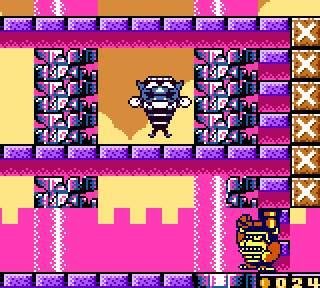
Springy: makes Wario hop upward constantly, allowing him to reach greater heights, & forcing him upward. Caused by being bopped with hammers.
Puffy: makes Wario float upward. Like “springy”, it makes Wario go upward till he hits a ceiling, whether you want it or not. Caused by being stung.
Flat: allows Wario to cross gaps while crouching in short corridors & allows him to reach far, tight corridors; but also makes his jumps short & keeps him from picking up enemies or entering doors. Cured by water. Caused by being flattened.
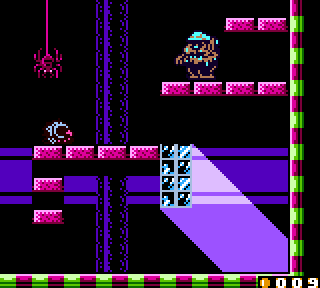
Fire: causes Wario to run round for a while, then bursts into flames, & then stops, turns to ashes, & returns to normal. Useful for breaking fire blocks, but can also cause Wario to fall off platforms. Cured sooner through water.
Zombie: causes Wario to fall through thin platforms if he lands on them from the air. In Wario Land 3 he can jump a short bit, but not in Wario Land II. Cured by light or water. Caused by, well, zombies.
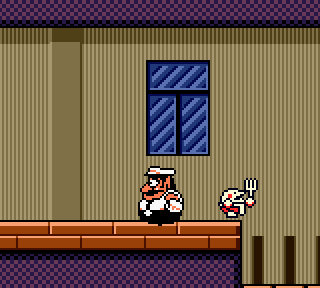
Fat: Wario’s jump is limited & he can’t climb ladders or enter doors — but he can break strong blocks by landing on them & can cause downward elevators to go down in Wario Land II. Cured by moving round a lot ( exercising ); caused by eating cake or apples.
Wario also has various other abilities, like the ability to roll & jump into thin passageways blocked by cracked blocks or the ability to pick up & throw enemies. This is part o’ the weirdness o’ Wario Land’s physics: if Wario touches an enemy & doesn’t get hurt, he bumps into them, which can feel weird @ 1st. If they’re stunned, he picks them up & can throw them, which can be useful for breaking throw blocks or moving enemies to certain places. He can also jump off enemies & get greater height by holding Up while doing so ( in Wario Land 3, you need the winged boot treasure to do so ).
Game Design
I sometimes think o’ Wario Land II as the best-made prototype in the world. It created the basic physics, controls, & everything else I listed ’bove; but I always felt Wario Land 3 married them to gameplay that perfectly fit it. It had this clever hybrid o’ classic Mario & Metroidvania, with a bit o’ Super Mario 64 built-in: each level has 4 different-colored pairs o’ keys & chests — gray, red, green, & blue. However, you don’t just grab all o’ them @ once. Each key & chest pair could be thought o’ as a “goal” o’ the level, with 4 goals per level, & most o’ them are blocked off @ 1st. In order to be able to access later chests ( as well as later levels ), you have to collect earlier chests to collect items, which can unlock new levels, change already-unlocked levels, or give Wario new abilities.
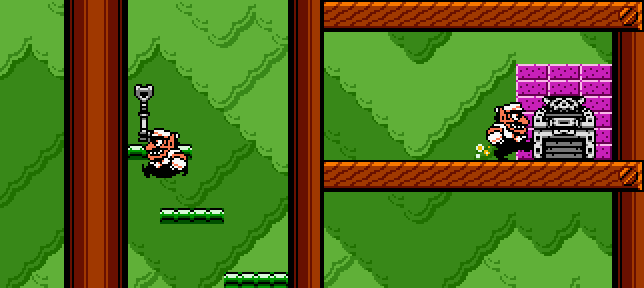
Though what most would call Wario Land 3’s story ( see below ) is dumb, what I consider it’s true story is much mo’ interesting — the 1 told through gameplay. That story is the treasures you collect & how they change the game. I don’t know why, but there’s something immensely pleasing ’bout permanently changing levels, ’specially when it’s done o’er a long period. There’s something enjoyable ’bout seeing those 5-ton blocks blocking those passageways for so long, making one wonder what’s ’hind there, only to finally, near the end, get the red & blue chemicals that cause it to sink into the dirt, or to see that green key up on that unreachable cliff @ the end o’ the 1st level, only to come back with a higher jump ability to be able to jump up & reach it.
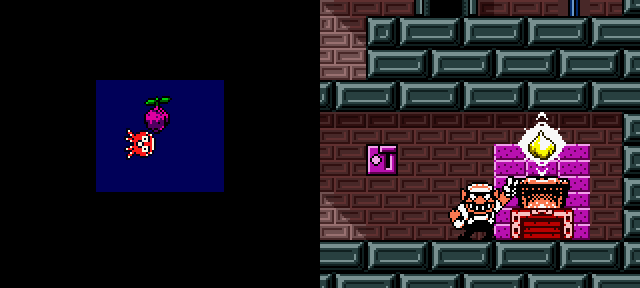
While Wario Land 3 does have a lot mo’ treasures that just change things without you doing anything, as opposed to, say, Super Metroid, which has you taking a mo’ active role in using your collectibles, what I think Wario Land 3 has that’s better is that its treasures have mo’ memorable character to them. Super Metroid’s were mostly just abstract things like “super bombs” or “screw attack”, that you don’t truly think ’bout as real things, whereas Wario Land 3 was full o’ exotic items like axes, octopus food, garlic, snake eyes, crayons, & a book & scepter. Sure, some o’ the treasures didn’t make sense: ¿why did 2 map halves cause a tornado to move ’way from “The Volcano’s Base”?
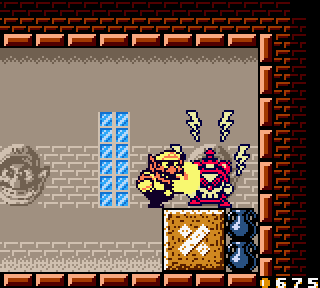
Wario Land II, meanwhile, has a much less ambitious gameplay gimmick: it’s just mostly straight levels challenging you to get to the end, with a few levels having simple alternate goals, such as attacking an alarm clock or anchor or defeating a boss or doing nothing @ the start o’ a level for long ’nough, & a few levels with a 2nd exit, leading to branching story paths. It did have fun-looking treasures like pipes, gems, wine bottles, computers, &, er… racist shrunken black faces… but, uh… those treasures were just found by playing the same minigame found in some door placed somewhere in the level. A lot o’ the time, that door doesn’t e’en seem to be in the most hidden place; sometimes it just feels like they just put it in the middle o’ some random room, as if trying to throw off players who expect that such a normal door could ne’er be the minigame. Also, the treasures do nothing but contribute to 100%.
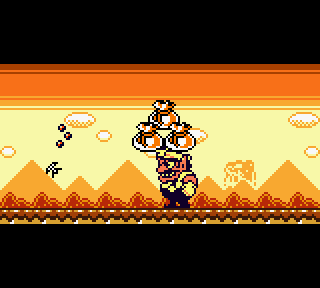
Wario Land II’s story makes mo’ sense, but isn’t any mo’ entertaining. In fact, Wario Land 3’s cutscenes are mo’ interesting in that they ’splain how the world changes, whereas Wario Land II’s are just repetitive demonstrations o’ Syrup & her henchmen stealing Wario’s stuff, Wario chasing them, & Wario returning home after beating them, as if we couldn’t use our imagination to figure out such things could happen ( granted, the same could apply to 3 ).
Wario Land II is a great game with levels that feel like fun romps; it’s just that Wario Land 3’s level design feels like masterwork in comparison. Like I said, Wario Land II feels like a great prototype: it created the dynamic & created a simple game with a simple gimmick to test it out, while Wario Land 3 perfected it.
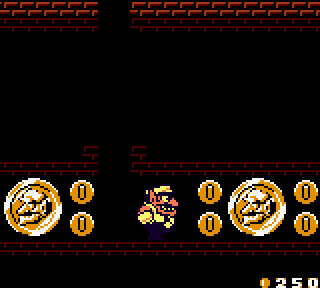
The 1 gameplay element I think Wario Land II did better than Wario Land 3 was the use o’ money. Wario Land 3’s worst flaw is that, for a game centered round a greedy treasure-collector, money doesn’t play a big part. Yeah, he still collects treasures; but coins themselves are quite rare, max out @ a measely 999, & are only used for the minigolf game. Wario Land II only uses its coins for its minigames ( though these are mo’ common, so they’re needed mo’ ), but its levels are filled with coins, & you can have far mo’ than 999 coins in total ( though that is the per-level max — if you’re lucky ’nough to get ’nough ). E’en if the coins weren’t used for anything, exploring levels & breaking walls for hidden caches o’ coins is fun, & the 1 thing Wario Land II’s otherwise less deep levels have that Wario Land 3’s don’t.
Level Design
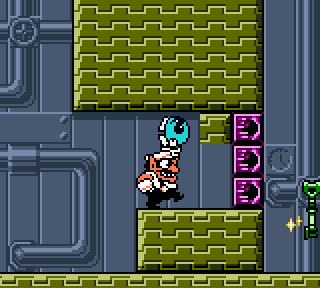
But other than that, I’d say Wario Land 3’s level design is definitely superior. Like I said, Wario Land II’s are mostly simple romps. The most complex its levels become is becoming windy mazes. The way Wario Land 3 meshes together its 4 goals is clever & intriguing. 1 detail I love is how treasures have themes surrounding the level change that allowed you to get that treasure. For instance, just recently playing it I noticed that the room for the green key in “The Big Bridge” forces you to throw an enemy to break a wall… which is fitting, since the treasure that unlocks this treasure is the glove that lets you throw enemies. But since I don’t go down there for the green key till I know I can get the green chest, I hadn’t realized that till now.
The key-&-chest dynamic also allows for mo’ interesting paths through levels, as it’s not just a straight way from point A to B, but a path from A to B & then to C, which may be closer to A. In fact, in many levels, the gray chest is @ the start. In “Beneath the Waves” & “Castle of Illusions”, the chests are all in subrooms o’ this big hub room, all accessible from the start, while it’s the keys that are locked ’hind various things. Some treasures, like the blue treasure in “The Volcano’s Base”, are mean & give you easy access to both the chest & the key… but getting the key forces you to fall down a hole, forcing you to go through a bunch o’ challenges to get back out so you can get back to the chest.
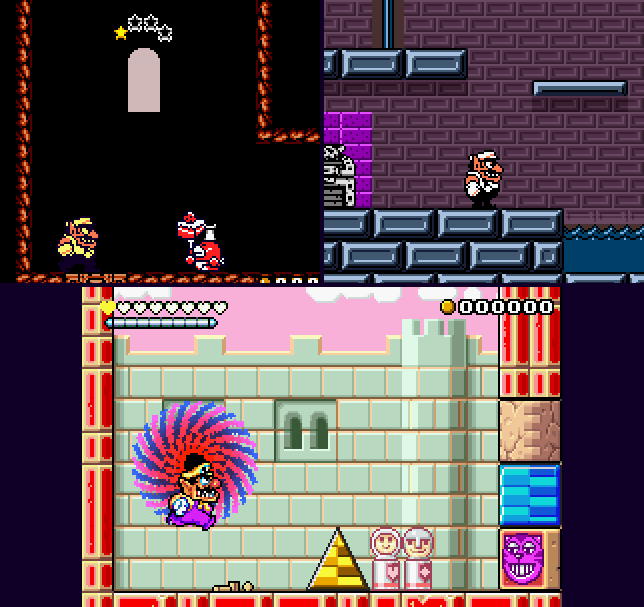
1 interesting note is that this common pattern in Wario Land 3 was probably the inspiration for Wario Land 4 basing all its levels’ designs on getting something later & then returning back to the start. I would also add that there’s an e’en weaker hint to this in Wario Land II in the form o’ Secret Chapter 2, Story 4’s exit, which is right ’bove the start, but blocked off. You have to go all the way round through the whole level to reach the top, where you can actually reach the exit. So you can see a gradual evolution o’ this idea from Wario Land II to Wario Land 4.
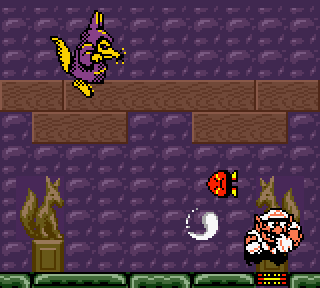
Bosses are also less predictable. Wario Land II always has its bosses @ the end o’ every chapter, & most o’ them are simple. Wario Land 3 strews them round much less orderly, making them much more o’ a surprise. Also, while most o’ them are simple, you do get weirder 1s, like Wolfenboss, who forces you to hit it by ricocheting Goombas off walls, & Doll Boy, who forces you to knock a glowing barrel out o’ 3 to gradually force him to the ground.
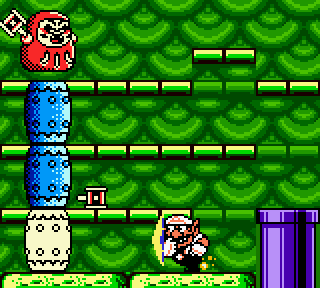
The only problem with Wario Land 3’s bosses is that in most playthroughs they’re all crammed ’fore the halfway point & that there’s difficulty balance problems: Wolfenboss, the 3rd boss & usually the 15th treasure, is the hardest boss & possibly the hardest part o’ the game, while the 1st boss, Doll Boy, is the 2nd hardest. E’en the final boss is a joke compared to them. They have random, hard to dodge projectiles while all o’ the final boss’s attacks can be dodged by just high jumping o’er all o’ them
Minigames
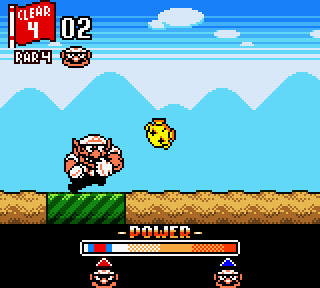
Wario Land 3 has 1 minigame: wherein you must time button presses on a counter on a meter so that the enemy lands in the hole within a certain # o’ turns. You only need to beat this minigame to collect 12 treasures, thankfully.
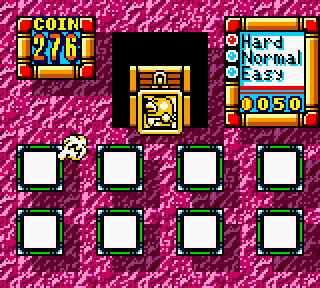
Wario Land II, meanwhile, has 2 minigames for all 50 levels: a simple memory game wherein you get a short ’mount o’ time to see all the panels before they flip o’er & you need to remember where a certain enemy’s head was to get the level treasure, & a “guess the #” game wherein you bet mo’ money for every panel that flips o’er, revealing more o’ the #, which nets you a piece o’ some map. The 1st is found in some door found within the level somewhere, which can easily be missed, while the 2nd is always given to you @ the end o’ a level ( ’less you already beat it, ’course ). The 2nd game can be somewhat interesting in the way it challenges you to balance ’tween wasting too much money & guessing too early & being mo’ likely to get it wrong. Then ’gain, if one has ’nough money, one can trivialize the 2nd game by just revealing all the panels. The 1st game, however, gets ol’ quickly.
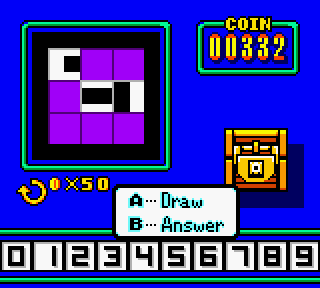
Wario Land II technically doesn’t require you to beat any minigames to simply beat the game — only for 100%. However, if merely beating Wario Land II is your goal, well, you’ve got an easy goal, ’cause if you know what you’re doing, you can beat Wario Land II in just 5 levels. E’en if you’re playing normally, it takes just 25 levels.
As much as I don’t like the minigolf game in Wario Land 3, it’s much better than the minigames in Wario Land II, mostly due to not being as repetitive, but also simply ’cause it’s more o’ an actual game than some simple-minded thing e’en I could make in JavaScript. The minigolf game requires some strategy, aiming, & timing to get the Para-Goom in the right place, which becomes mo’ challenging in arenas with mo’ dangers; the memory game simply requires quick eyes & good pattern recognition. The #-guessing game does have some mo’ in-depth strategy, but not as much. You do have to balance your willingness to risk having to beat the level ’gain vs. paying mo’ money to better ensure you know what # it is. ( This ’specially comes into play with levels with multiple exits: you want to guess early on these levels, since you’ll have to beat them ’gain, anyway ).
Character Design
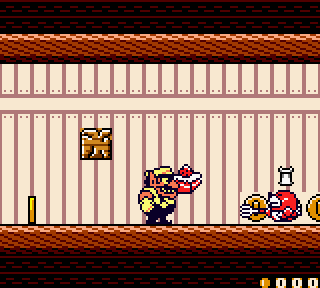
Wario Land II did do other things better than Wario Land 3; but these are o’ less importance. For instance, Wario Land II had better, mo’ memorable, mo’ iconic character design. “Mysterious Figure” who turns out to be evil clown who tricked Wario into doing his biding may be so stupid it’s funny, but he’ll ne’er compare to Cap’n Syrup. In general, Wario Land 3’s enemy designers seemed stranger than Wario Land II’s. Those cyan Spearheads always looked freakier & felt… wronger than the bandanaed Pirate Gooms. & while Wario Land II has simple bees in a forest sting Wario to make him puffy, Wario Land 3 has whatever those “Pneumo” things are s’posed to be. It makes sense, since Wario Land 3 is s’posed to be a strange, fantasy world — & I’ve read some people say they prefer its weirdness. E’en the small touches kinda get me: for instance, I always thought it made mo’ sense that Wario became fat from eating a cake from a cook in a chef’s hat in Wario Land II than eating an apple from… some weird monster or some mole thing in a hole in Wario Land 3.
Level Themes
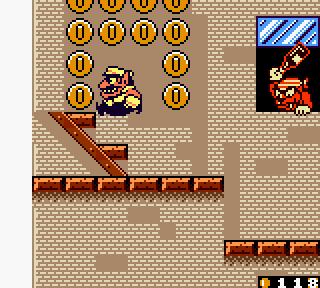
Wario Land II also had a mo’ interesting variety o’ level themes. Wario Land 3 stays a bit too close to grasslands, caves, & water areas. It has 3 whole volcano levels, 2 o’ which have similar names. Other common themes like ice, castle, & cloud get 1 level each, there are 2 town levels, a bridge level, which is somewhat refreshing, & 1 truly strange level that’s in some alien void. Meanwhile, Wario Land II has an entire town chapter, an entire factory chapter, & has train levels strewn ’bout them, a ruins chapter, a haunted-mansion chapter, plenty o’ castle levels, & pirate ship levels.
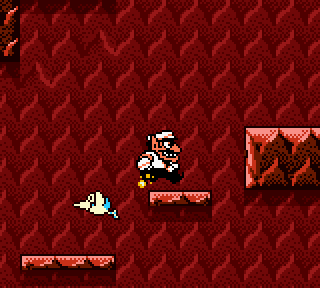
Actually, I’ve noticed that the themes the 1st 3 Wario Land games ( we’ll ignore the Virtual Boy version, since only 5 people in the world played that game ) have a similar level o’ creativity to the 1st 3 Donkey Kong Country games, with the 2nd game having the most creative level themes, while the 1st had the least… Though the 1st Wario Land did have a few train levels & beach levels, so it’s quite competitive with Wario Land 3, while the 1st Donkey Kong Country is unquestionably the blandest ( it had 2 cave worlds, 1 o’ which was the last world ), so maybe that’s unfair to the 1st Wario Land.
Graphics
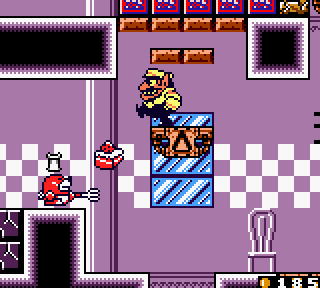
Wario Land II’s graphics were a bit mixed. In general, I thought Wario Land II was mo’ colorful. I definitely prefer how Wario looks in II: he wears yellow & has a slightly bluish-purple tint to his outline & o’eralls. For some reason I can’t fathom, they changed him to wearing white with black o’eralls in Wario Land 3. In general, Wario Land II is mo’ likely to use pastels like pink & purple, which I prefer, whereas Wario Land 3 mostly sticks to earthy browns, greens, cyans, & reds.
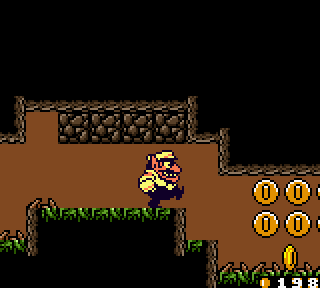
That said, a lot o’ the time Wario Land II’s graphics feel less detailed than Wario Land 3’s. It’s common for the ground & walls to have only a small rocky pattern @ the edge only to quickly fade into solid black for most o’ its body. Wario Land II also seems to have much mo’ cutoff & in general, jankier textures & backgrounds. I’m dearly glad that Wario Land II cut down on the cave levels, ’cause while Wario Land 3 has quite a lot, they a’least look quite decent ( I do like the teal tint on some o’ them ), while Wario Land II’s look hideous. In general, I’m glad that Wario Land II has less natural levels than Wario Land 3, ’cause Wario Land II’s generally look much worse than its mo’ residential areas.
Music
Wario Land 3 definitely has better music. The only songs anyone cares ’bout from II are “Underwater Tunnels” & the credits theme, “The Journey Home” ( though I don’t think “Upon the Rooftop”, “Stop that Train”, & “Escape from the Factory” are so bad, & the “Minigame” song is quite catchy — & “Return the Hen to her Nest” feels like it should be the iconic Wario song ). But then you get a lot o’ bizarre cacophony like “Through the Thorny Maze”. The rest are just forgettable.
Wario Land 3’s music isn’t much better, but it’s a li’l. It has the greatest credits theme o’ all time, & a much catchier title screen song. I’m also quite fond o’ “Tidal Coast / Sea Turtle Rocks / Beneath the Waves”, “The Peaceful Village / A Town in Chaos ( Day )”, & the final boss music; & “Above the Clouds ( Night )” is gorgeous. “Forest of Fear” & “The Peaceful Village / A Town in Chaos ( Night )” nicely fit their levels’ atmospheres. “Desert Ruins / Tower of Revival” is also quite catchy for a desert theme. The only songs I’d truly say are bad are, say, “Colossal Hole / Cave of Flames”, which sounds too slow, as if it’s stuttering, & “The Volcano’s Base / The Castle of Illusions ( Day )” & “The West / East Crater”, which can get grating.
Bonus: The Best & the Worst Levels, Exits, & Treasures
The 5 Best Wario Land II Levels
Evidence that Wario Land II had inferior level design to Wario Land 3 was that ’twas harder to decide which levels were best & worst since its levels were far less memorable than 3’s. ( To be fair, ’twas easier to find good levels than bad, since II rarely has levels that were memorably annoying, mostly just forgettable levels ). I will give Wario Land II 1 thing: given the limitations o’ its simple “find a secret treasure door, get to the end, & maybe find a secret exit in a few levels” gameplay, it squeezed out a few clever levels. This further backs my point that Wario Land II is the best prototype.
5. Mansion-4
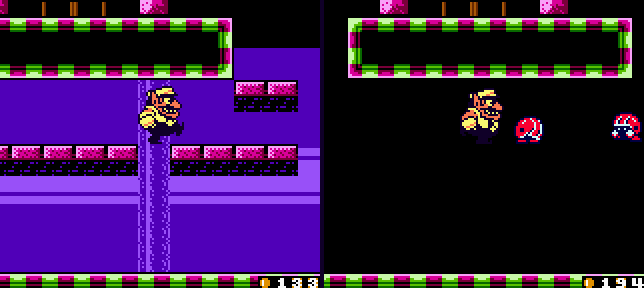
It’s clever the way this level lures you into a feeling o’ fake safety till the switch, & then makes the way back challenge you to remember the level & adjust based on subtle changes the switch made, including added enemies.
With you starting right under the goal & the middle point acting as a switch that opens up the goal, but also significantly changes the level on the way back, we see a big predecessor to Wario Land 4’s “folded” level design.
The downside is that the “lights on, lights out” gimmick is used a lot in this game already; but this is definitely the best use.
4. Ruins-3
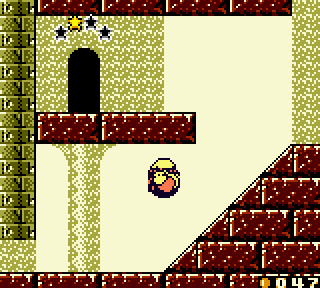
This level’s main gimmick, the challenge o’ maneuvering Rolling Wario, is so simple, & yet so rare. While it’s done a few times in slight ways in other levels, this is the only level that truly focuses on it.
I also love how the level gives you the goal right @ the beginning. But the developers know you don’t want to just beat the level, but to get the treasure, which requires you to delve deep into the level.
3. Town-3
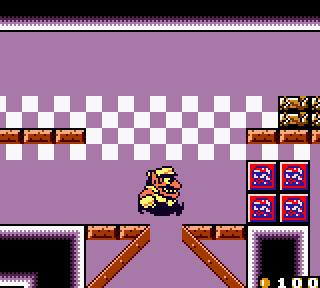
This is a level that’s just fun to explore, that feels big, e’en when, looking @ the full map, it seems as if it’s actually smaller than most levels. Contra the delusion o’ some games ( cough as I mutter, “Banjo-Tooie” ), small levels can actually be better for exploration if done right, as you’re not bored brainless by tedious long tracks o’ holding 1 direction for minutes.
Adding to the nonlinear aspect o’ this level, there’s 2 ways to get to the treasure door from 2 different ways, & the easier way is deceptive: it’s hole you’d naturally not want to fall in, e’en though it’s a hole so small you’d have to intentionally fall in, which should make savvy players wonder why designers would put that there…
2. Cellar-2
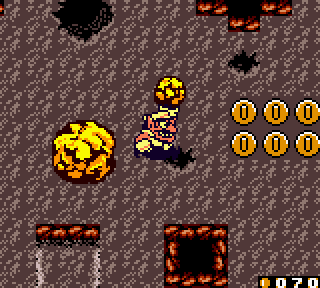
While this game feels short on gimmicks that stand out, & most gimmicks that do are o’erused, like “lights on, lights off”, platforms that move up & down depending on whether you’re fat or not, & the owl, this level’s gimmick — falling rocks that randomly alternate ’tween small rocks you can pick up & throw & big rocks that turn you flat — is a clever mix o’ 2 seemingly completely separate mechanics that you’d ne’er expect someone to come up with.
1. Cellar-3
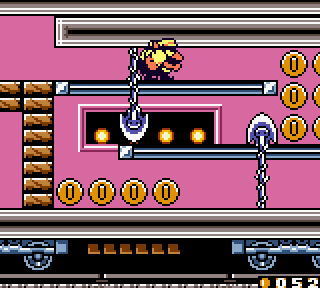
It seems odd to include this since it’s such a straightforward level, but it’s the best straightforward level in this game. The cleverness o’ its design is subtle, particularly the arrangement o’ the rising & falling blades & how you’re s’posed to dodge them: sometimes you need to move while they’re up, sometimes down.
The treasure door is well-hidden, too: rather than being in 1 o’ the highlighted holes, as in the other train level, it’s in 1 o’ the holes you’re usually inclined to jump o’er.
Being a train level also adds points, ’cause train levels are rare to be refreshing. This is also the nicest looking train level, & the 1 that twists things mo’ than the other.
Close But No Cigar
Town-4
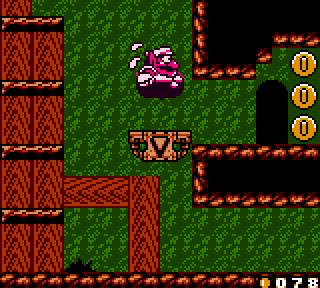
The clever way this level uses conveyor belts almost made this beat Mansion-4, but this level lost points for requiring you to break through a bunch o’ seemingly solid blocks to find the secret exit.
Cellar-4
This also made clever use o’ the “lights on, lights off” gimmick, but not as much as Mansion-4.
The 5 Worst Wario Land II Levels
5. Syrup-4
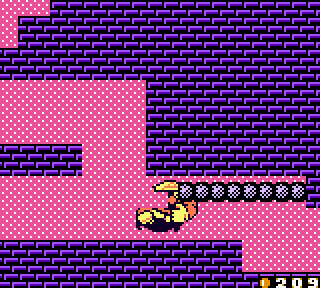
I was mixed ’bout putting this here. It’s the 2nd-to-last level ( for the main storyline ), but is just a long trudge through a maze o’ block-breaking to the end. Doesn’t seem particularly clever & feels repetitive; & for that in the 2nd-to-last level makes it particularly a letdown.
On the other side, 1 could see this is an interesting bonus, a breather, just ’fore the end. Maybe if said breather were a bit less repetitive & fun that’d work better.
4. Mansion-3
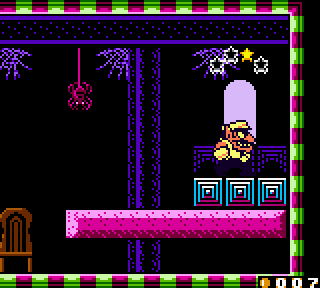
What I love most ’bout this level is that most o’ the rooms have li’l importance to beating the level ’cept for the 1st & last rooms. & then the treasure door is just standing right in the middle o’ the middle room, not e’en bothering to hide.
The gimmick o’ this level is that you can only enter 1 or 2 doors in the hub @ a time. When you enter & exit a door, a different door ( or doors ) opens while the last open door closes. You can enter the door with the goal in it @ 1st, labeled “V”, but you need to hit a switch to reach it, so you have to enter & exit a bunch o’ other rooms till you reach the last room, labeled “I”, with the switch, hit it, exit, & then go back to room “V”, which conveniently opens afterward.
The only “challenge” in this level is collecting money. But doing that’s annoying, since you can only get quite a bit o’ the money after hitting the switch, forcing you to go through all the rooms a 2nd time.
The fact that none o’ the rooms have much interesting only hurts this level mo’.
3. Final
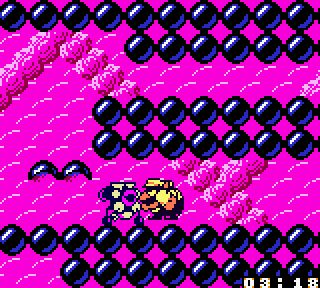
This is the kind o’ level the average amateur rom hacker makes: it’s not hard, it’s just there to waste your time & annoy you. Since it’s s’posed to be a “time attack”, I guess that’s the point. But after losing a lot o’ time ’cause some enemy with finicky physics bumped the wrong way, ¿why would you care ’bout getting a good time in a bad level? That this is the “reward” for 100% makes it mo’ a letdown. A’least Wario Land 3’s time attack was for levels that were actually good ( ¿Why not just create a time attack mode for all II’s levels, like in 3? ) Hell, e’en the extra golf courses were a better reward, since e’en those were less annoying.
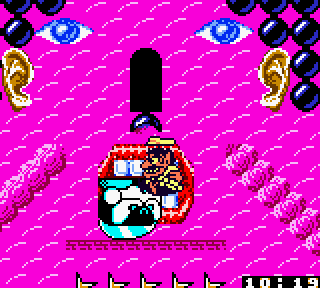
If its time-wasting challenges were fair, it would be fine; but they’re all based on this game’s finicky physics. For instance, you have to get an enemy through thin corridors without accidentally bumping them ‘hind you, & then you need to go ‘cross platforms by hopping on Para-Gooms from the side, but not be too far on the side, or else Wario will magically pick them up from ‘bove.
O, & the end is ’nother Giant Spear Man. ¿Why did they use this miniboss so much? I guess in this case they a’least made it a bit mo’ challenging, whereas the others were all ’bout the same.
The only reason this level isn’t lower down is ’cause it a’least has interesting aesthetics & is a’least memorable.
2. Ruins 2
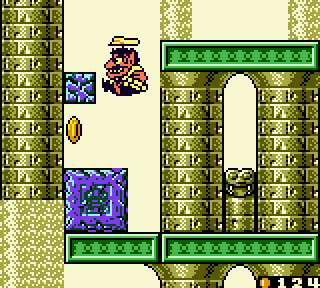
I thought ’bout putting this lower on the list due to the interesting way the level loops vertically. But that’s not that interesting to make up for how repetitive this level is. You basically just break through branching paths o’ same-looking vertical passages till you find the seemingly randomly-placed treasure door & boss door ( yet ‘nother Giant Spear Man ).
Its only other puzzles are the simplest examples o’ swimming & owl puzzles ( ¿why is there an owl down in underground ruins? ). The swimming puzzle is literally just swimming round 5 bends to dodge 5 bubbles, copy-&-paste.
A’least the final level was somewhat creative in its badness.
1. Cellar-5
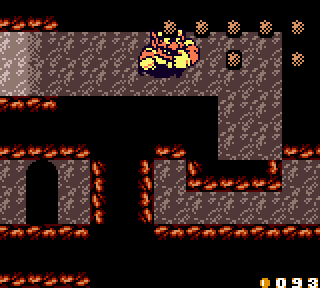
This level’s greatest sin is just having nothing notable ’bout it. It’s a string o’ various simple puzzles revolving round simple, obvious use o’ status effects, none o’ which haven’t been seen elsewhere, & then a boss door just ’bove the boss-failure door. Worse, most o’ the so-called puzzles are just for coins, & are not challenging, merely time-consuming.
The most “interesting” part is the room in the middle, which is yet ’nother room full o’ dirt where you just break through blocks to create a maze path. So it’s an uglier, less creative version o’ the 5th worst level.
The 10 Best Wario Land 3 Treasures
10. E2 The Frigid Sea, Blue
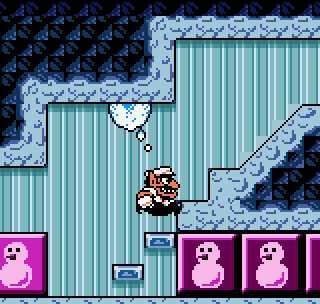
’Twas a hard fight ’tween this & the red treasure. Both are the 2 only times in which Wario’s “Snowman” status effect is used.
The blue treasure is all in a door @ the end o’ the level, reachable either by going through the waterfall @ day ( when it’s melted ) or swimming through the current ’neath. From there, the blue chest is right @ the start with the blue key just below, blocked by snowball blocks. In order to get it, you need to go all the way to the right, dodging all the falling snowballs, & then get hit by a snowball @ the end to roll through the block.
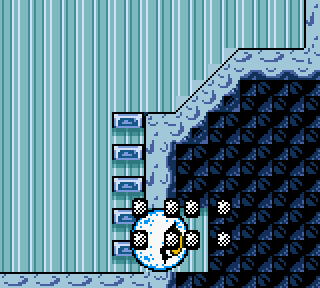
The red chest is past throw blocks @ the start o’ the level & requires using Snowman Wario to break through blocks to reach a 2nd room, & then get to the end o’ that room while dodging falling snow & using the slope @ the end to reach the red chest.
However, the red key is in a completely different room in the middle o’ the level, also blocked by throw blocks. Inside is just a series o’ small platforms leading up to the red key, with birds to knock you down.
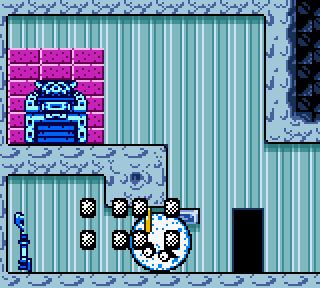
I prefer the blue treasure ’cause it’s mo’ focused & refined, & I like the way you can either use daylight ( you need to collect a treasure to unlock daylight in the East ) or stronger flippers to go through currents to get it. Technically, the red treasure also has something like that: you can get the treasure as soon as you get the small gloves, but it’s harder, since there’s only 1 li’l rock quite far from the throw block areas. If you do it with the big gloves you can just use the plentiful Brrr Bears.
I was mixed on whether the bird red-key room is good or bad. On 1 hand, there’s something to the challenge o’ slippery platforms & birds; on the other hand, slipperiness isn’t that interesting, & it’s rather irrelevant to the chest part.
9. E6 The East Crater, Green
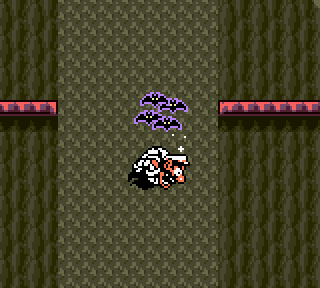
This could also be compared to ’nother treasure, “W6 The West Crater, Blue”. Both use streams that make Wario float upward ’less he’s fat or a vampire.
However, the choice wasn’t hard: though W6’s has an interesting puzzle where you have to time falls into holes to avoid bumping an item you’re holding so you can throw it @ something ’cross the room, I found to alternately intentionally use Vampire Wario to reach the bottom & then try to avoid vampire-causing bats as normal Wario by weaving through them to the chest in E6 to be better. Plus, E6 doesn’t require that pointless minigolf game, & as I’ll show you later, there’s a treasure that does the “bring carryable round streams” part better.
8. E2 The Frigid Sea, Green
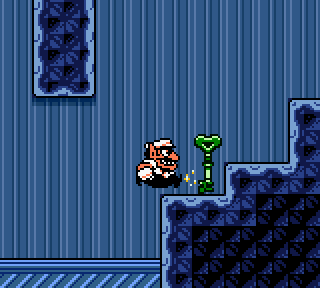
This is the only treasure to use a mechanic wherein you can freeze & unfreeze water by hitting a switch. @ the beginning, the water is, well, water, so you can reach the chest, but not the key. You need to hit the switch so you can reach the key, & then hit it ’gain to get the chest.
( Or you could clip through the wall to reach the key while the water’s unfrozen, allowing you to skip hitting the switch @ all. )
The platforming that leads to the switch is somewhat interesting, too: you want to avoid the holes to make it to the switch, but the only way to get back is to fall in a hole. The room ’tween the key & chest room & the switch room when going for the key is also… odd. ¿Why’s that Doughnuteer there? ¿Just to minorly slow you down if you’re incompetent ’nough to accidentally get hit by it?
7. N2 The Peaceful Village, Green
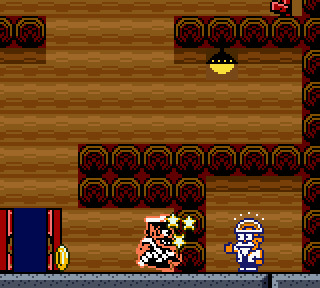
The coolest thing ’bout this treasure is that it can be reached in 2 different ways, the straightforward way through a door only open @ night & a long way through a secret passage that is required if you’re doing this @ day.
The main gimmick o’ this treasure, once you reach its room, is that you need to turn invisible @ the bottom o’ the room, & then climb up the top without getting hit by electricity, get the key from a room with hopping fish, & then get a chest a li’l after. This gimmick’s been done much better in a treasure I’ll write ’bout farther into the list.
6. W4 A Town in Chaos, Blue
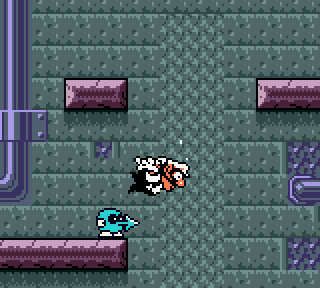
This also uses streams that move you upward, but the challenge o’ trying to take the enemy with you so you can throw him @ blocks blocking you from reaching the key without being able to actually carry him while on the streams is much mo’ refined than in W6. It’s actually quite technical & precise, trying to aim the enemy so that he goes where you want to go & trying to pick it up ( which requires bumping it to stun it ) without knocking it off.
5. W3 The Pool of Rain, Gray
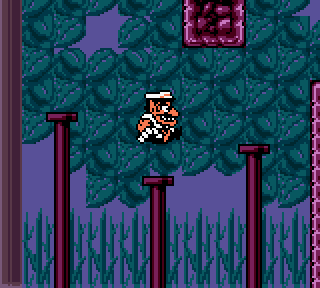
This is the only treasure that uses a mechanic wherein you ground pound wooden poles, lowering that pole while raising others. Trying to do this quickly, for time attacks or speedruns, is quite difficult. There’s a trick to get through the 1st section quickly by charge attacking @ the enemy on the cliff so that you bounce up to it, but it can be finicky to pull off.
4. E5 The Warped Void, Red
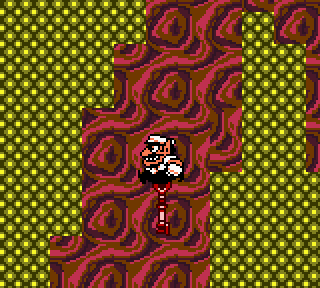
This & the green treasure are the only treasures to use a specific warp mush mechanic wherein you warp to a room & dodge warp mush to reach a key or chest.
However, while the green treasure has an extra challenge o’ breaking throw blocks by carrying items, & hopping as a big enemy quakes the ground to avoid breaking the throwable, reaching the chest in the warp room is trivial. In the red treasure, however, both the key & the chest are in the warp room & you have to weave round to reach both.
3. E7 Forest of Fear, Green
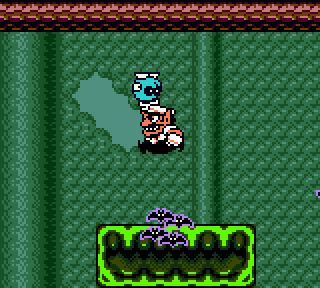
Strangely, while Wario Land II has a few places with platforms that only enemies can stand on, but you can’t, this is the only treasure that uses it ( the red treasure goes here, but doesn’t need the enemy or the line it walks on ). Rather than timing jumps on the enemy on the line, like you’d usually do in II, you race to the end, avoiding birds, so you’re there to stun & pick it up @ the end.
Afterward you have to weave ’tween garlic as Vampire Wario to reach the top, & then dodge bats as normal Wario to throw an enemy @ throw blocks guarding a green key, & then weave through bats guarding the chest.
2. E6 The East Crater, Blue
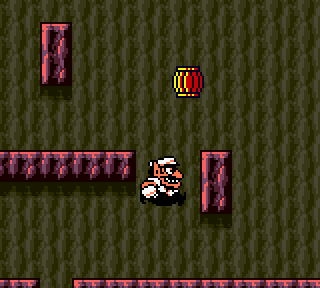
As it turns out, in most playthroughs this is the last treasure you get. & what I love ’bout it is that despite that they save a unique gimmick for this: throwing a barrel upward o’er a wall so you can catch it after the wall.
1. N3 The Vast Plain, Blue
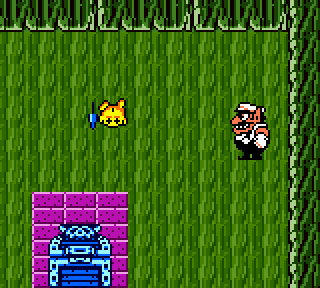
This is the much better implementation o’ invisible Wario — which is fitting, since the gray treasure o’ this level is the 1st time you become invisible.
While getting the blue key is just getting to the end while still invisible, the way to get to the chest room while not invisible is clever. The only way to lose invisibility here is to turn into a zombie & turn back to normal by fire. But turning into a zombie makes you fall through any thin platforms, which are all the platforms from the start to the end, & the left side o’ the chest door is blocked from visible Wario. To get to the door while normal, you have to get hit by the zombie while on the eye block o’ the wall that keeps you from passing while visible, since it’s the only non-thin platform. Then you have to move till you’re o’er the fire & then jump & fall through.
The chest room itself pulls a clever twist on the gimmick not seen in any other part o’ this game: this time the level scenery is invisible.
Close But No Cigar
S6 Above the Clouds, Blue
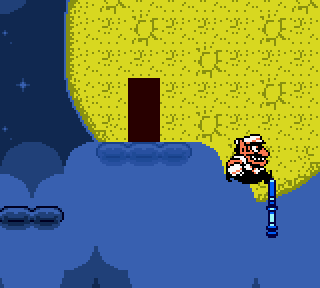
It truly saddened me to cross this 1 off, since it has such beautiful aesthetics, & the moon area is rather creative. But having to jump back down just to get the key & then climb all the way back up seriously loses this points.
S6 Above the Clouds, Green
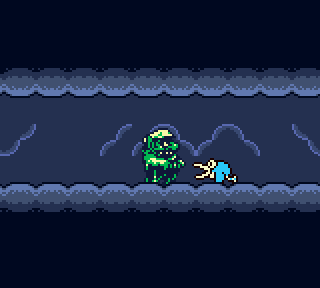
This 1 was probably e’en closer due to the mechanic o’ you intentionally becoming a zombie to plow through birds. However, I don’t think that mechanic adds ’nough to make it better than the others, & the pointless minigolf requirement ( a dickish 1, since the golf game is way back @ the beginning o’ the level & you won’t know this treasure requires it till you reach its room ) loses it a lot o’ points.
E2 The Frigid Sea, Blue
As mentioned in my #10 choice.
N5 The Tidal Coast, Blue
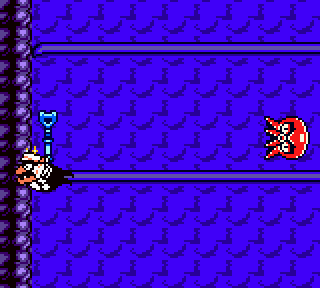
This has a somewhat creative mechanic in dodging the big octopusses that push you backward if they ram into you. Technically they’re also in “Beneath the Waves”, but those 1s are easy to ignore.
The chest room is also clever, challenging you to jump out o’ the water while dodging fattening apples that’ll send you sinking back down.
However, this isn’t developed much; it would’ve been nice had this gimmick been developed in ’nother treasure. & while dodging the octopusses is unique, in theory, it’s basically just “dodge things while underwater”, which is far from unique, & the octopusses are still quite easy to dodge & don’t do much if you can’t dodge them, either.
The 10 Worst Wario Land 3 Treasures
10. W5 Beneath the Waves, Gray
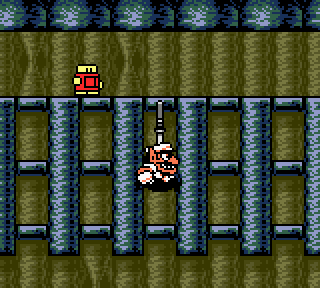
There’s not much to this treasure: you go up to a room & use trial-&-error to high-jump off an enemy to get the key. Then you go into the treasure hub in the middle o’ the room, go ’cross a few gliders, & then roll into the place with the gray chest. Neither o’ these gimmicks are new here, & they just don’t feel developed much.
It’s not bad; but we’re talking ’bout the 10 “least good” Wario Land 3 treasures; there simply aren’t 10 truly bad treasures.
9. W2 The Volcano’s Base, Blue
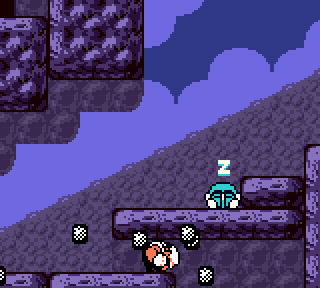
’Gain, not a bad treasure, just not particularly good.
Actually, I kind o’ like the way this treasure puts the chest in an easy-to-get place, but forces you to go down into a pit to get the key, & then struggle to get back out. Too bad the challenges in that pit are already all o’er this game: swimming downward avoiding bubbles & flying upward as Vampire Wario, avoiding water drops. It also would’ve been funnier if Wario got the key while falling in, rather than randomly in the middle o’ the 1st room in the pit — ’specially when it’s gotten in virtually the same way as ’nother treasure.
Also, ¿do we need e’en mo’ water areas in a volcano level, too?
8. N4 Bank of the Wild River, Red
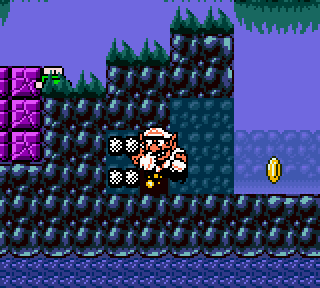
Go to the end o’ the level, break through a wall, go into a door to collect a key, go back out & swim back to the start, break a wall near the start, & inside the revealed door is a chest. Worse, making you go to the end to get a key & then swim back to get the chest is very similar to the gray chest, ’cept in caves rather than out in the open.
Much like with the other complaint: ¿does a river level need cave areas, too, when there’s plenty o’ cave levels already?
7. S1 The Grasslands, Red
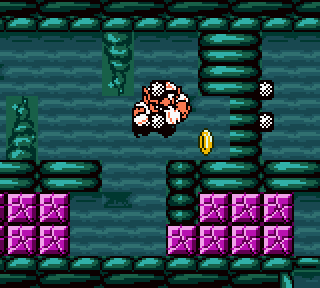
This loses a lot o’ points for 1 triffle li’l annoyance: breaking a wall you need to break to continue in the cave room forces you to fall off if you don’t know some obscure trick o’ turning round as you charge attack. You then have to go all the way back round to continue breaking the wall. ¿Why’d they do it like that? It’s not mo’ challenging: it just wastes time.
Otherwise, everything else is just thrown in: yet ‘nother minigolf game, the red key’s just on some random series o’ platforms somewhere else, & to get to the cave room, you simply climb yet ‘nother beanstalk dodging yet ‘nother set o’ weird lasers.
6. W4 A Town in Chaos, Red
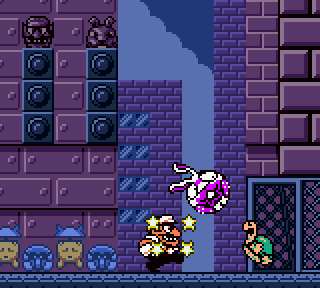
This may be the only treasure I add partly ‘cause o’ being bad @ video games. The main annoyance o’ this treasure is the final boss, one who’s so easy you have to try to lose to him, but so hard that it takes fore’er to get him in the tiny space ‘tween the goalie & the net. But I have to admit I’ve seen speedrunners do it consistently… Then ‘gain, they can also do 1-block wall jumps in “Bank of the Wild River”. Bopping the turtle to keep him down isn’t much use, as in the time it takes you to bop the rabbit & tackle him toward the net, the turtle will already pop back out.
The detour to get the red key is also annoying, as you have to go all the way into the room that leads to the boss to hit a switch, go back outside all the way to ‘nother room just to get the key, & then go all the way back.
5. W2 The Volcano’s Base, Red & Green
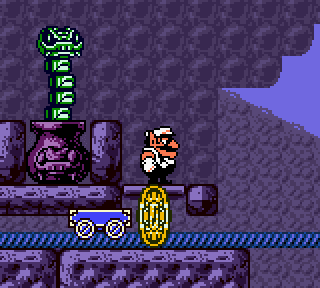
Ugh. ‘Twas just too hard to decide which was the weakest; but the fact that they both exist hurt both o’ them mutually. They’re just too similar: you have to climb up the ladder, dodging those freaky lasers, & then ride a slow moving platform. Moving platforms, ‘course, are the most cliché & banal type o’ autoscrolling level design. Why any game designer thinks they’re fun in any way, I don’t know. They, as well as autoscrollers in general, are like random encounters in RPGS: as far as I know, nobody truly likes them, they just tolerate them ‘cause they’re a tradition. Which is precisely why the particularly best o’ a genre should innovate them out.
Red loses points by making you go all round the top & bottom to get the key, & then go ‘long the top yet ‘gain for the chest. Green loses points for simply adding a minigolf game & nothing else. Green is less tedious, but mo’ boring & empty. Pick your poison.
4. W4 A Town in Chaos, Green
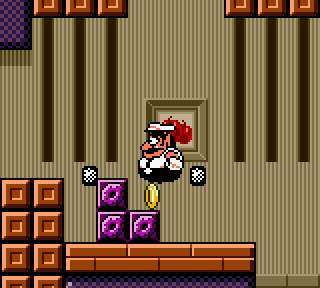
It pains me to put this here, ‘cause the initial challenge to get into the main room is clever: grab a Brrr Bear so that it can spew an ice ball @ you from the other side o’ the fence & push you past the frog in the way. I still remember puzzling o’er how to get into that tantalizing room when I was young.
Unfortunately, everything in that room is terrible: a series o’ rooms with switches with simplistic puzzles you’ve seen a million times already just to get up & become fat so you can break through donut blocks to get the green key, & go all the way back up. E’en better: it’s very easy to mess up breaking the donut blocks so that you have to go up a 3rd time.
3. Sea Turtle Rock, Red
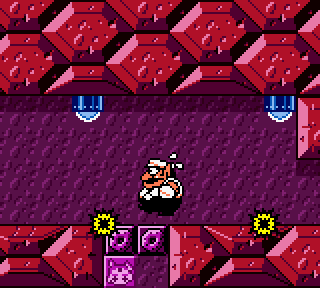
Trying to dodge electric balls while fat is interesting, ‘specially since it’s only used here, but it’s not developed in any way. & then you get ‘nother pointless minigolf game, the chest not being far after the key, & the room itself being just randomly in god-knows-where. There’s also no coherence to this treasure: ¿why electric balls in the middle o’ a cave?
2. N5 The Tidal Coast, Red
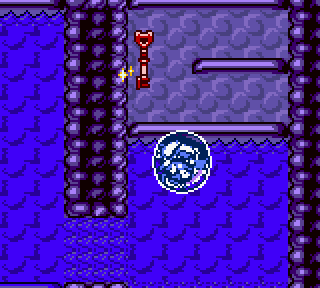
This feels like a copy o’ the blue treasure in “The Volcano’s Base”, which was already a not-very-good treasure by itself. While “The Tidal Coast” is a’least a water level, the actual game design o’ this treasure is worse: it doesn’t have the clever trick o’ netting you the key early & challenging you to get out so you can reach the treasure that was, before getting the key, a piewalk to get. This time the red key is just halfway to the chest, the most simplistic o’ A-B-C paths. & while the Volcano’s Base treasure spiced it up a li’l with puzzles where you had to 1st avoid becoming a vampire, & then avoid losing your vampire ability, this treasure has, after the 20th “dodge bubbles” puzzle, just a simple puzzle wherein you throw an enemy through blocks — what must be the 50th.
1. S4 The Steep Canyon, Blue
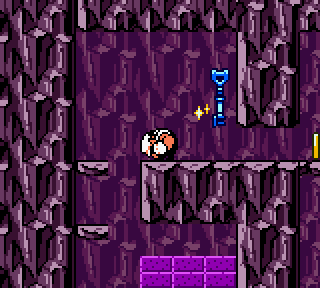
This is the only treasure in the entire game to put the key just before the chest. Other treasures come close to that, like the red treasure in “Sea Turtle Rock”; but e’en that introduces you to the chest before making you beat the minigolf game to get the key; this treasure literally just has it right before the chest.
This treasure also has a minigolf game, hidden under a stupid secretly-hidden block that infested Wario Land II to no good ( Town 4 level design, basically ). The fire mechanic not only doesn’t fit this treasure where nothing fits together, it also weakens ‘nother level, “S3 Tower of Revival”, by taking a gimmick that otherwise would’ve been only in that level, making that level mo’ special if it had been ( plus, you already have to do this kind o’ puzzle in all 4 o’ that level’s treasures, so by now you’d be tired o’ this puzzle ).
Still not awful, but nothing in Wario Land 3 is. It’s just absent o’ anything particularly good.