Nadie se engaña esta vez.
La Tiranía de 2017
2017 April 2

Nadie se engaña esta vez.
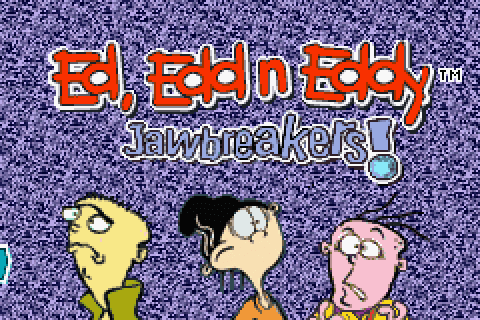
I wanted to end my GBA Tribute with Mario vs. Donkey Kong on March 21, exactly 1 year after I started it. But then I remembered I absentmindedly forgot this pillar o’ gaming & knew I had to continue.
Also, I ne’er did Mario & Luigi: Superstar Saga. But that’s later. We have, ahem, a masterpiece to discuss.
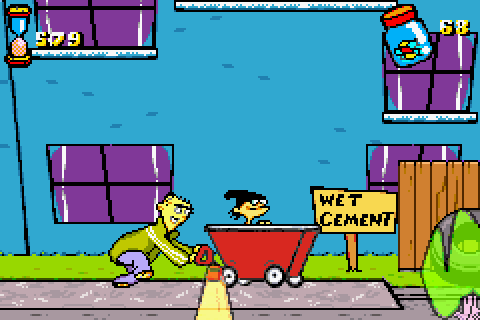
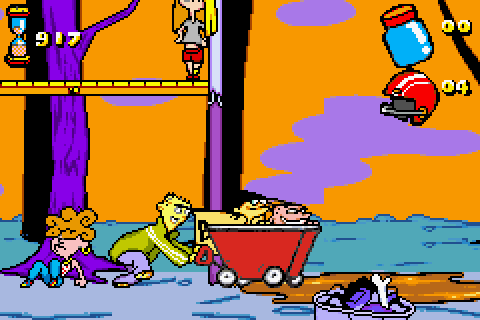
Jawbreakers! actually has a nifty game mechanic: it essentially copies The Lost Vikings, allowing you to switch ’tween “the Eds”, as the gamesters down in Peach Creek call them. Each character has different abilities: Eddy Gizzard can double jump & is generally the most agile, making him the most fun to play. He can also collect a jetpack & fly round in later stages. Double-Dogg-Dare-You can collect wrenches & slingshots & use them to fuck up deadly chihuahuas, chickens, & fire hydrants, but is a pussy & won’t walk o’er cement. Finally, Gravy Train can carry the others o’er dangerous terrain with a wheelbarrow & can collect a helmet to bash things with his head. However, he’s the least agile lump o’ fuck. Also, if he gets too close to a chicken, he starts chasing it, making you lose all control o’ him & forcing you to make Double-Draw-Bridge murder the sneak with his slingshot.
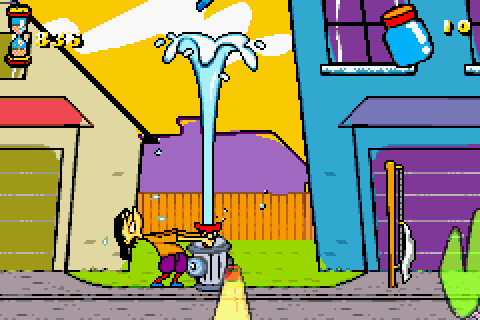
The game also takes a page from everyone’s favorite DK game, Donkey Kong 64, & gives them all their own… uh… ¿quarters? ¿Colored pogs? ¿Who cares? Collect 100 & you get an extra life.
The goal, as one can imagine, is to get all o’ the Eds to the end o’ the level. Unlike The Lost Vikings, if a character dies, you’re not stuck in an unwinnable situation & forced to just restart, but just makes you lose a life & sends that Ed back to the last checkpoint. On the other scale, I’m pretty sure The Lost Vikings didn’t have lives @ all & just let you retry levels an infinite ’mount o’ times, which, ’specially for an SNES game, was mo’ forward thinking than this GBA game made in the 2000s.
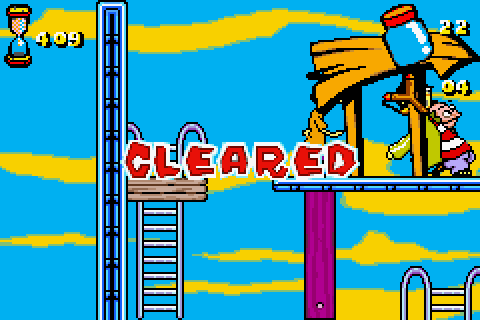
That said, this game does have autosave, which is nice.
You wouldn’t expect it, but the time can be rather frustrating, as these levels go on fore’er, every character but Eddy Blizzard is slow as sludge, & physics can be finicky.
This game’s biggest problem, I think, is that it’s not sure if it wants to be a fast-paced action platformer or a slow, exploratory puzzle platformer. The levels can be quite linear, despite their large size, & expect you to make many tiny, tight jumps ’cross moving platforms, & give you a time limit; but the characters move sluggishly, & 2 o’ the characters have immensely weak jumps. Having to traverse the whole level essentially 3 times can drag on. While I’d defend this in Donkey Kong 64, in this game the levels are a bit too linear & too similar ’tween characters, & the characters just move so slowly. Yes, sometimes characters have to take different routes ’cause o’ their different abilities; but mostly, the game just makes you wait for different characters to get to where your current character is so you can break whatever obstacle’s in the way with whatever ability key the other character has.
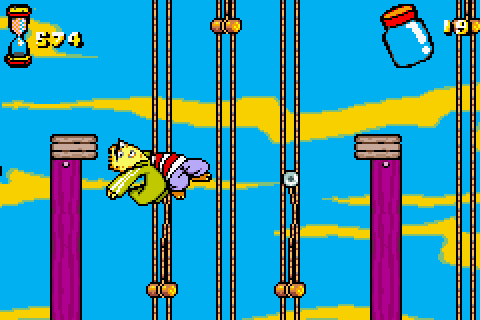
The interaction ’tween the camera & the level design is a bit wonky, too, leading to cheap deaths. It’s not uncommon to end up in a place where you’re forced to make a blind jump, with the high risk that you’ll fall on a rabid chihuahua & die.
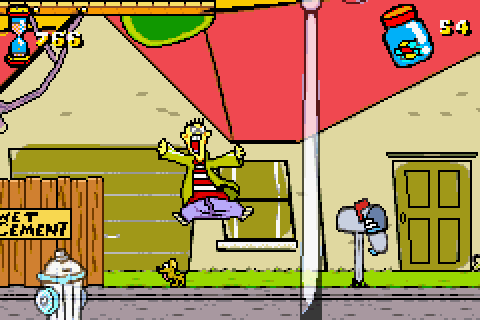
The controls can be a bit wonky, too — ’specially with Double-Dutch-Fudge-Packer having B be both the run button & the stop-&-shoot button.
Speaking o’ shooting, the game’s not terribly out-front ’bout how the aiming works, so it’s quite easy to miss targets. The problem is, in many cases in levels you have to kill certain enemies for certain characters to pass, & there’s only a limited ’mount o’ ammo in a level, making it quite easy to end up in unwinnable situations.
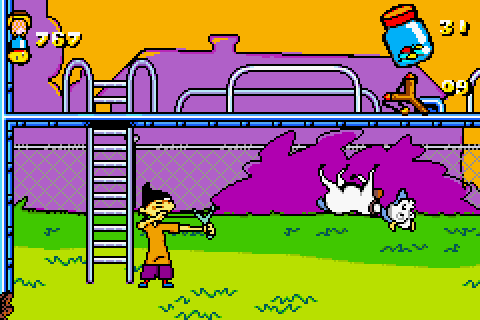
The levels are cool, though. They’re based on settings from the show; & I don’t know if you e’er watched the show, but the art style o’ that show was great. It had an abstract style that was bizarre, but rather subtle in its bizarreness, & used subtly off colors, such as having purple tree trunks & yellow skies. Thankfully, this game keeps that art style, e’en if its in low-res GBA pixel-vision. Hell, they e’en kept the weird wiggly outlines on the characters from the show, which is impressive. Honestly, ’hind only the SNES & Genesis Capcom Disney games, this may be 1 o’ the best-looking 2-D pixellated game that tries to emulate cartoon graphics.
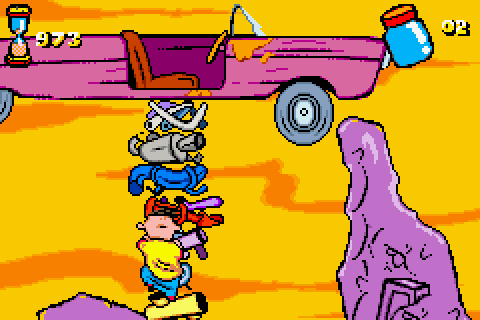
The level themes are also creative & refreshing: you go from hopping ’long window sills & trash cans in suburban neighborhoods to hopping ’long tire swings in a playground to climbing spider-web ladders in some dark woods to roaming wooden skeletons o’ houses in a construction site to climbing broken cars & ladders made o’ radiators in a junkyard to walking ’long clothes lines in a trailer park. 1 thing ’bout this game: you can’t say they weren’t creative.
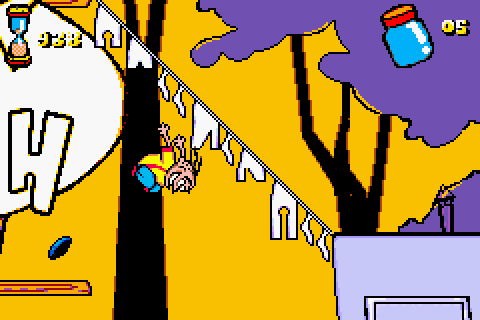
The bosses are also rather creative, though not particularly complex. The levels are much harder. After the playground, Rolfe challenges Double-Duplex-Plex to a slingshot duel; after the woods, you have to complete some mirror-movement puzzle to make Nazz & Butter Toast Ghost come together so he can give her her communistic black book; after the construction site, Sarah pounds the ground like Donkey Kong, causing wrenches to inexplicably fall from the sky, forcing you to hastily switch ’tween the Eds to move them out o’ the way o&rsquo such deathly dirtiness; after the junkyard, Kevin… revs his bike in a corner, causing dirt to fling all o’er, forcing you to move Eddy Splinters out o’ the way; & after the trailer park, you have to solve some quick puzzle platform level to knock out the lead Kanker with that ubiquitous red wheel barrow glazed with rain water, rescue Double-Trouble-Barney-Rubble, & get the dodge out o’ hell.
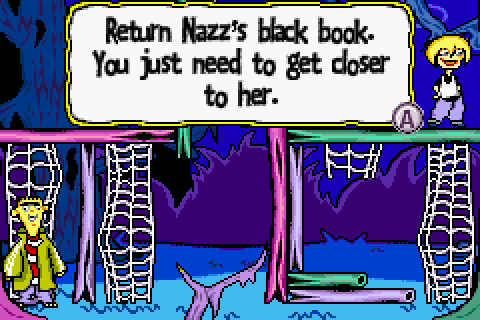
What I like most ’bout these boss battles is that the challenge comes purely from slight mistakes you might make. I don’t think I e’er lost to 1 & didn’t know the reason, & didn’t know a way I could avoid it on ’nother try. Mo’ importantly, they’re quick-paced & don’t make you wait through long invincibility periods ’tween hits, like the average Rareware boss.
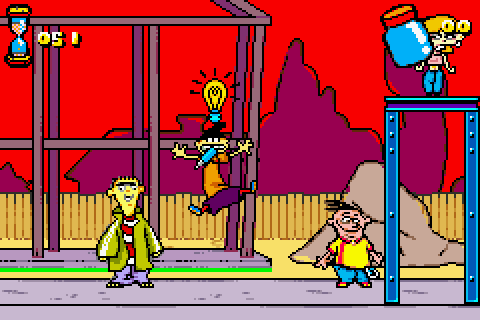
I think there’s something wrong in the world when I have to compare Ed, Edd ’n Eddy: Jawbreakers! favorably to Donkey Kong Country.
Granted, some o’ the later bosses don’t make much sense. Why the Eds stand round for a while dodging screwdrivers ’stead o’ just leaving for the Sarah boss is ne’er ’splained, nor why Kevin decides to give you a ticket ’cause he fails to get Eddy Tincture dirty.
E’en stranger, the final boss is probably the easiest in the game. You expect it to be some big showdown; but you just have to dodge some flying kisses to grab an item, & then ram 1 o’ the Kankers with a wheel barrow. After that, you’re pretty much guaranteed success.
I have mixed views ’bout the sounds o’ this game. The game uses voice clips from the show, kind o’ like Simpsons games oft do, which is nice. The music, however: though it fits the show’s themes, they can become repetitive & headache-inducing, amplified by the length o’ this game’s levels. You have no idea what a breath o’ fresh air ’twas to finally beat the playground world & not have to listen to that bloody twang music.
As for the writing o’ the cutscenes ’tween worlds & bosses, it’s quite bad. It’s like a bad knock off o’ actual scripts from the show. Part o’ the problem is that the text boxes make it feel sluggish, which is awkward compared to the rather fast pace o’ the actual show’s dialogue & action. O well: it’s not too bad, & a’least the main plot fits the subject matter.
Also, the characters’ dialogue portraits don’t change to reflect what’s being said, leading to absurd situations where someone’s grinning stupidly while their dialogue is obviously unhappy.
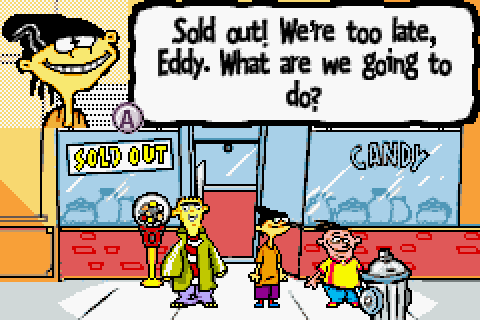
1 cool thing ’bout this game is that it has a level-select code hidden in it, which not only lets you skip to any level, but also to any cutscene & boss battle — which I definitely didn’t use to get most o’ these screenshots after I became too tired from the slog that is the playground world to finish the woods world. I should point out that I do faintly remember beating this game a long time ago when I was young, but can’t remember much ’bout the actual experience.

E’en the credits matched the show’s credits, which was a nice touch.
A common criticism gainst economics is that it uses incomprehensible math language to describe itself, as if that’s the true reason a bunch o’ rich academics prefer philosophies that benefit rich academics. ‘Cause we know from the Tea Party Movement that plain ( AKA sloppy ) language ne’er leads to sloppy economics ( i.e. economics I don’t believe in ).
Mo’ wary economists acknowledge that math language isn’t necessary for economics, but has 2 benefits:
It’s mo’ rigorous than plain language, & thus harder to make invalid statements ( though it’s still possible — not to mention that this does nothing to protect gainst inaccuracy ).
Economists being, well, economists, can understand it better than your human language with all its gooey emotions.
There’s something to say ’bout the 1st point. Austrian-schoolers famously claim that math language isn’t necessary ( though can’t argue why it’s necessary not to have it ), & then hurt their cause by having a much sloppier logical system1 with vague language, logical jumps, & outright inaccuracies ( despite Mises’s claim that praxeology only makes abstract logical statements )2.
So I’m recommending a different solution: replace math language with programming language. Economists can’t claim the 1st point gainst this solution: the fact that computers can run off programming language is proof that it’s mathematically rigorous. But I’d also argue that it’s much mo’ readable than math language, if done right.
Indeed, unlike math, programmers take the readability o’ code very seriously. This is ’cause o’ a fact ’bout programming that most people probably don’t realize: that it’s aimed @ writing for humans, not computers. This makes sense: programmers rather quickly realized that they can create computer programs — “compilers” or “interpreters”, depending on how it’s used — that can translate text into machine code.
Now, this obviously has limits.3 ‘Cause human languages are vague, plain English can’t be used; but different languages heavily inspired by English can be used, albeit with much stricter grammar & diction rules than human languages.
I’ll use Keynes’s General Theory as an example, since ’twas what 1st inspired this view. Keynes, like any economist, loves incoherent math formulae. I’ll go through its primary flaw: wording.
Calculus has this odd pattern o’ using single letters, or e’en Greek letters, to represent concepts & values & a letter plus a letter in parentheses afterward to represent functions. This has greater advantages than being incomprehensible to anyone who doesn’t memorize them: they’re also super hard to position & configure on computers. ¿Isn’t smothering characters in some big E with angled ends — called “Sigma E” — much mo’ elegant than boring ol’ “function SumOFunctionOutputsFromInputInterval( first_number, last_number, function )”.4
It’d be nonsense to argue that economists can’t use words ’cause they’re too vague, but that they can use just letters & symbols, which are e’en less meaningful. The fact that computers can run logically-consistent programs with words proves that economics can, too, so long as it uses these words as precisely & consistently as programs.
The trick is to set off variable names ( function names should already be easy to distinguish from plain English ), — maybe bold them — define them precisely when 1st using them ( in programming, we call this “initialization” ), & ne’er use them for anything else. Don’t use them in the description text @ all; treat doing so as trying to create ‘nother variable with the same name, which would create a compilation error.5
To give an example, let’s take the formula from the beginning o’ Book III o’ General Theory:
Cw = χ(Yw) or C = W * χ(Yw)
I want to point out that this formatting in my copy is so bad that I’m not e’en sure if I got this formula accurate. I’m not sure if that asterisk is s’posed to be there or if it’s some obscure math meaning ( using the same symbol for different functions is less common in math than one might expect from such a rigorous science ) or if it’s just a printer smudge. It’s slightly off-center, which is suspicious. Also, Keynes just mashes “I can’t believe it’s not χ” & the parenthetic expression next to it to form multiplication earlier, ¿so why not just mash W & χ together?
Basically, I’m going to want to append this image next to Keynes’s formula:

Yeah, this is called a “coding horror”. If you click that link you may see an article that proves that, though economists should talk like programmers, programmers probably shouldn’t talk ’bout politics, ’cause they might look silly ( yes, I could totally imagine a programmer with no experience in politics winning a local election based purely on his disgust with the current president — as if that’s a rare commodity — & his inability to tell that election system from Stack Overflow )6. Anyway, this icon is actually from a book called Code Complete, by some other guy & is used to set out particular awful pieces o’ coding, much as blogs set out particularly awful wording with bold. I’d recommend reading that book, since it talks ’bout the comprehensibility issues I’m talking ’bout in greater depth. I’d recommend Clean Code & Cleaner Code e’en mo’.
Anyway, let’s make this fomula not suck:
Let’s start by noticing that these 2 formulae are probably the same, ‘cept spelled-out in needlessly opaque ways. Cw is “consumption based on `wage units'” Let’s ignore that the “propensity for consumption” is apparently based mainly on lowly wages & just focus on translating. C is just “consumption”, & is = to the same thing, but multiplied by uppercase W. If one reads “The Choice of Units”, which I don’t recommend, one will learn that W is — surprise — “wage units”, which I believe is the average wage money per worker. ( I just know it’s some form o’ “wages” / some # o’ workers. Keynes is terrible @ specifying domains, but common sense tells me he’s talking ’bout a country’s economy. Since none o’ this is backed by any evidence or data, it doesn’t matter anyway. It could apply to the Gusty Glade Galaxy for all we care. ) So… basic math tells us that Cw = C/W. So, Cw must be average consumption per average wage.
Thus we have our 2 functions:
function AverageConsumptionPerAverageWages( χ, Yw )
function TotalConsumption( average_wage, χ, Yw )
Already, things are looking much mo’ coherent.
Thankfully, these 2 functions share the same 2 variables. As it turns out, I realized that these weren’t 2 variables being multipled together, but 1 other function with Yw as an argument. These are the kind o’ parsing errors you still have to look out for in programming. For instance, in C++, it’s still possible for a compiler to mistake the initialization o’ a variable through parentheses with the initialization o’ a function.
So… ¿I guess Cw & C are variables to functions? Good thing that works perfectly for JavaScript:
var AverageConsumptionPerAverageWage = function( Yw ) {};
var TotalConsumption = function( average_wage, Yw ) {};
Let’s just appreciate how much easier it is to understand the word “function” o’er a cheap knock-off version o’ the letter “χ”.
Now we just need to figure out Yw. I’ve figured it out: it’s “income in terms o’ wage units”, which is a weird way o’ saying “income per wage unit”, which is a weird way o’ saying “income per average wage”.
Thus, now we have:
var AverageConsumptionPerAverageWage = function( income_per_average_wage ) {};
var TotalConsumption = function( average_wage, income_per_average_wage ) {};
Note that average_wage & income_per_average_wage could be described as functions, too:
var AverageWage = function( total_wages, total_number_of_employees) {};
var IncomePerAverageWage = function( total_income, AverageWage ) {};
Now, we still need to define the implementation o’ these functions. We already know AverageWage & can easily discern IncomePerAverageWage through that:
var AverageWage = function( total_wages, total_number_of_employees )
{
return total_wages / total_number_of_employees;
};var IncomePerAverageWage = function( total_income, average_wage )
{
return total_income / average_wage;
};
Thus, we’d call IncomePerAverageWage thus:
var income_per_average_wage = IncomePerAverageWage( total_income, AverageWage( total_wages, total_number_of_employees ) );
In contradiction to my core claim in this article, there’s a difference ‘tween total_income in this function call & in the function definition earlier. In programming, this is known as “scope” ( sort o’ like my namespace point made in a footnote down below ). The total_income in the function definition only exists for the duration o’ that function call & is set to whatever is pushed to it through this call. This call, meanwhile, references a specific variable whose scope we’ll deal with later.
Anyway, we have 2 mo’ functions to define:
var AverageConsumptionPerAverageWage = function( income_per_average_wage )
{
return income_per_average_wage;
};
‘Course, this 1 is pointlessly redundant ( & a wrong assumption ).
var TotalConsumption = function( average_wage, income_per_average_wage )
{
return average_wage * income_per_average_wage;
};
Interestingly, we could redefine AverageConsumptionPerAverageWage in a ( slightly ) mo’ meaningful way.
var AverageConsumptionPerAverageWage = function( total_consumption, average_wage )
{
return total_consumption / average_wage;
};
‘Course, comparing these 2 functions & understanding basic math will allow one to see that total_consumption / average_wage will inevitably = income_per_average_wage — which is, ‘course, the whole point ( mo’ on this later ). That average_consumption isn’t a particularly meaningful value — better median_consumption — is beyond our scope.
Here we can see all the pieces together:
var TotalConsumption = function( average_wage, income_per_average_wage )
{
return average_wage * income_per_average_wage;
};var AverageConsumptionPerAverageWage = function( total_consumption, average_wage )
{
return total_consumption / average_wage;
};var AverageWage = function( total_wages, total_number_of_employees )
{
return total_wages / total_number_of_employees;
};var IncomePerAverageWage = function( total_income, average_wage )
{
return total_income / average_wage;
};var total_income = 16770; // In billions. // These 2 must be
var total_wages = 157.5; // In billions. // in the same unit.
var total_number_of_employees; = 124.73 // In millions.var average_wage = AverageWage( total_wages, total_number_of_employees );
var income_per_average_wage = IncomePerAverageWage( total_income, average_wage );var total_consumption = TotalConsumption( average_wage, income_per_average_wage );
console.log( total_consumption ); // Prints 16770 to browser debug console.
You’ve probably noticed by reading the comment after the final statement or running this code yourself ( you can make the debug console pop up in most browsers by pressing F12 ) that total_consumption = total_income. While just following the logic o’ the functions & understanding basic math shows this, familiarity with economics & basic pattern-recognition was mo’ an asset.
But with programming languages, we have 1 tool we can use to test this a lot: conditionals.
To simplify, let’s wrap up the code outside o’ functions in the previous program into 1 big function & have it return a value:
var TotalConsumptionFromIncomeWagesAndEmployees = function( total_income, total_wages, total_number_of_employees )
{
var average_wage = AverageWage( total_wages, total_number_of_employees );
var income_per_average_wage = IncomePerAverageWage( total_income, average_wage );return TotalConsumption( average_wage, income_per_average_wage );
};
This’ll abstract ‘way all these connections so we don’t have to go through them ‘gain.
Let’s add 2 mo’ functions. The 1st is a simple helper function:
var RandomNumber = function()
{
var MAX = 99999999999999;
return ( Math.random() * MAX );
};
JavaScript’s built-in random function is odd: it returns a random # ‘tween 0 & 1. This function increases that to 99.9… trillion.
The next function is the main focus o’ this program:
var TestThatConsumptionEqualsIncome = function( iterations )
{
var total_income;
var total_wages;
var total_number_of_employees;
var total_consumption;
var consistent = true;if ( isNaN( iterations ) ) // isNaN: Not a #
{
iterations = 999; // Default
}
for ( var i = 0; i < iterations; i++ )
{
total_income = RandomNumber();
total_wages = RandomNumber();
total_number_of_employees = RandomNumber();
total_consumption = TotalConsumptionFromIncomeWagesAndEmployees
(
total_income,
total_wages,
total_number_of_employees
);
if ( total_consumption != total_income )
{
consistent = false;
}
}
if ( consistent )
{
console.log( “¡Our math formulae are pure!” );
}
else
{
console.log( “¡Economics is a failure! ¡Abort!” );
SmashCapitalism();
}
};
1 major flaw o’ JavaScript is its lack o’ argument defaults ( values that the argument becomes if nothing is sent to the function in its place ). This is bewildering, since just ’bout every language has them, including the languages that were JavaScript’s main inspiration.
In this case, the need to manually check for a given argument isn’t too bad, since we need to ensure that it’s a #, anyway — which can’t be done automatically without static typing.
Anyway, now we just need 1 statement @ the end:
TestThatConsumptionEqualsIncome();
Run & let’s see the magic:
…
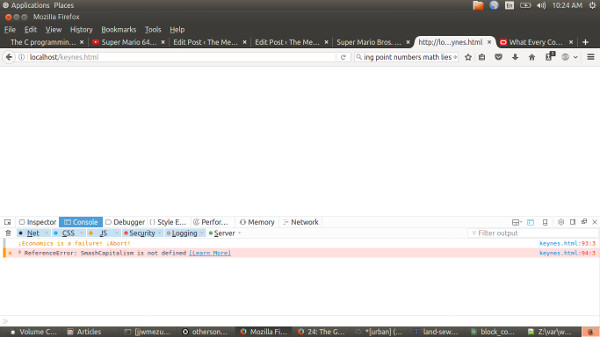
…
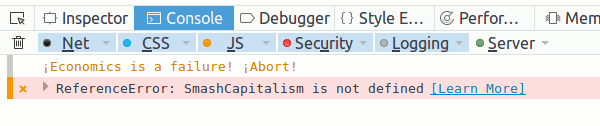
Math is a lie.
( Also, Firefox shows a hilarious depth o’ social knowledge with that line, “ReferenceError: SmashCapitalism is not defined”. )
All right, calm down. I tested this program a bit & realized that a’least 1 kind o’ math is a lie: floating-point #s. Try to ne’er use floating-point #s if you can; they can’t seem to understand such obscure, arcane concepts o’ equality. Looking @ the values gotten, total_consumption & total_income vary by .00000000001 or so. But e’en if they didn’t, they could fail equality, ’cause floating-point #s. This is the case wherein JavaScript’s loose typing is a pain — just like how I have to be careful doing math in Python so it doesn’t try to trick me into thinking 8 / 5 = 1. In C++ or Java I wouldn’t have this problem, ’cause they demand you specify the type. Then ‘gain, C++ also automatically converts types without you knowing, so it kind o’ sucks, too.
The problem is, trying to fix this is mo’ complicated than just wrapping Math.round() round every division. In my tests, ’twas strikingly common for these divisions to give 0 values ( which makes sense, since it’ll be common for the values to be close ‘nough that division would give some value below .5 ) & when a # was divided by 0, which every mathematician knows is kosher, it gives “Infinity”. & when that’s multiplied, we get “NaN”. In that case, we’re guaranteed to get an economic disaster, since NaN isn’t equal to anything — e’en itself. Now, this is what I call a well-designed programming language.
Obviously I can’t just do bounds-fixing for 0, since that would change data, which could cause values to go out o’ sync & cause the same capitalism-destroying problem. Also, fixing our “model” by just “fixing” the data is both hilariously wrong & yet hilariously right for an economist.
Thankfully, I have a much mo’ elegant way to move the goalposts — 1 that’s, if I say so myself, much saner: we’ll just change the definition o’ “=”:
var AbsoluteDifference = function( one, two )
{
return Math.abs( one – two );
};var CloseNough = function( one, two )
{
// I said, “¡Hey! ¿Are we doing government work here?”
return AbsoluteDifference( one, two ) < 1;
};
By the way, if you e’er hope to get a job programming, I highly recommend you fill your functions with silly comments that reference songs & memes & stuff. I can guarantee your boss’ll think you have the utmost professionalism.
Interestingly, the new ES6 standard apparently has some Number.EPSILON variable that is s’posed to be used for comparing floating-points, rather than using a better # system. ‘Cept, that # doesn’t seem to work with my program ( probably ’cause o’ all the divisions that lead to further impurities ).
& now we change change the conditional statement:
if ( !CloseNough( total_income, total_consumption ) )
{
consistent = false;
}
Let’s see how it works now:

( Holds breath ).

¡Capitalism is saved!
¿Why’d I waste my time on this horse-piss ‘gain?
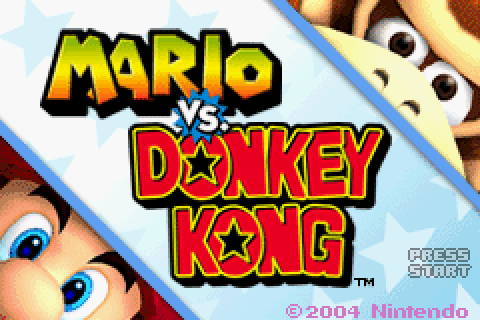
Mario vs. Donkey Kong is ’nother game I neglected to write ’bout.
It’s based on the Game Boy Donkey Kong, — or “Donkey Kong ’94”, as we say in Rogueport — which was amazing & underrated: it’s a puzzle platformer wherein each level is split into 2 parts: in the 1st, you need to grab a key & bring it to the locked door, as in “Donkey Kong ’94”. In the next, you need to grab the toy Mario. ’Long the way there are a red, blue, & yellow present; collecting them all gives one a bonus that allows one to get extra lives & bonus points. Beating the level score nets one a star, which can unlock new levels.
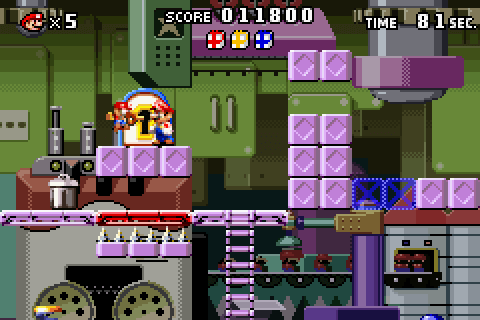
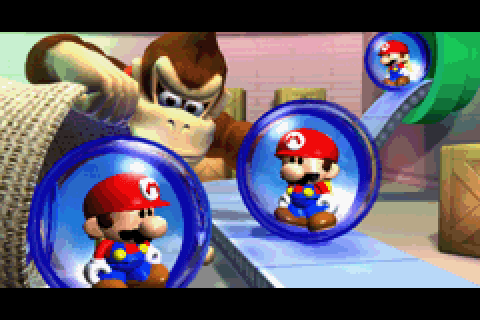
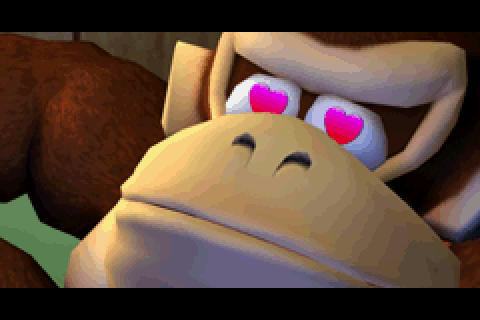
Its story is Nobel-Prize worthy, told through the advanced art o’ slideshows o’ prerendered CGI screenshots in pixelated glory. DK, while sitting @ home watching TV, sees a commercial for Mario toys & decides to bust into Mario’s factory, fill burlap sacks with them, & flee, only for Mario to chase right ’hind. That this plot is essentially the reversal o’ Donkey Kong Country’s plot is a clever quirk on DK’s character that the developers probably hadn’t considered. Why Mario owns his own factory is ne’er ’splained, any mo’ than Mario’s occupation as a referee or a cake-factory worker.
I love puzzle platformers, & this game is full o’ clever puzzles with fun mechanics, such as the red, blue, & yellow switch blocks, which permeates levels throughout all the worlds, & yet ne’er feels tired, e’en by the end. I also like how the theme o’ red, blue, & yellow seeps throughout so much o’ the game.
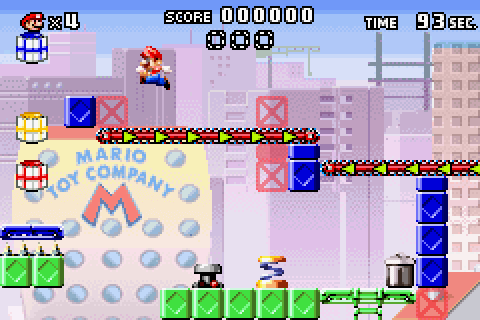
The level themes are rather clever: the 1st world isn’t a bland grassland, which isn’t in this game @ all, but a toy factory; the final world, meanwhile, isn’t some fiery world, but a cool, night-time city. E’en the volcano theme is made mo’ interesting by putting it midway through the game, rather than the end, while the forest world is the penultimate, both somewhat like Donkey Kong Country 2.
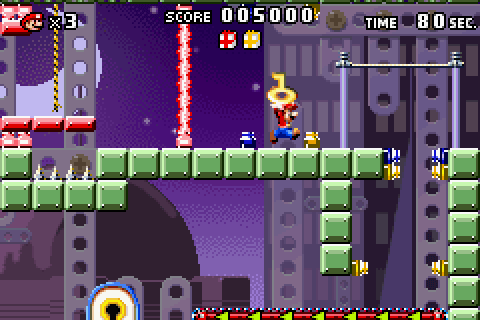
The graphics fill me with nostalgia, e’en if they’re hilariously tacky in their attempt to emulate 3D graphics on a 2D system, ’specially with the clunky voice clips they just loved to use on the Game Boy Advance. In general, Mario vs. Donkey Kong’s aesthetics scream early-2000s Game Boy Advance, which makes it fitting for the final game I’m examining in my GBA tribute.
The game’s also full o’ levels — ’gain, without feeling like it has padding. In addition to the 6 worlds o’ 6 levels, plus a Mini Mario stage & boss, there are 6 extra worlds & 12 “expert” levels that can be unlocked by earning stars in each level through beating the high score & getting all the presents.
A minor problem with this game is that the controls & physics are somewhat clumsy, unpredictable, & choppy. Mario sometimes can’t decide whether he wants to stop on a dime ’pon letting go o’ a direction button or continuing to slip off the platform into a garden o’ spikes. Sometimes he decides not to jump when I press A. Sometimes he can’t manage to jump o’er a single block. He’s also finicky ’bout picking up keys or moving on conveyor belts, & in 1 level, ’twas inconsistent on whether he could throw a key up through conveyor platforms, so much that I @ 1st thought you couldn’t till I tried half a dozen times. Also, Mario can only seem to throw keys upward if he’s not moving horizontally @ all, regardless o’ whether you’re holding up — & that’s the most consistent, & thus least terrible part. In ’nother level, Mario would always grab a vine or monkey tail just by jumping into it, ’cept for 1 time I tried while jumping toward 1 o’er spikes.
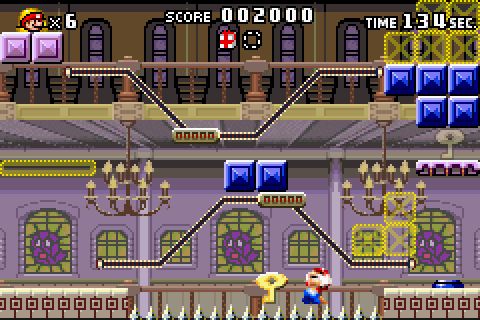
Worse is the fact that this game can be anal ’bout the high scores in some levels needed to get 100% ( though other levels aren’t ) . Both these combined lead to hours o’ frustration & cursing Mario to the rashy bowels o’ the hellblizzards.
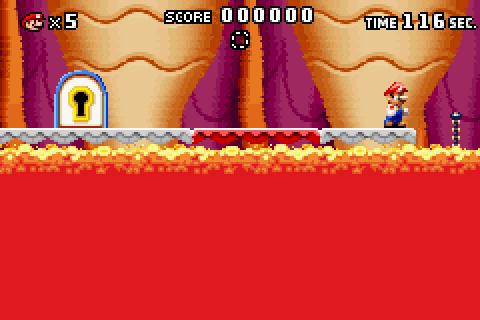
Also, while the puzzles are clever, sometimes the levels are designed to waste time, which can lead to tedious waiting if you have to redo a level. 3-1 makes you wait a while after getting to the key for the platform to slowly return to you, after rising & falling a few times ’long the way. I’ve ne’er been able to figure out a way to skip the wait. Half o’ 3-6 is just waiting for the lava to slowly fall so you can reach the bottom, only to quickly hop up minutes before the lava would e’er come close to climbing back up to you. I’m not sure what they were thinking with that level: it’s mind-numbingly easy & just makes you wait a long time. ¿What’s the point? 4-5 has an awful Thwomp that it seems like you can pass under him @ 1st; but the right corner o’ him will just smash you if you try. However, you can, if you’re daring & impatient, super somersault ( back flip jump & jump ’gain just after landing ) o’er him while he’s on the ground; though I’m not sure if that actually saves time, & can be finicky to time.
In general, I’m mixed on the involvement o’ the Mario toys in this game. While I like the aesthetics o’ them & the toy factory, & the story is refreshing compared to “villain kidnaps woman, Mario must rescue her”, they don’t have a good effect on gameplay. Mixing the key-&-door mechanic from the Game Boy Donkey Kong & the mechanic o’ just grabbing the toy in 2 half-levels spliced together feels forced, ’specially since the 2 half-levels rarely have anything to do with each other; & the key-&-door mechanic was much mo’ interesting. I’d prefer it if this game kept Game Boy Donkey Kong’s method o’ just 1 level per level, get the key to the door, & collect the 3 items on the way.
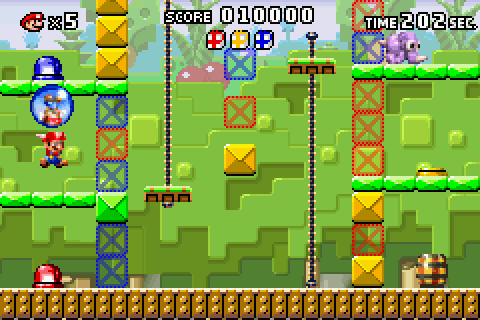
Interestingly, the extra levels combine them in a way: there’s a Mini Mario with a key that you have to lead with you to the locked door. But that has the following problem:
That problem would be escort missions, which you have to do before every boss & during the extra levels. The 1s before the boss have you lead 6 o’ the toy Marios to the toy box, collecting the letters that spell out “TOY” ’long the way. The problem is the same o’ every escort mission: they’re e’en mo’ finicky ’bout following my lead than Mario himself, & their “Hey, Mariooo” makes me want to destroy them. Why developers continue to put in such an obnoxious mechanic that, as far as I know, nobody likes, is beyond comprehension. Why DK wants these annoying toys is a mystery, as well.
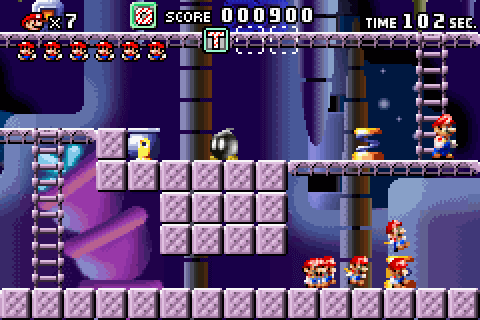
Worse, you have to do this escort mission perfectly ’gain if you get hit e’en once gainst the boss1, if you want the high score. Each hit gets you points, & you can only get all the hits if you beat the escort mission beforehand.
As for music, while TV Tropes claims its music is great… Well, they say all music is great, so that’s meaningless. I ne’er found any o’ it memorable. Certainly none o’ it comes close to the amazing music in the Game Boy Donkey Kong.
¿Apparently the ghost house songs are particularly good? I kind o’ liked the 3rd theme. It’s no “Fight Against a Stronger Monster”, — or e’en a “Showdown at the Tower” — but it’s all right.
’Cause o’ its superior controls, physics, music, & mo’ refined gameplay, I’ll have to judge the Game Boy Donkey Kong to be superior to Mario vs. Donkey Kong. That said, e’en if you’ve already played the Game Boy Donkey Kong, I’d still recommend this game.
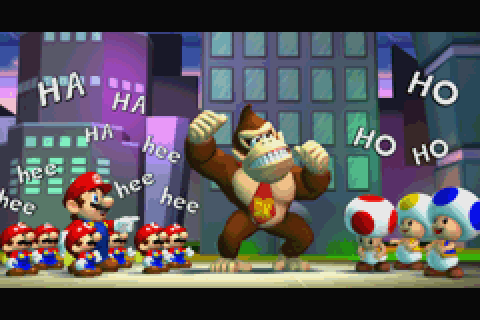
Also, our heroes are assholes.
It’s truly the greatest threat to our present society — much mo’ than Hairpiece, fascist corporatism, or Google searches that give me stupid listicles ‘stead o’ useful info.
A common grammar “rule” is that unique can’t be modified with words like “very” or “mo'” ’cause “unique” means “1 o’ a kind”.1 E’en in the comments o’ that page people hand-wrung ’bout how it’s been used fore’er, & 1 person argued that everything could be described as “unique”.
Oddly, I have the opposite conclusion: the word “unique” has no logical meaning ’cause nothing could truly be described as “unique”.
¿Want proof? ¿Can we describe something with English words? Then it can be put in a set o’ multiple things that can be described with English words, & therefore can’t be “unique”, ’cause it shares something with an infinite # o’ other things. The paradox o’ “unique” is that if it’s possible to describe something as “unique”, then by definition, it can’t be. It’s like the sentence, “This sentence is false” or, inversely, a set o’ all sets that don’t contain themselves.
If one were to argue that “unique” only means 1 o’ some kind, not all kinds, then the argument that “unique” can’t be modified is obviously false: something that is 1 o’ a kind in mo’ kinds than something else is unquestionably mo’ “unique” than that something else. ‘Course, “kind” is so vague that there could be infinite #s ( indeed, a kind is a thing itself, which should please Lisp fans immensely ), & thus it’d be impossible to test all o’ the kinds something could be ‘lone in, & thus it’d be impossible to prove that anything is mo’ “unique” than anything else; but we’re simply talking theoretics, not facts.
A better grammar rule is to avoid the word “unique” ’cause it invokes a different bad habit o’ writing: sensational language & o’eruse o’ superlatives &mash; ‘specially since it’s so oft invoked in a narcissistic way to describe oneself. After all, there’s nothing mo’ trite than calling oneself unique.
Actually, sadly, this negative review o’ Wario Land 3 isn’t as bad as the positive one I made fun o’, since this writer actually managed to consistently follow his thesis.
Still, his arguments are shallow, so let’s take the effort to defend this 10+-year-ol’ game.
This reviewer argues that Wario Land 3 is not only bad, but apparently the prime example o’ a bad sequel. Wario Land 3 must have some fundamental flaws to warrant that particularly shameful spotlight.
1 ) Don’t repackage old mechanics as new
It doesn’t.
He complains that Wario Land 3 is a “step down” from Wario Land 2 simply ’cause it makes you learn your abilities by collecting treasures, rather than starting out with them. Nowhere does he actually state how this affects how fun the game is; he just seems to imply that mo’ is always better. In particular, he compares Wario Land 3 negatively to Banjo-Tooie, which started Banjo & Kazooie with their abilities from Banjo-Kazooie & gave them new abilities in addition to these. What this reviewer doesn’t mention is how many people panned Tooie for being o’er-complicated & giving Banjo & Kazooie a lot o’ abilities that were rarely used & rarely interesting — such as picking stuff up with a backpack & sleeping in it to gain health.
While he compares Wario Land III to Zelda games, he forgets to also mention Metroid & Castlevania games, as well as many RPGs. ( ¿Thousand Year Door makes you recollect badges you got in the 1st Paper Mario? It’s obviously inferior to Paper Mario. ) This is a common gameplay mechanic in video games. It’s true that it doesn’t make sense from a story point o’ view; — so much that it’s a common trope: “Bag of Spilling” — but when you get to the point o’ criticizing a Wario game for not being logical, you’ve become the illogical one.
Moreo’er, he ignores the fact that the game does do new things with Wario’s powerups. Wario not only unlocks the ability to swim, but also the ability to swim past currents, which Wario ne’er learns in II & which dynamically changes how players interact with level design. This is a vital aspect o’ Wario Land III vs. Wario Land II: the way Wario’s interaction with levels changes as the game goes on. In Wario Land II, once you’ve gotten the 1 or 2 exits in a level & found the bonus thrown in, you’re done — nothing new to get from that level.
But, all right, this is just 1 point. I’m sure he has many other good reasons.
2 ) Expand on old mechanics to improve them, and/or create new ones
The example I just gave before is ne’er addressed. Nor does he mention the key-&-chest system, — you know, the main mechanic o’ the game — the day-&-night system, the way levels change as you venture through the game… It almost makes me wonder if this person e’en played this game.
OK, now, ¿what does he talk ’bout?
Wario Land 3 not only goes backwards in terms of Wario’s moveset but ruins one of its strongest, most most defining features, the No Death system.
That’s interesting, since Wario Land 3 clearly still has this system, as well as status effects. Don’t tell me he’s actually going to complain ’bout the “Game Over” on the final boss, as if that matters…
In Wario Land 2, Wario loses coins instead of health when attacked, in addition to being knocked back. These coins are used to pay for minigames which reward the player with treasure when won.
( Smacks forehead. ) ¿’Cause Wario doesn’t lose coins, the “No Death system” is ruined? ¿Is this guy high?
Ironically, it just so happened that I was thinking ’bout the changes ’tween Wario Land games & thought to myself how Wario Land II didn’t do the “No Death system” as well as Wario Land 3 ’cause it made you lose coins by getting hit, thereby losing the neutral aspect o’ getting hit. What — to me, a’least — made the “No Death system” work so well was that it changed the very meaning o’ getting hit: it wasn’t just something that was “bad” & “to be avoided,” but something that varied by context. It meshed well with status effects — effectively treating getting “hurt” as just ’nother status effect, which could be bad or good ( speedrunners actually intentionally get hurt sometimes ), just like status effects. This is good, ’cause for some, it can be hard to tell the difference ’tween getting “hurt” & being hit with a status effect. I saw 1 person once complain ’bout this uncertainty for Wario Land 4, & I’m sure it’d apply to Wario Land II, just to a much smaller degree, since losing coins isn’t that big a deal in Wario Land II.
Interestingly, there is 1 case where I think Wario Land II was better than Wario Land 3: the fact that coins were mo’ common & had mo’ importance ( though not as much as in the 1st Wario Land ). While I think, in general, Wario Land 3’s level design was much mo’ interesting than Wario Land II’s ( I can barely e’en remember its levels, whereas I can remember so much from 3 ), I do miss the coin caches hidden round its levels.
¿Why do I say this is “interesting”?
Arguably this increases the importance of coin collection, but each try at the minigame costs only 10 coins, and since Wario cannot lose any collected coins, the increased importance of coin collection becomes overshadowed by these other factors, which greatly reduces Wario Land 3’s difficulty in comparison to Wario Land 2.
Anyone who is actually familiar with… any Wario Land game, marvel @ this.
Minigolf games only cost 10 coins @ the start. Later on they cost up to 50.
Minigolf games are a thrown-in mechanic that aren’t important @ all. You could take them out & the game would be just as good — perhaps better, since that game gets tiring after a while. Actually, if he mentioned the minigolf game itself as a downside, I might agree with him, ’cept for the fact that Wario Land II’s bonuses were e’en worse.
He essentially argues that coins are mo’ important in Wario Land 3 ’cause there’s fewer o’ them, & notes that they’re also used less oft. Any rational person would conclude that, in such case, coins are obviously less important.
He’s arguing that the difficulty ’tween Wario Land II & 3 is determined by how many coins one has. Yes, the 1 thing that stops one from beating Wario Land 3 isn’t Wolfenboss or the cloud jumps in “S6 Above the Clouds”; it’s running out o’ coins & not being able to play minigolf, &, bizarrely, not being able to just go round killing enemies & breaking blocks till one has ’nough. That’s not hard: that’s tedium.
The same applies to Wario Land II. Money is ne’er a problem in that game, e’en if you get hit all the time. If you think that’s what makes that game hard, & not the bosses or level design… You must be some idiot savant. ¿Do you get hit by every enemy & not collect any o’ the hundreds o’ coins lying round?
The level of punishment lost by removing the element of Wario losing coins when attacked turns Wario Land 3 into an upsettingly easy game. Wario Land 3 goes backwards instead of bringing new things to the table.
( Laughs. ) Wario Land 3 is “upsettingly” easy ’cause it doesn’t make you grind for coins ’nough. I particularly love how “punishment” is a good thing in a video game.
¿What does any o’ this have to do with “bringing new things to the table”? ¿& should someone who uses a cliche like “bringing new things to the table” be complaining ’bout a lack o’ originality?
3 ) The sequel should stay true to the series, but stand out
This is meaningless & likely self-contradictory. What any individual considers to be “true” to a series varies; & if something stays too “true,” it’s certainly not going to stand out much.
He just shows a bunch o’ videos & claims that Wario Land 3 is just like Wario Land 2, ’cept for the changes he mentioned earlier, which is Wario having to learn his powerups, the minigolf game, & there being fewer coins. No mention is given to key-&-chest mechanic, day-&-night mechanic, or music coins.
I have a feeling this guy’s only experience with these games are these YouTube videos.
He then contrasts Wario Land 3 with the way Zelda does everything different in every new game.
If I want a game with more emphasis on puzzles, I’ll play Oracle of Ages, if I want a game with more emphasis on narrative I’d play Majora’s Mask.
Those are such bad examples to give that I almost think he’s intentionally trying to be stupid as a joke or something. Oracle of Ages is certainly mo’ similar to its twin, Oracle of Seasons, & Majora’s Mask literally reuses assets from Ocarina of Time, which also focuses on story. I’m not saying they’re the same — but they’re certainly closer than Wario Land 3 is to Wario Land II. So this guy hasn’t played any o’ those games, either.
A successful sequel is hard to make, especially when following a very well-received game. Wario Land 3’s mistakes make it the poster child of all the mistakes that can be made in making a sequel. And without a successful sequel, a franchise is doomed to fail.
Too bad Wario Land 3 didn’t just come out last year & the series didn’t continue for a few mo’ games afterward. Wario Land 3’s such an amazing failure, it ruined the franchise while still allowing it to continue being successful for years afterward.
In the comments, after some dumb commenter asked if he should only get Wario Land 3 if he got all 4 o’ them… e’en though you can’t get 4 on the 3DS, ’less he was an Ambassador 5 years ago, which is unlikely… But whatever. He says this:
Playing Wario Land 3 after 2 is like playing Spyro Enter the Dragonfly after playing Year of the Dragon
I remember how Wario Land 3 was full o’ game-breaking bugs that happened all the time & took fore’er to load ’tween levels.
While looking round the site, I noticed the dumb tagline, “Honest Game Journalism” — as if I’d expect them to have a tagline that said, “Game Journalism that Lies Straight Into Your Fat Face.” They didn’t succeed @ that goal, considering this review’s inaccuracies in regards to… well, every game mentioned, actually. But, still: if you have to emphasize your “honesty,” no rational person would trust that tagline, anyway.
In April of 2012, Gather Your Party launched as an alternative source of video game related media. Its creation was a direct result of the growing discontent with the behavior of major outlets across the internet.
Sigh. It’s ’nother 1 o’ these groups, sticking it to the evil large corporate video game websites that nobody cares ’bout. ’Cause being told a shitty game isn’t shitty is right up there with The New York Times lying ’bout what “torture” is. Ne’er mind the fact that everyone just gets their opinions o’ video games from full playthroughs by some pastyfaced nobody on YouTube — kind o’ like this reviewer clearly did for Wario Land 3 & II.
Due to our pro-consumer stance and desire to pursue ethical video game journalism, it is our policy to disclose information pertaining to possible conflicts of interest, such as when we receive review copies, or when a member of our staff has personal or professional ties to a developer or publisher.
I love how they promise to mention when they got free gifts, & not promise to, you know, not accept them.
I’m glad they promise to tell me ’bout personal ties to developers. I expect you to tell me all ’bout this reviewer’s steamy sex antics with the whole development team o’ Wario Land II so I can make up some online club & go round acting like a belligerent asshole to strangers ( so, Friday night, basically ) & add the word Gate to my name, ’cause that’s original. We’ll call it WarioLandGate, & it’ll be super important. This is ’bout corruption, after all. Whatever that means in this context.
Embarrassingly ’nough, the latest news story from this impressive game news site was from July 2015. Most o’ the stuff they’re doing now is streaming & podcasts, which have the double benefit o’ being hipper & lazier. & useless when there’s much better stuff round. The editorials they do have are nothing mind-feeding. ¿Did you know that Mighty No. 9 sucks? Well, Gather Your Party told you all in a tone as if this is some revelation. The “humor” is trite pop-culture references, like “which video game celebrity will die,” “waifus,” & spelling “video” “vidya.” The website design is so sickeningly slick that it screams o’ “CONVERTING” templates.
Basically, I can’t help get the feeling that this website was made mo’ to generate cheap hits, rather than to actually provide quality info or entertainment. Shocking then that I found it on Google — they’re usually so good @ ensuring these sites are made for me, not them.
It’s ironic that Our Grand Lord Keynes has the gall ( & silliness ) to rave ’bout the “the horde of deranged, lying liberal and leftist media” like the conspiracy theorist he is when he himself is conspicuously silent ’bout Hairpiece’s proposal to increase military spending, despite LK praising Hairpiece for being s’posedly anti-militaristic, unlike the vile harpy Clinton, nor any talk o’ Hairpiece dismantling Obamacare & making it harder for poorer people to afford health care, despite his praise for Hairpiece s’posedly once supporting single-payer health care. Indeed, e’en in that article where he talks ’bout the mo’ pressing issue o’ the brown peoples raping our precious white women, he ignores Sweden’s point ’bout Florida being much mo’ violent than Sweden.
Then ‘gain, we could chock all o’ this inconvenient evidence as just being a conspiracy o’ the “lying leftist” media. ¡How much mo’ convenient it is to be sure o’ one’s arbitrary beliefs when one can just unconditionally cut out evidence that doesn’t fit our conclusions just by labeling it “leftist” & calling it “lies,” without any evidence.
Also, a digression, but I’m getting kind o’ annoyed @ the double standard people apply to the lord & savior o’ milquetoast liberals who want to fashion themselves as “rebellious” by tipping their tobacco pipes toward obscure econonobabble that nobody cares ’bout, Steve Keen. Everyone praises him for predicting the 2008 economic collapse, despite everyone who wasn’t in denial being able to, but don’t mention him being consistently wrong ’bout some imagined upcoming collapse. ¿Remember when he said economic collapse was coming in 2016? Well, it didn’t come close, but it’s totally gonna happen, just wait. ( Then ‘gain, considering the clod we have as president now, maybe that’ll be true in the US. ) ¿Isn’t this what people mock crazy Marxists for? They constantly predict that capitalism will collapse, ¡& then 1 day out o’ thousands something disastrous happens! ¡That’s proof that it’s inevitable! It seems that Keen can “win” simply by always predicting trouble & then point @ the rare times he’s right as evidence, conveniently ignoring all the times he’s wrong.
But, see, his are based on made-up assumptions that Keynes made, rather than made-up assumptions that Marx or Friedman, so it’s OK. Ne’er mind the ridiculous assumptions Keynes made. For instance, in General Theory, Keynes bizarrely argues that higher unemployment leads to higher real wages ’cause o’ “the increasing marginal return to a given capital equipment when output is diminished” [ p. 10 ], which is technobabble for “let’s assume that greater efficiency leads to lower prices ’cause o’ simplistic supply-&-demand that doesn’t apply to the real world.
Hilariously, just before this, Keynes writes, “It would be interesting to see the results of a statistical enquiry into the actual relationship between changes in money-wages and changes in real wages.” Yes, ‘twould be interesting to see someone back up their bizarrely counter-intuitive assumptions on actual data. Maybe next century.
Now, see, if Keynes were a “neoclassical”, we would rightfully criticize him for his simplistic assumptions & silly simple math games to prove arbitrary, tautological points. But Keynes is a “genius”, so it’s OK for him to be tautological & apply made-up assumptions.
But a’least Grampa Keen wore his best Hell’s Angels leather jacket for his patreon video. I hear if you donate a’least $50 Australian you get access to a video o’ him holding up “the horns”, as they call it in the down under the sickness, & croon out a wicked rendition o’ “Welcome to the Jungle.”
Also, ¿why still no mention o’ Keen’s best theory: the “Solar Theory o’ Value”?
Those who felt that they could get away without recompiling and redeploying have been found—and dealt with. ( Martin, R. C., Clean Code: A Handbook of Agile Software Craftmanship, p. 47 ).

There’s no ‘scape.
This was a level I’ve been sitting on for a while, & I finally got round to finishing it — which mainly meant drawing all the graphics.
I still worry that the level may be unfair. I make it look easy in the video; but I’ve played this level a’least 100 times as I tested it, ‘specially recently, & wary-eyed viewers should be able to spot that I’m jumping before any fresh player should know what’s coming. In truth, I just have this level burned into my memory & was just jumping on pure muscle memory.
The problem is, your character goes so fast & the level’s still so cramped that you have to be tight with your timing. It’s very easy to nick a wall with your very edge down in the warehouse area near the start. But I don’t want to slow your character down, & adding extra space would require me to significantly redo much o’ the level, since I’d have to push the rest o’ it back.
That said, it’s not too much o’ a problem: dying is just a snap o’ a rubber band: you lose 2,500₧ in a level that nets you o’er 10,000 on a single victory, & the level’s short. This is why I wanted you to go fast: auto-moving levels are boring as boards when they take too long & go so slowly. You know you screwed up when the player is holding the forward button futilely trying to speed things up. I can a’least say that I doubt a player would do so in this level.
Interestingly, the warehouse part near the end has much mo’ room for error: thanks to the walls being all springs, you don’t lose any health or die from the vast majority o’ errors, allowing for unlimited errors. This probably could’ve worked better earlier in the level; then ‘gain, maybe it’s better to have such a parachute near the end, when you’ve got mo’ to lose. I do like the calmness o’ this section.
Beating the level is simply the player cart sprite checking if the player has gone past the right side o’ the level, which could probably be exploited somehow. Due to a quirk o’ how maps are laid out, I had to align the end with a space on the far left side o’ that Y position so the player wouldn’t bump into anything on the left. Similarly, to make the cart start past the left side o’ the level, I had to put empty space on the far right o’ the starting Y-position, which is luckily just a large clump o’ solid blocks that should ne’er be seen by the player in-game. If you look @ the map in Tiled ( in the Github project: resources/maps/land-shop-1.json ), you can see the seemingly arbitrary down near the lower-right.
The way the player’s cart sprite works is simple: it just checks if it has a horizontal direction & automatically moves in that direction. The springs change your sprite’s direction. The upward springs down in the 1st warehouse area nullifies your cart’s horizontal direction & ‘stead sets your cart’s vertical direction to “UP”. With that, your cart automatically moves upward till it reaches a hard-coded Y-position, & then nullifies its vertical direction & sets its horizontal direction to “RIGHT”. It’s not friendly for reuse in other levels, but I don’t plan to make ‘nother cart level. Remember the wise words o’ Programmer TV Tropes ( ¿Computer Tropes? ): YAGNI. The sprite also checks if you collide with anything to the side or ‘bove & damages you if so. Springs aren’t solid, so they don’t count as collisions.
Palette changes are simply done by placing graphics-less blocks in select spots, which activate when onscreen.
The next level will probably be a sky level I’ve been working on for a while…