I. EarthBound
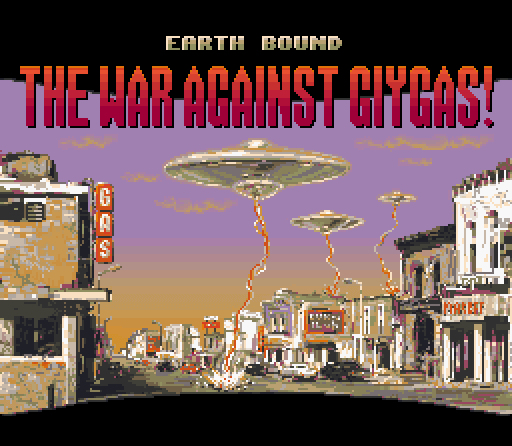
I’ll actually start with EarthBound ’stead o’ Beginnings, not just ’cause that’s the 1st game most English-speakers played & ’cause that’s the most notable o’ the series (in both the western world & Japan), but ’cause some points I make here will be relevant for Beginnings.
Way back when I started this blog—which I’m surprised was only halfway through 2013 & not earlier, actually—I considered writing ’bout a’least the 1st 2 EarthBound games, but felt hesitant to write ’bout EarthBound itself, since it’s been written ’bout so much that it seemed redundant. Now 3 years later, when the game’s 1 o’ the highest selling games on the Virtual Console & everyone’s making Let’s Plays or art based on it, or making inferior ripoffs that don’t hold nearly the same magic, it seems e’en mo’ redundant.
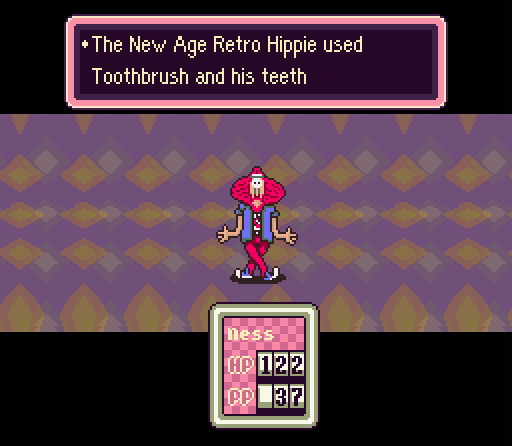
Everyone always has their explanations for why this game’s beloved, & they’re mostly shallow—usually they mention a few nonintegral elements, like the “New Age Retro Hippie,” e’en though that enemy only appears briefly for a limited time & is quite easy to miss. Then ’gain, rare elements can be quite notable, ’specially in RPGs. I think I mentioned in that Pokémon article how I thought the relative rarity o’ a lot o’ the 2nd generation Pokémon in the 2nd generation games actually made them mo’ interesting.
Certainly nobody’s e’er said ’twas the gameplay or mechanics, & that is, indeed, the reason given when someone considers the game o’errated. EarthBound has no customization & quite wonky character balance. Ness is pretty much the only truly good character, worsened by the fact that you play him far mo’ than any other character & that he gets a giant EXP boost near the end o’ the game; he not only has the best attack, defense, health, & healing magic, he also has magic attacks that are stronger than Paula’s, the usual offensive magic user, which is only slightly balanced by the fact that they cost much mo’ PP. The game also has lame Dragon Quest menus that had become outdated years ago.
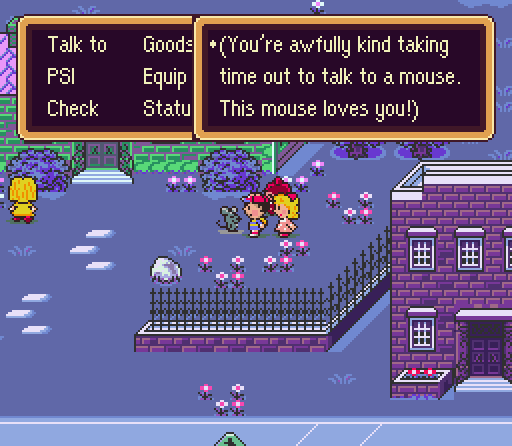
Meanwhile, it’s usually acclaimed for its writing &—less oft, though I personally think it may be e’en mo’ important—it’s aesthetics. Its writing is, indeed, interesting, not just in that it has satire & humor,—something that’s not that rare in RPGs—but just in the way it’s written. E’en throwaway lines that weren’t particularly funny had that EarthBound style that made them sound completely different from other games.
The story itself was gleefully random. @ it’s core it’s the cliché “collect x # o’ McGuffins”; but rather than being epic crystals or badges, they’re footprints that reminded your character o’ childhood memories for no reason @ all. I’m actually not sure whence they were s’posed to have come or why they reminded Ness o’ anything. Actually, I’m going to admit that this game’s story made absolutely no sense to me & that I ne’er cared whether it did or not.
If you want an indication o’ how random this game’s plot was, here’s a bare sequence o’ events (obviously with omissions):
-
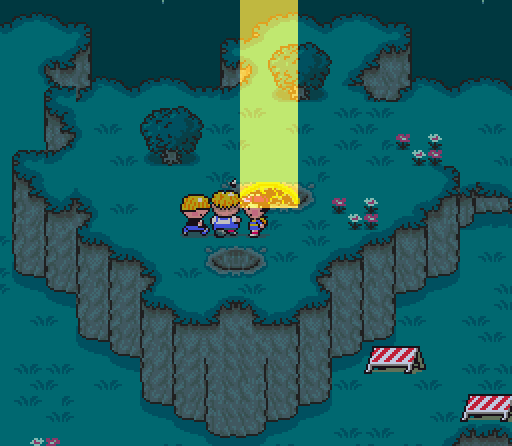
Ness explores a meteor that happens to fall, which leads him to meet a time-traveling dung beetle (essentially Trunks from Dragon Ball Z) who tells him he has to defeat an alien monster ’cause Ness is 1 o’ “the chosen 1s.”
-
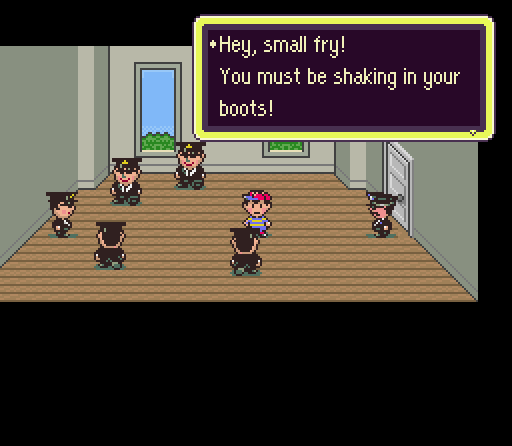
In order to leave Onett, Ness has to defeat the police, who are mad @ you for stepping into an area you were explicitly given permission into by the mayor.
-
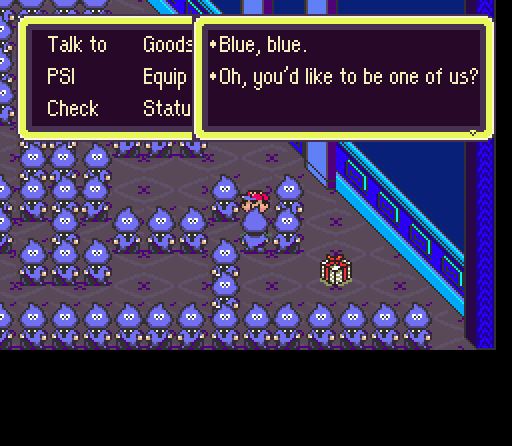
After Twoson, you end up in a town taken o’er by a bunch o’ cultists dressed like KKK members with an obsession for the color blue. You must save some random girl from them.
-
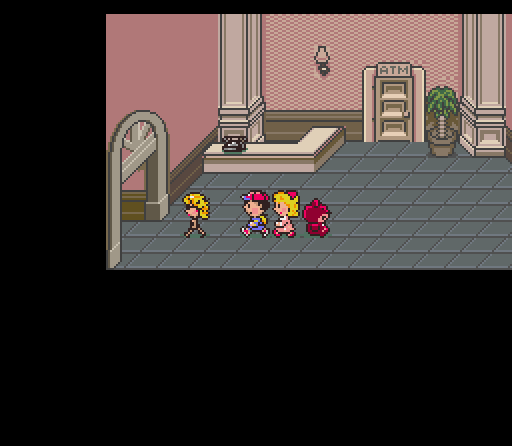
In Halloween-land Threed, which is taken o’er by the occult, you must get captured by zombies, lured by following what is probably a prostitute into a hotel. The only way to ’scape is by praying to a random boy in a snowy boarding school in Winters to come fly a space ship into your dungeon.
-
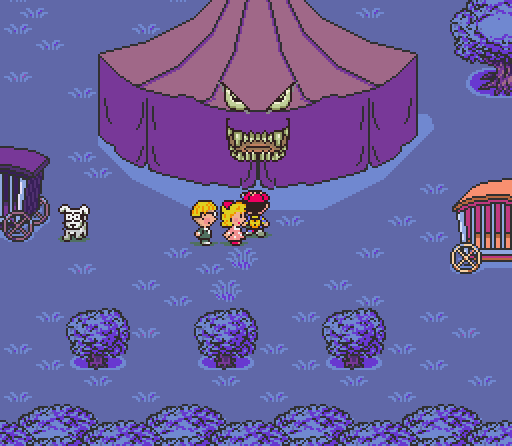
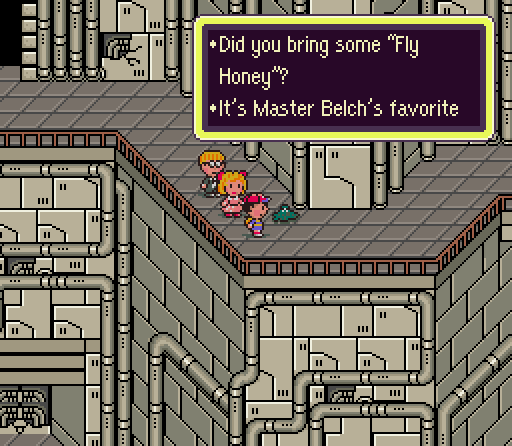
Back in Threed, you must fight a possessed tent & defeat zombies with the zombie version o’ fly paper.
-
To finally fix Threed, you must travel through a valley o’ big-nosed faces with feet & hair bows & then venture into some sewers by waiting in front o’ a waterfall for 3 minutes. In there you fight a giant pile o’ vomit.
-
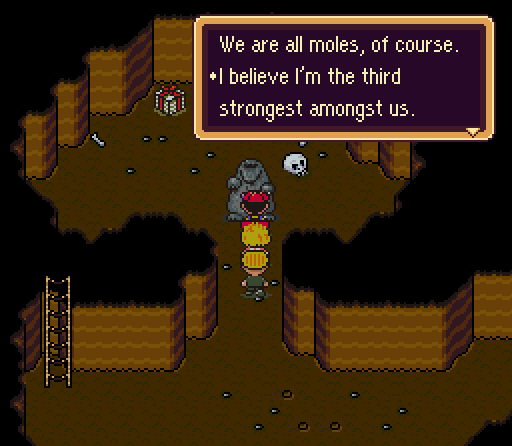
To free some jazz band called “The Runaway Five” with 6 members imitating the Blues Brothers in Fourside, you must explore a gold mine for a diamond, where you must fight 5 o’ the 3rd strongest moles. This part is literally only in the game ’cause the writer happened to have a hobby for gold mining @ the time & is literally only possible to navigate with a map from GameFAQs.
-
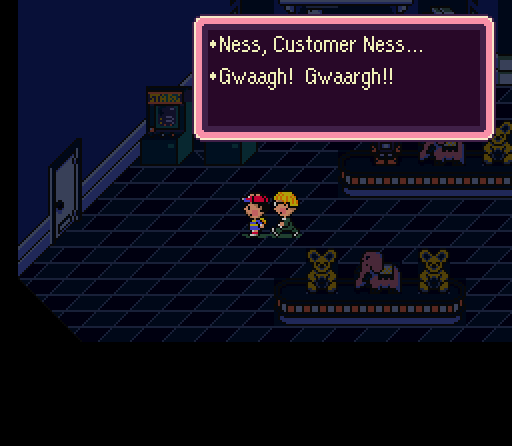
You must go to the dept. store, where Paula will be kidnapped & you’ll have to fight through possessed records & cups o’ scalding hot coffee. These are some o’ the most dangerous enemies in the game.
-
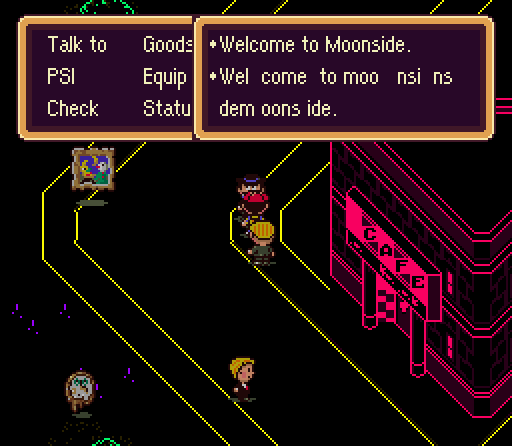
You must go to a cafe, where you will find a way into a neon bizzaro version o’ Fourside called “Moonside,” where “yes” is “no” & “no” is “yes” & you have to fight possessed fire hydrants & melted clocks, & then ’ventually an Evil Mani Mani statue. This is the best part o’ the game—or any RPG e’er.
-
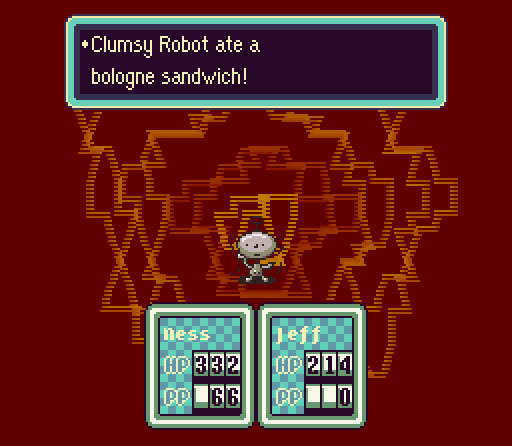
You must explore monkey caves to get a trout yogurt dispenser so you can get inside the Monotoli Building. When you defeat his Clumsy Robot who pretends to heal itself with bologna sandwiches by having that jazz band from before randomly come in & defeat it @ the last second, Monotoli will allow you to use his helicopter, only for it to be flown ’way by your next-door neighbor, despite him being a preteen @ oldest.
-
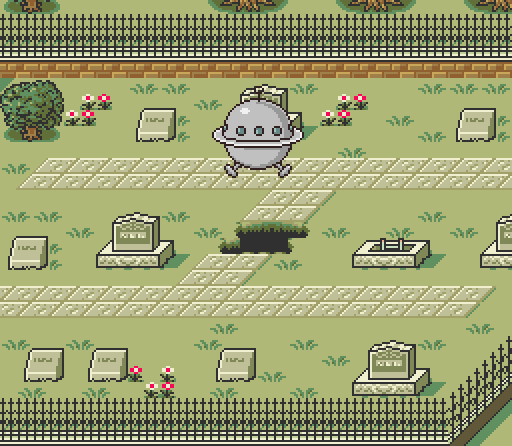
In order to fly to Summers, you must fix the UFO Jeff crashed into your dungeon prison. This is actually the most logical part so far.
& that’s only half the game.
Actually, though I made fun o’ the obsession with the New Age Retro Hippie, I do think the strange enemies are some o’ the best part o’ the game, ’specially their verbose names. I’d recommend looking through a list with pictures.
In truth, what made EarthBound so great—& why I’m so leery ’bout all the ripoffs—is its originality, a quality that’s being sapped year after year, so that I’m not surprised it’s not that amazing anymo’. Not only that, but the sheer ’mount it had.
See, we have this tendency to try compacting great works o’ art into pithy sentences, not only ’cause it’s necessary to describe a work in a way shorter than the work itself to convince someone to undertake the work @ all, but also ’cause it just seems natural in our marketing-saturated world where e’en ordinary people nowadays seem to be talking mo’ & mo’ in “catchy” slogans than natural, honest language (read the average online review on places like GameFAQs or Amazon for examples o’ the former).
The problem is, I think we’ve gotten it backward: the best works o’ art can’t be described with those pithy “elevator speeches” ’cause they’re just full o’ so much content.
A common example would be Shakespeare. Try ’splaining Shakespeare’s quality through pithy descriptions; it’ll inevitably sound lame. It’ll most likely focus on the bare plot, despite Shakespeare’s plots all being trite (e’en for his time) & oft wholesale plagiarized. ’Less one goes line-by-line, looking @ all the ways he meter, rhyme, alliteration, theme, & wordplay, one will only get a shell o’ the quality.
The same applies to EarthBound. The hippie enemy is only ’bout .1% o’ what makes this game interesting: there’s dozens o’ other enemies just as interesting in their own ways, dozens o’ lines, dozens o’ interesting areas & plot points (& that list I typed earlier is, true to point, only a hollow shell o’ what’s actually contained in the game through those parts).
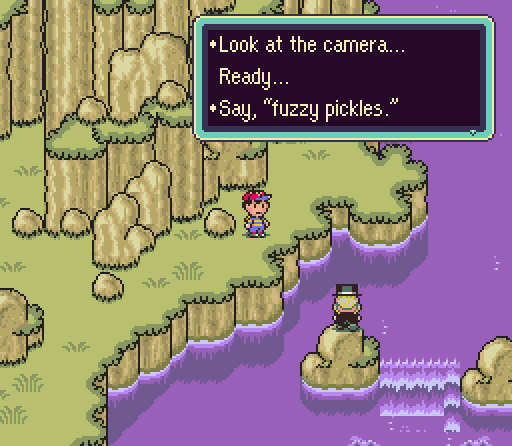
But if one were to have to sum-up EarthBound’s point o’ success, it’d not be some insignificant detail, like the hippie enemy or the fact that you have to call your mother when your character randomly gets the status afflictions “homesick,” or the fact that some random photographer pops in to take your picture while asking you to say, “Fuzzy Pickles,” or the fact that you can play it with 1 hand while eating pizza with the other, but how the game differs from other games & how this, ’bove all else, affects the player.
I actually came up with a clunky metaphor for this game’s impact, comparing it to the history o’ English poetry:
One could think o’ games like Final Fantasy & Dragon Quest as like the Shakespeares or Romantic poetry o’ RPGs, in glorious iambic pentameter. This is what people think o’ when they think o’ great epic poetry.
The Pokémon games can best be compared to Robert Frost, a mo’ mainstream poet. He’s probably the most well-known poet ’mong Americans a’least (all right: let’s limit this to the history o’ poetry in the US, since I’m clearly already way o’er my head). Walt Whitman could perhaps be ’nother comparison. It’s also a great comparison, since there are plenty o’ Americans who like Frost & Whitman, but don’t hardly know anything ’bout any other poetry, much as there are plenty o’ Pokémon fans who hardly play any other RPGs.
¿So what is EarthBound? EarthBound is the T. S. Eliot or e. e. cummings o’ RPGs—the modernism.
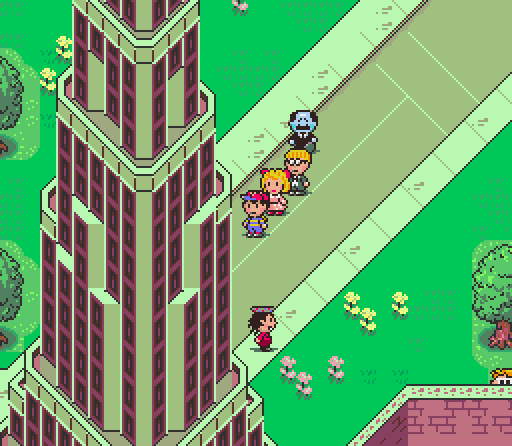
Though most would probably agree mo’ with the cummings comparison, since that’s probably the 1 out o’ the 2 that most know—& what they know ’bout him is his strange syntax—I would actually emphasize T. S. Eliot in impact.
@ the time, T. S.’s early poems (most who care think his later poems, like those in The Four Quartets, were rather mediocre), like “The Love Song o’ J. Alfred Prufrock,” were considered revolutionary. This was just after a time known as sort o’ a dark age in English poetry, when ’twas mostly reams o’ people regurgitating trite poetry, all in the same hokey iambic pentameter pattern that’d been used for centuries & almost all focusing on o’erwrought effusions ’bout nature, & patriotic pride, & other banally wholesome dreck.
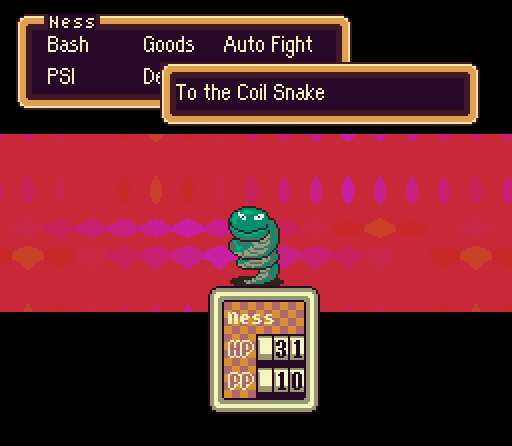
Then you have this poem that is neither iambic pentameter, nor the customary 8, 12, or 16 lines, nor has end rhymes. Then you have this poem talking ’bout grungy city streets—streets that “follow like a tedious argument”—with yellow fog & smoke that rub backs & muzzles into window panes, a yellow smoke that “[l]icked its tongue into the corners of the evening”—both o’ which I could imagine as EarthBound enemies. Here we have a poem that meshed apocalyptic thoughts o’ time & eldrtich imagery with tedious domestic get-togethers focusing on spoons, dresses, & cakes.
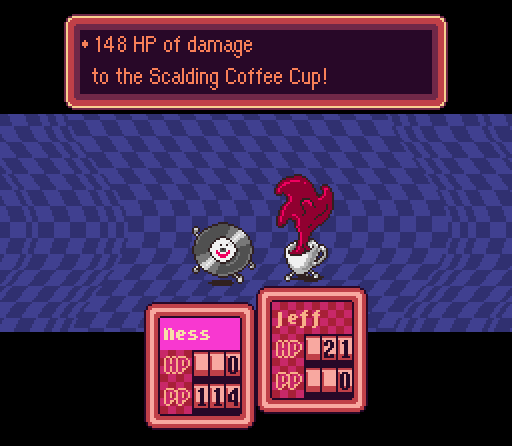
EarthBound has this effect. Nothing ’bout it fits with the RPGs o’ its time—from it’s checkerboarded menus, to its psychedelic neon backgrounds, to its equally psychedelic music, to its urban scenery, to its enemies that ranged from possessed bag ladies to possessed stop signs, to its use o’ pastels & high contrast o’ bright purples & blacks.
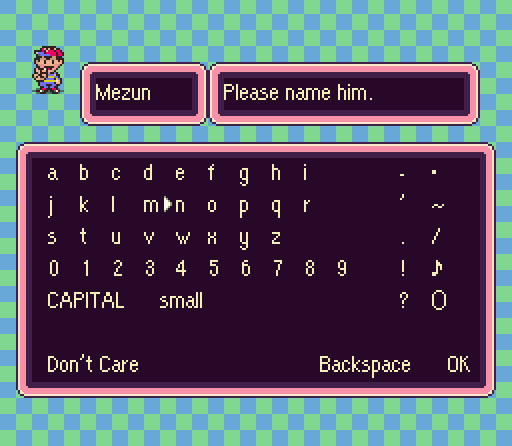
My favorite example is the naming screen. Perhaps that’s ’cause it’s the 1st time you actually play the game. Perhaps it’s ’cause o’ the music. While the title screen’s music was different from most RPGs, its apocalyptic, sci-fi flavor wasn’t that out there—I could imagine a Phantasy Star game having it. But the name selection music is unquestionably unmatched—it’s probably the most unique ’mong the whole game’s soundtrack. Here we have a song with samples from the theme song o’ Monty Python’s Flying Circus in the background, ’long odd beeps & boops that sound halfway ’tween sci-fi & horror. The instruments in general used are strange—oft in just how simple & toned-down they are. The childlike sound o’ a lot o’ the drums, is a particular example. ’Stead o’ the epic symphony you’d expect in a Final Fantasy or Dragon’s Quest, here you have a li’l kid playing a toy piano while TV noise plays in the background—& here you have “Let us go then, you and I, / When the evening is spread out against the sky…” o’ RPGs.
Indeed, EarthBound almost felt somewhat subversive in its not taking itself seriously, but still putting itself up on the shelves next to stuffy-ol’ Final Fantasy, Dragon Quest, & Chrono Trigger.
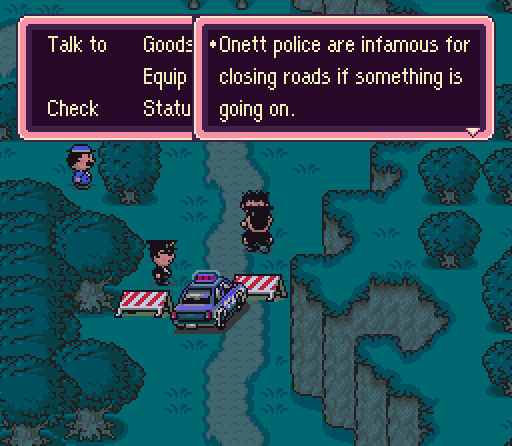
Actually, EarthBound could be subversive in general, now that I think ’bout it. ’Twas full o’ satire, largely aimed @ upper-class people: from corrupt policemen who do nothing but block pathways & try beating up children, to mayors who rely on children to do his work cleaning up the streets, to heartless rich people whose neglect & mistreatment o’ their children lead 1 o’ them to become a complete monster.
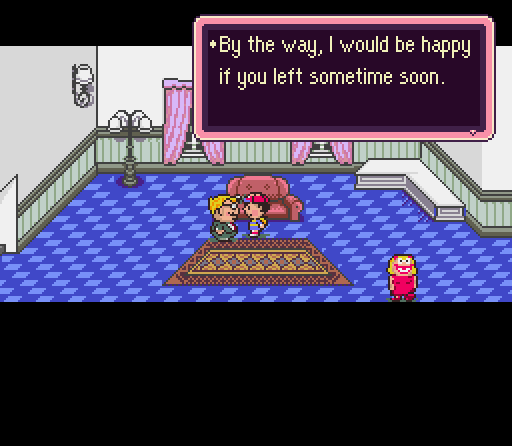
It actually reminds me o’ Kafka in the way it can mix some quite harsh black comedy with an otherwise light world. Much as Kafka’s work is full o’ innocent protagonists who are cruelly treated by the world, the heroes o’ this game, despite being unassumingly nice, can be told quite harsh things by a lot o’ the grown-ass adults throughout the game, oft in absurdly nonchalance ways. Probably the best example is the aforementioned rich bad parent, Aloysius Minch, who, after having his children returned to him by you, tells you, incidentally, that he wished your family would move ’way, since your loser poor father borrowed “maybe a hundred thousand dollars” (well, maybe not that much…) & he was sick o’ your family lowering the value o’ his property. That he would discuss such a decision with a child who obviously has no input makes it e’en mo’ absurd. But a’least Ness ne’er loses that smile o’ his.
Then ’gain, in general the EarthBound series as a whole seems to have this theme o’ friendly-seeming worlds with ugly undercurrents.
Music Recommendations:
(Note: You can download the entire soundtrack from Starmen.net,—as well as SNESMusic.org in lossless SPC format—which are probably higher quality than the YouTube videos I link to.)
¿Do I truly need to recommend music for this game? Everyone knows this game’s music is amazing—I’d say 2nd only to Super Mario RPG’s.
Well, yes, but that doesn’t mean we all agree on what music from this game is the best. I’m going to point out some o’ the unfairly underrated songs, as opposed to songs like “Pokey Means Business,” which everyone’s already heard praise for a million times.
Your Name, Please: Yes, this is the “Let us go then, you and I” song I mentioned earlier, & I’m listing it ’gain, ’cause it’s just that good & includes all o’ the best elements o’ what made EarthBound music so good & memorable: its strange instruments & stranger samples.
The Cliff that Time Forgot: Everyone loves to talk ’bout how pants-wettingly frightening the Giygas battle themes or “Cave of the Past” are, but I always found this song mo’ eerie. Those songs are a bit too conventionally creepy, as if they’re trying too hard. This song’s creepy in just how weird & loud it is.
Threed, Zombie Central: It’s spooky Halloween music. Anything halloween is good in my webpage.
Apple Kid: I actually associate this song mo’ with the Onett police than Apple Kid, & it’s whilst encountering their lair that you 1st hear it. To me, this is like the anthem to the kind o’ strange citizens that inhabit EarthBound’s world. & damn is this just a bizarre, but quite low-key, song. It’s so low-key that I think, while most players certainly react to its eerie strangeness in-game, they hardly remember it as a song that one can listen to independently @ all, but mo’ as a piece o’ the atmosphere that blends in too well.
Zombie Paper: This is the lovechild o’ “Apple Kid” & “Threed, Zombie Central.”
Paula’s Theme: ’Gain, people like to mention Giygas’s music & “The Cave of the Past” as being the scariest songs, but I find this song not only creepier… it has quite a melancholic creepiness to it. It’s the perfect music for the scene in which a plays: a scene in which you have to save Paula, who is @ risk o’ being killed by the aforementioned blue-obsessed KKK wannabes. It’s perfect for representing a horror @ a possible sad outcome. If anything, its sadness, mixed with the bizarre horror that is mo’ @ home with EarthBound, makes it sound mo’ like a Mother 3 song (mo’ on that later).
’Course, I should note that this is actually a remix o’ an EarthBound Beginnings song, “Youngtown,” which is e’en mo’ melancholic, but not nearly as creepy, & in my opinion, not nearly as good.
Happy Happy Is Blue Blue: Speaking o’ the Happy-Happy gang, holy shit is this music weird as shit—1000 times mo’ than the songs I already mentioned.
Winters White: All right, I’ll say it: I prefer this song to “Snowman.” It seems to have a better balance o’ jolly & melancholic, which goes well with where it’s used, a time when Jeff most has a reason to feel mixed ’tween being somewhat sad ’bout leaving his ol’ life ’hind & somewhat optimistic ’bout what he’s embarking on.
Spooky: ¿What the hell was this song e’en used for? I think ’twas used after talking to eerie people, if I remember.
Moonside Swing: ’Cause it’s Moonside, & as I said, that’s the greatest scene in any RPG e’er. Literally the only flaw with that place is that you spend far too li’l time there.
Pokey: What I love ’bout this song is how it already clues you in that Pokey’s a villain. No heroic character—or e’en a neutral character—would have such a creepy song. Its clownish, meandering sinisterness perfectly matches Pokey’s insincere villainy.
Dangerous Caves: Such atmosphere…
Peaceful Rest Valley: I debated adding this, since I questioned if it’s truly that underrated. Then ’gain, I’m not sure if “Threed, Zombie Central” is, either.
It’s a rather grim song, ’specially with the booming beginning, despite also being rather soft in its instruments. It fits the area well: while “Peaceful Rest Valley” has a soothing name, & looks soothing, with its pastel colors, when you 1st enter it it’s rather dangerous. It’s where you 1st run into the infamous exploding trees, for instance, as well as Li’l UFOs that constantly give you colds (this game’s equivalent to poison) & Mobile Sprouts that can sap your PP.
Super Dry Dance: EarthBound was so clever that it found a way to turn a desert area—what are usually to me the most boring areas o’ video games—into something fresh by adding an urban spin to it. For a highway stretching ’cross a desert, ¿what better music to accompany it than far’way radio music & noises meshed with the swoosh o’ sandstorms?
This was also a remix o’ a song from Beginnings, & like “Paula’s Theme,” was better in this game. The radio sound is what makes this song, & that’s sadly lacking from the NES version.
&, ’course, there’s the many battle themes, which are probably not nearly as underrated, but fuck it, they’re so good I’m listing them, anyway:
& the absolute best for last…
Someone’s Knocking at the Door: EarthBound wins the award for most authentic door-knocking sound o’ any video game.
II. EarthBound Beginnings
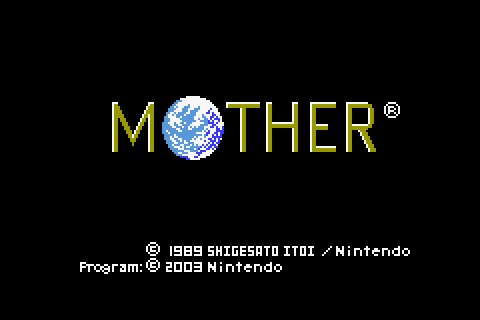
After such lavish praise, now it’s time to shit on EarthBound’s parent.
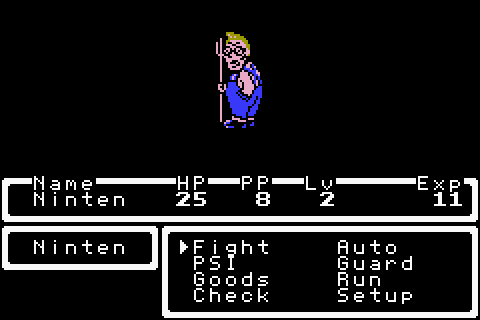
All the things I praised ’bout EarthBound are missing in Beginnings. While EarthBound is full o’ character, color, & imagination, Beginnings is depressingly empty, dull, & boring—e’en compared to other NES RPGs o’ its time.
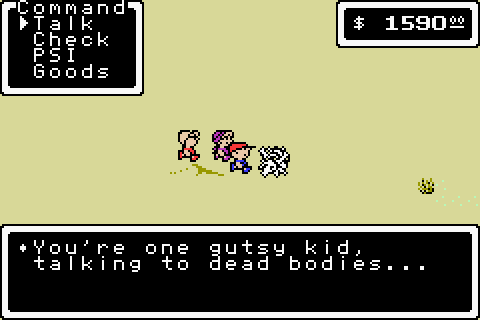
’Stead o’ psychedelic light shows ’hind enemy battles, you get the same flat black void in Dragon Quest. The bright contrasts o’ neon purples & cool blacks are replaced by mostly whites & washed out primaries. While EarthBound had a cartoonish look, it still had texture & detail; Beginnings is full o’ flat colors—mostly white or almost-white peach—that make it look as if its graphics were unfinished. E’en the 1st Final Fantasy & Dragon Quest games had mo’ texture & color—& they came out a’least 3 years before Beginnings, which was a late NES game. For god’s sake, this came out after Mega Man 2. Just compare the 2. & just compare it to Final Fantasy 1 & Dragon Quest 1:
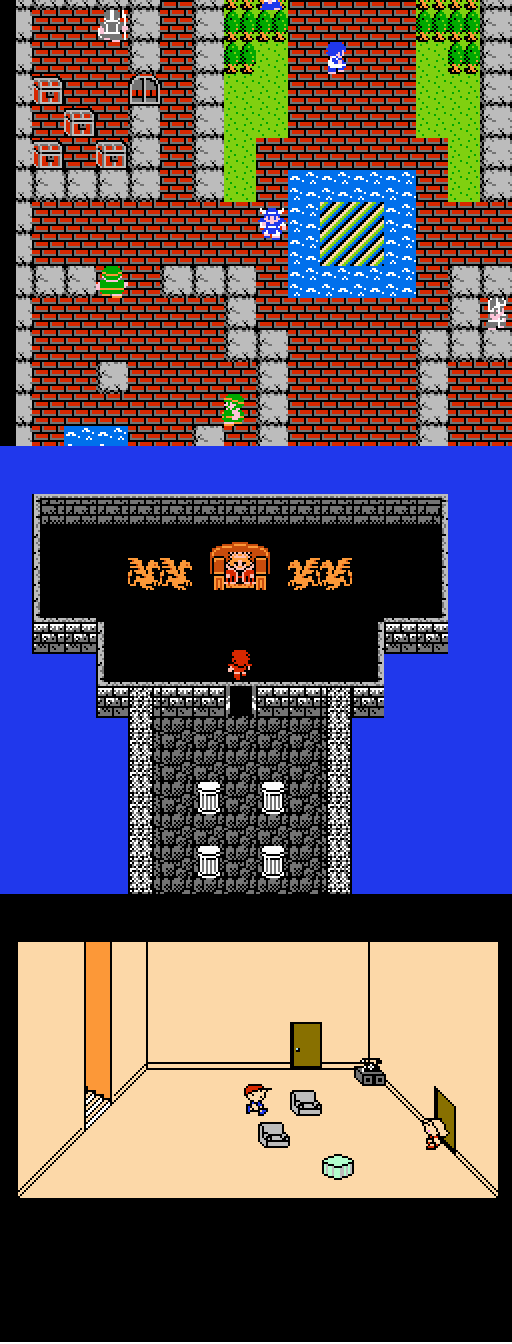
EarthBound Beginnings is 1 o’ the ugliest NES games there are. Only its enemy graphics are good—& they’re only just as good as Final Fantasy 1’s & Dragon Quest 1’s.
I guess, to be fair, there is kind o’ a neat effect they pull to add variety to monsters by laying sprites o’er their graphics to make them look different in mo’ ways than just being a different palette. For instance, while most dog enemies have naked necks, Stray Dog has a collar on its neck. But this isn’t much; & it’s certainly not impressive for 1990 NES technology.
It also has none o’ the psychedelic music, & far less o’ a variety, too. 1 thing I forgot to praise EarthBound for was the fact that it had mo’ than 1 song for regular enemy battles, which varied depending on the type o’ enemy you fought. Beginnings only has 4, 1 o’ which is also used for almost every boss, 1 o’ which is just a repetitive tone used for the final boss, & 1 o’ which is only used by a few rare enemies. A lot more o’ this music is the happy, poppy jingles that wouldn’t sound that out-there in other NES games.
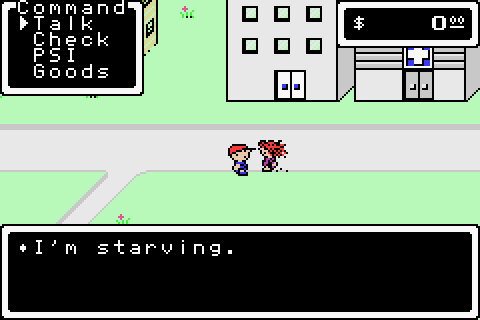
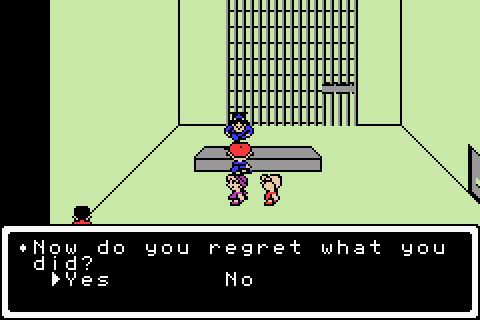
Dialogue is far pared down, & a lot less funny or interesting—it sounds like trite RPG writing, which was what EarthBound was so good @ avoiding. Same goes for plot. The only parts I remember was 1 short scene where you explore a graveyard with Pippi Longstockings—who is tragically replaced by some o’ the worst characters in RPGs—& a scene where you get put in jail for going into an adult club & have your weapons confiscated (you can also heal your HP through the jail bed). These are the only proto-EarthBound scenes you get. Most o’ the time is spent traveling through eye-searingly bland grasslands, as well as a bland desert & god-awful factory maze trying to figure out what you’re s’posed to do, ’cause there’s li’l indication.
Nothing that happens in this game’s plot makes sense, which I mentioned applied to EarthBound, too; but e’en then, that game was better @ a’least telling you that you need to fight the police to leave Onett, get trout yogurt to get into the Montolli building, & so on. This game expects you to guess that you’re s’posed to look for a tiny cactus ’mong thousands that happens to have a face or where to find Canary Village, where 1 o’ the melodies needed to beat the game is. While EarthBound scattered its 8 steps rather evenly ’long the trail o’ the game, Beginnings puts them in random places, & has them put in jarringly unbalanced places: 3 o’ them you get right near the start & the last 2 you can’t get till near the very end. Much o’ the game’s elements don’t get much breadth: you’d think you’re s’posed to save the parents o’ Youngtown/Easter, but that’s not till beating the game. Within the game itself, it’s just a place to cross, & maybe learn Teleport by mind-reading a random baby.
Moreo’er, while EarthBound’s random plot elements were amusing or just cool to experience, Beginning’s are just boring. While that game has fighting the police & going to Moonside, this has exploring the most boring & bland factory just to blow up a rock in the way o’ a train station & wandering a desert & swamp that both feel unfinished.
People oft brag ’bout how this game had a larger map than EarthBound; well, it doesn’t use hardly any o’ it—it’s mostly all filler. It’s shocking how much o’ it isn’t used for anything other than red-herring space that leads to dead ends. Anyone who compared the 2 maps would see that while Beginnings’s was bigger in size, EarthBound’s—& Dragon Quest’s, for that matter—was far bigger in content. ¿Why brag ’bout the fact that I have to spend mo’ time wandering aimlessly through the same green cliffs & trees ’stead o’ doing actually interesting things?
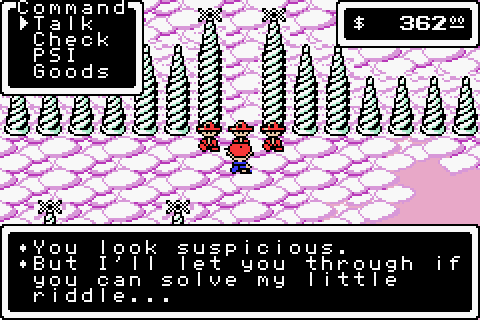
I guess the Magicant was kind o’ interesting, both in its design, its look, & the enemies it had nearby. But, damn, did it have god awful music—& by “music,” I mean a cacophony o’ beeps & boops that sometimes steadied their drunken asses ’nough for a second or so to resemble a melody.
This all sounds frivilous so far, so let’s talk ’bout the meat o’ the game, the gameplay. While Beginnings’s graphics are mediocre & its writing OK, its gameplay is wretched. I mentioned that EarthBound wasn’t particularly good in gameplay & mechanics, but ’twas tolerable ’nough. ’Twas just meh.
But Beginnings is terrible—& no, that ’twas ol’ doesn’t change that. ’Gain, Final Fantasy 1 & Dragon Quest 1 are still fun today. Good NES games weren’t good “@ the time”; They’re still good or they ne’er were good. Honestly, e’en if Beginnings were the only video game @ the time, I’m sure if I were a kid then I would’ve preferred to play board games or read books.
I want to emphasize my comparison to Final Fantasy 1 & Dragon Quest 1 ’gain ’cause a common defense I hear is that you have to appreciate “ol’ school” RPGs to like EarthBound Beginnings. ’Cept Beginnings is nothing like ol’ school RPGs; it’s an utter pathetic joke compared to ol’ school RPGs. If anything, it’s focus on story (despite having li’l story) o’er gameplay makes it mo’ like modern RPGs, ’cept without the qualities that make modern RPGs bearable—which was why most waited till modern times to make them. It’s like trying to make a Where’s Waldo game for the NES—it’s guaranteed to suck. Nobody can succeed @ that.
What made Final Fantasy & Dragon Quest fun was customization. ’Twas fun fiddling with your characters’ stats & classes. It made the grinding they forced you to do to hide how small the games were less tedious. Beginnings has none o’ this. Grinding in that game is mindless, since you have no control o’er your characters @ all.
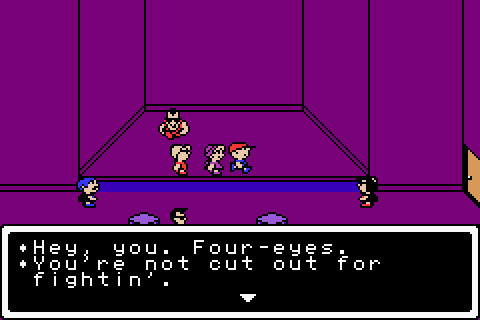
But e’en then, Beginnings was badly balanced. I complained ’bout Ness in EarthBound being the only truly good character in that game, but a’least the other characters were decent ’nough; in this game, other than Pippi Longstocks & Teddy, both o’ whom are temporary, all the other characters are garbage. Loid is useless & has a dumbass misspelled name & it’s a true tragedy when he flies in to return to your party on Mt. Itoi. Ana is infuriating in how useful she would be if she weren’t useful. She’s the healing character, & the only 1 who learns how to revive other party members through magic. Too bad she’s always the 1st to die ’cause she has shit for defense & HP. To be fair, a lot o’ RPGs did this, having the healer, who should be defensive, have shitty defense & HP while the attacker has everything. This is why the best part in Final Fantasy is 3 Fighters & a Red Mage. & it still pisses me off ’cause it’s so dumb. The only games that got it right were the Pokémon games.
Beginnings also had an obnoxiously common random encounter rate, that made the huge maps only mo’ annoying. EarthBound doesn’t have random encounters—as no RPG should, since they’re the worst thing in video games—but enemies on the map, with actual skill involved in whether you fight them or not or whether you get an advantage or disadvantage.
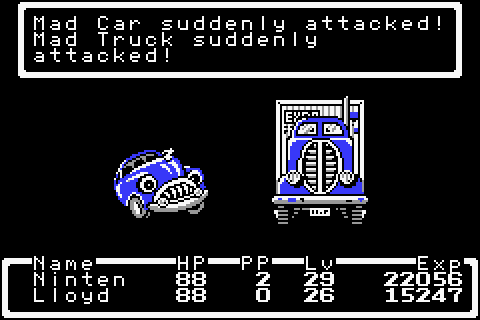
I want to point out, too, that I played this all the way to the end. These opinions are not hastily-drawn from an hour’s worth o’ gameplay, but after struggling all the way to Mt. Itoi & enjoying almost none o’ it. Other than the few minutes o’ chuckling @ the aforementioned jail scene, the only part I remember having a li’l fun was fighting the car enemies in some area I don’t e’en remember anymo’. & e’en that only lasted a few mo’ minutes.
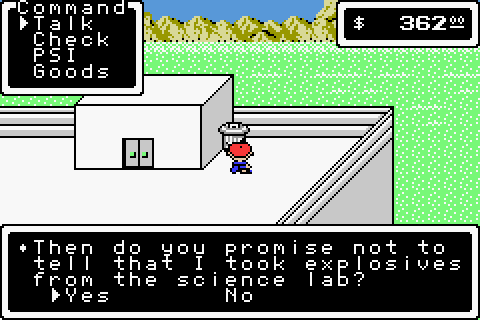
¿Are there good parts ’bout EarthBound Beginnings? Yeah. I feel like some o’ the story ’hind Beginnings was mildly interesting, though there isn’t much o’ it in the game. While the desert & haunted house in Spookane/Halloween were just empty padding, there was something to the tale o’ the Youngtown/Easter kids’ parents’ being captured by UFOs, e’en if it doesn’t play a significant part in the actually plotline o’ the game, & Lloyd’s background as a bullied kid with a fascination for explosions. None o’ it gets much breadth, though.
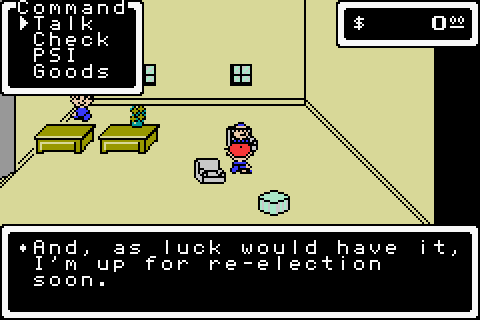
There’s e’en some mildly interesting or funny dialogue mixed in the general flood o’ bland exposition, mechanics explanations, & boring background info for characters nobody cares ’bout. There’s the mayor in Podunk who acts somewhat like the corrupt mayor in EarthBound’s Onett, asking a kid to do his work & caring mo’ ’bout his re-election than Pippi’s safety. There’s e’en a funny twist on the “¡But Thou Must!” trope wherein ’stead o’ constantly bugging you till you say yes, he just assumes you said yes regardless o’ what you answer. It doesn’t have the clever diction or style that EarthBound has, but it’s something. Also, while questionable as a gameplay element, punishing you for doing what you’re usually s’posed to do, the fact that you can sometimes catch a cold (this game’s version o’ poison) from other people is rather amusing.
I think reading a mo’ fleshed-out story as a novella—a novel would probably be too long—would be better than playing this as a game.
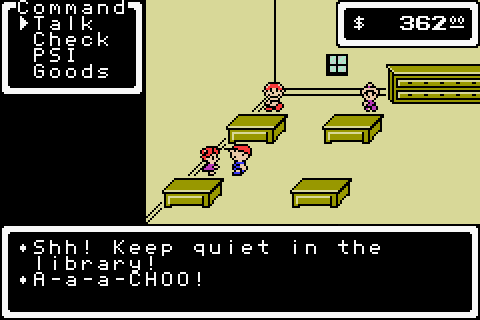
Beginnings also did have some good music, e’en if not as diverse or out-there as EarthBound’s. In fact, a few o’ the songs in this game that were later remade for that game, such as the hippie song & “Snowman,” are better in the original. Mt. Itoi’s music is amazing, & it’s a crime it wasn’t remixed in a later game. It’s easily the best song in the game. It fits the danger o’ that area.
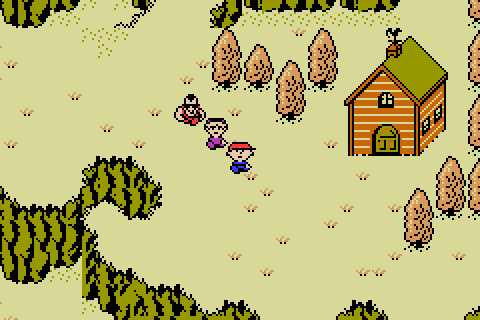
Actually, as ass-backward as this may seem, I rather liked Mt. Itoi—a’least till I got sick o’ it. Yeah, it’s ridiculously hard; but a’least it’s @ the end. I feel like if the rest o’ the game were less annoying & your players were mo’ bearable to use, a hard final area would be a fun challenge. It works in other RPGs.
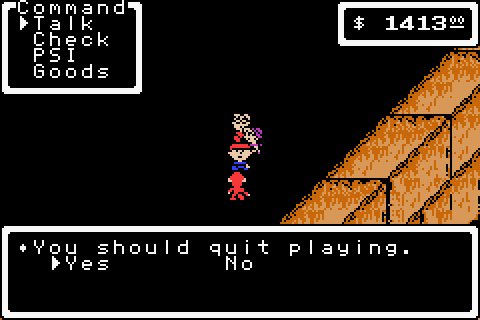
In fact, the challenge has nothing to do with this game’s problems. I know that ’cause I tried Mato’s Baby Ring in the fan translation he made for the GBA remake. It didn’t make the game much mo’ fun; the fact that I raced through the game only emphasized how empty ’twas in actual content, though it did, admittedly, make getting through the content much easier (which is why these screenshots are from the GBA version, ’cause fuck playing through this game ’gain on the NES version). When your game is nothing but empty grinding, getting rid o’ the grinding doesn’t make it better; adding actual content does.
That said, if one did want to get the content, I do recommend using the Easy Ring, as well as save states, a walkthrough, & an emulator with a turbo function (’cause good lord is this game unbearably slow naturally). They make the game so much o’ a joke that you’re hardly playing it—but that’s the point. None o’ the gameplay is good; only the dialogue & music. Plus save states can make some o’ the bullshit parts funny, like the aforementioned townspeople who give you colds or saying “no” too many times to Teddy when he asks to join causing your father to call you from outer space & warp you back to your home… for some reason. There’s no explanation @ all.
Music Recommendations:
(’Gain, you can download the whole soundtrack in MP3 format @ Starmen.net, as well as in lossless NSF format.)
Mt. Itoi: In addition to perfectly fitting the direness o’ the area in which it’s located, it’s also 1 o’ the most EarthBoundesque o’ songs on the NES.
Approaching Mt. Itoi: ’Nother EarthBoundesque song. The best way to describe it is “almost as good as Mt. Itoi, but not truly.”
Battle with a Dangerous Foe: Not as good as “Sanctuary Guardian” from EarthBound, but still fitting music for bosses &, well, dangerous foes.
Battle with a Flippant Foe: The main battle theme is quite catchy, too, though not nearly as good as any o’ the EarthBound battle themes.
Factory: This song’s also in EarthBound, but that game had ’nough music recommendations already. The NES version o’ this song gets props for not feeling pared down @ all compared to the newer version, despite being on the NES, which is impressive. For as disappointing, e’en for NES games, as Beginnings’s graphics were, its music was impressive for the NES.
Youngtown: I mentioned finding “Paula’s Theme” better, but this version is still quite creepy & depressing in its own right.
There’s also some spooky music:
III. Mother 3
According to Mato, Japanese players were apparently so let down by this game that they preferred Beginnings to it. Then ’gain, I’ve also heard claims that Japanese players preferred Final Fantasy IV to VI, so maybe it’s just that the ones with bad taste are the most outspoken. For Mother 3 it could also just be that the western fans who don’t like the game can mo’ easily ignore it—that it’s not so much that westerners prefer the game so much as that the only people who actually talk ’bout it are people who actually like it.
Certainly Mother 3 is no 2nd EarthBound; but then, it’s impossible to make ’nother EarthBound, & as I complained ’bout throughout its review, people should stop trying, as it only waters down what made EarthBound so radical in the 1st place, & waters down the attempted copy e’en worse. That Mother 3 wasn’t an attempt to recreate its parent is a testament to its developers practical wisdom.
If anything’s a letdown, it’s probably Mother 3’s music. Though it’s mo’ ambitious than EarthBound, having far mo’ songs, it’s music is a lot less out-there; it sounds much mo’ like typical RPG music, & is just much less memorable. There’s certainly no song in Mother 3 that rivals “Your Name, Please” or “The Cliff that Time Forgot.” If anything, like I said in that game’s music review, I think Wario Land 4 had music mo’ resonant to EarthBound than Mother 3 (& thus better music), ’specially the bizarre “music” they had in the so-called sound test. Then ’gain, Wario Land 4 was also a mo’ surreal, kooky game, like EarthBound, whereas Mother 3 is a li’l mo’ serious. Admittedly, EarthBound’s weirder music probably wouldn’t fit in with this game.
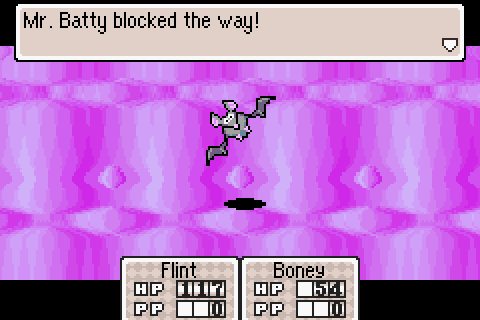
That said, Mother 3’s music certainly wasn’t bad. While quite a bit o’ it was rather forgettable epic adventure music, they still found ways to be diverse & interesting. “Mr. Batty Twist” (which, sadly, is only used for 1 enemy that disappears after the 1st chapter) is somewhat o’ a return to the spacey kookiness o’ EarthBound’s battle music, somewhat reminiscent o’ “Battle Against a Weak Enemy.” Master Porky’s Theme’s warped horror, melancholy, & danger perfectly fits the final boss battle. I do think Natural Killer Cyborg was trying a bit too hard to be the next “Pokey Means Business,” though. Perfectly good song, still.
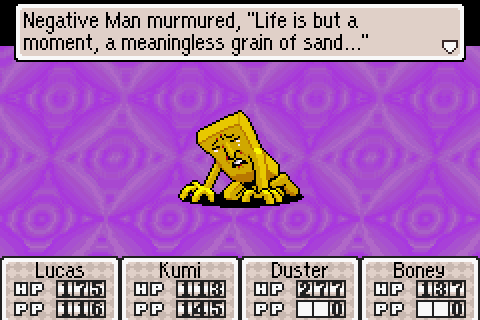
& in general, one could say that Mother 3 is less radical than EarthBound. For most o’ the game, a’least, it leaves the boisterous cities & neon lights for typical forests & small villages. The enemies, too, are mo’ naturalistic, though this game does have some weird, memorable enemies—’specially as the game goes on. A bestiary with possessed bathroom signs, living dictator statues, Rock Lobsters, & some unique creature that looks like a french fry & is suicidally depressed can’t be too bad.
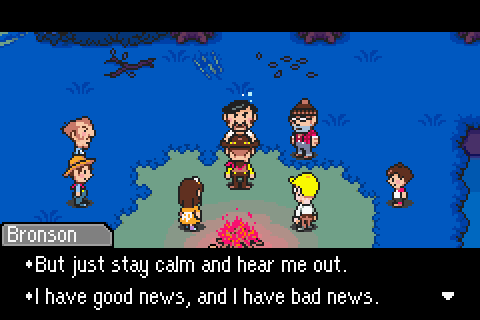
Mother 3 also starts rather slowly. For the 1st 3 chapters you’re jerked round different characters without much time to learn ’bout them, a flaw shared by Final Fantasy IV. Japanese critics who complained ’bout the tragedies after tragedies have something o’ a point: Hinawa’s death on the 1st chapter comes much too soon to truly care, since you hardly know any o’ these characters; & Salsa’s story in chapter 3 is basically nothing but nonstop misery, with hardly anything else to define him. Defining characters purely by their tragedies is a typical literary error.
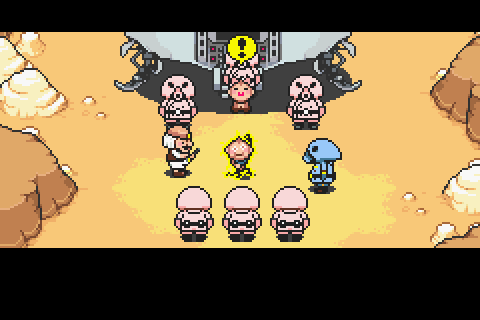
Then ’gain, maybe both critics & fans are taking the so-called serious parts o’ this game too seriously. I’m going to admit that I didn’t react nearly as emotionally to many o’ the scenes as many other people. For instance, I took Salsa’s story to be a bit more o’ black comedy than tragedy. Hinawa’s death literally has a silly joke included in it. Hell, to be honest, that drug trip scene in Tanetane Island that s’posedly the writer cried through as he wrote it, I thought ’twas s’posed to be funny. I mean, having a mailbox open & release a bunch o’ letters full o’ excess nothing is like a punchline straight out o’ Liō.
I mean, c’mon, ¿am I truly s’posed to take the following as “too much tragedy”:
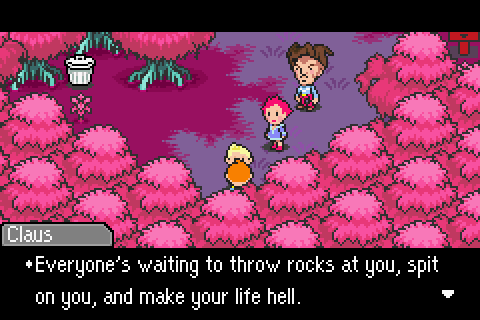
Everyone’s here, Lucas. Everyone’s waiting to spit on you, throw rocks at you, and make your life hell. Who’s “Everyone”? … Everyone you love.
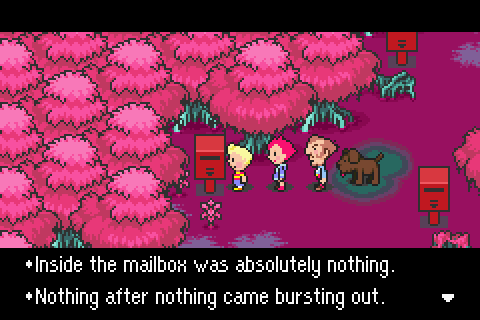
Inside the mailbox was absolutely nothing.
Nothing after nothing came bursting out.
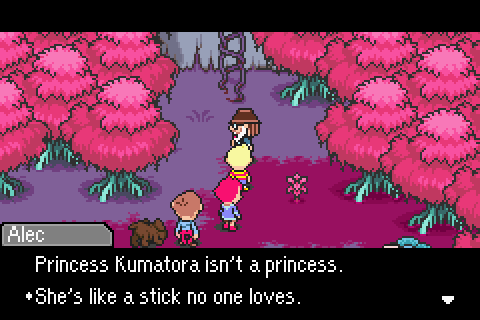
Princess Kumatora isn’t a princess. She’s like a stick no one loves.
That sounds like stuff I’d write for 1 o’ my silly poems.
Then ’gain, maybe the Japanese fans had a lesser taste for bathos black comedy.
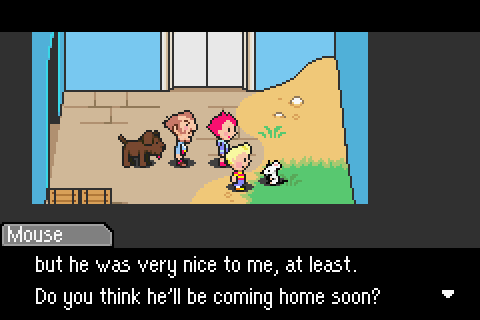
Some o’ the other o’erwrought elements could be taken to be rather humorous, too, such as the clumsy way the game tries to make you feel sorry for Fassad near the end by just placing a random mouse there, who tells you how nice Fassad was to him. It’s such a hokey bad-writing trope, but done in such a goofy way—¿why pick a random, nameless mouse?—that it can only be funny, as if the game itself is riffing on the trope.
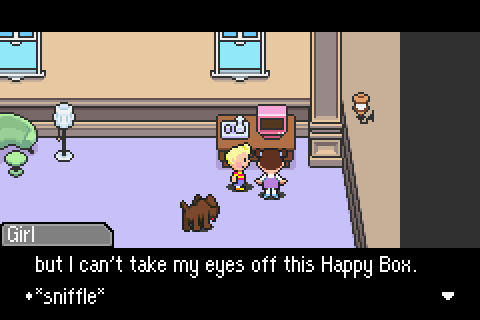
One could say that Mother 3 was a bit too preachy. I mentioned that EarthBound satired powerful classes quite a bit, but ’twas mostly just out o’ anarchic mockery rather than any attempt to teach you morals (which matched its rather anarchic world). Granted, I disagree with TV Trope’s claim that Mother 3’s morals are hammered into your head (I also disagree with their o’eruse o’ emphasis, as if they’re gossipy preteens). The fact that they don’t e’en specify themselves what these “messages” are adds to that.
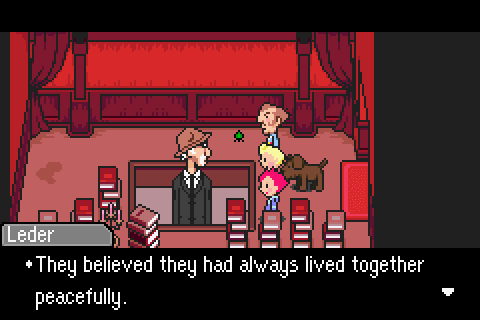
If anything, Itoi was most unsubtle in ways that are so obvious & clearly meant for character demonstration mo’ than morals, such as Fassad’s abuse o’ Salsa clearly meant as a way to show that Fassad is bad. As for the troubles o’ technology & urban flight, that’s left to be mo’ ambiguous. For instance, in Leder’s final speech in the game, he seems to criticize the townspeople for letting themselves become too innocent ’bout modernization, which made them fall victim to the unfamiliar technology ’gain. This makes sense, since having a video game made by a guy who spends much o’ his time blogging with people arguing that technology is evil ’cause it does nothing but break people apart would be the ultimate in hypocrisy. If anything, one could argue that the real problem o’ the game was that the townsfolk just didn’t think ’bout how they were using the technology, just staring blankly @ flashing screens.
Indeed, just look @ all the handwringing that goes on ’mong Starmen.net posters trying to understand this game’s moral. Most o’ the conclusions they derive are meaningless tripe like “it’s about life,” man, & “it’s the human condition.” What “human condition” is s’posed to e’en mean, I’m not sure. But it’s clear that most Mother 3 players online weren’t bashed hard ’nough on the head with Itoi’s “anvils.”
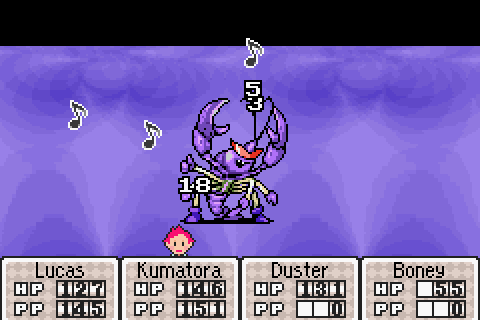
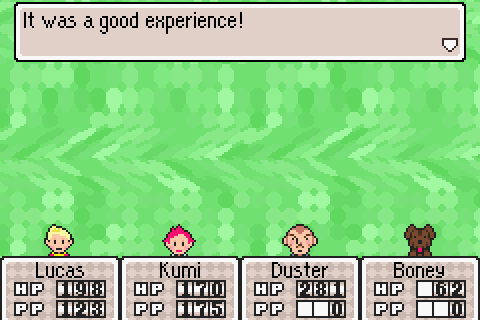
In terms o’ gameplay, though, Mother 3 is unquestionably better than EarthBound. It gets rid o’ the clunky Dragon-Quest option box that pops up when you press A & just has you interact directly with objects & people, like modern RPG; moving items into storage doesn’t require waiting for some guy to slowly drive o’er to you just to pick up only 3 items; they added a rhythm-based timed hits mechanic to battles to make them a li’l less vanilla. Best o’ all, the character balance is much better: Boney’s still pretty lame, but Duster can hit rather well, & Kumatora with her improved magic & attacks o’er Paula is competitive with Lucas, as opposed to EarthBound, where Ness was pretty much the only truly good character. The difficulty balance is also better for the most part, save for 1 following example. Contrast this with EarthBound, which actually seemed to start rather difficult (a’least once you reach Onett) & became a piewalk once you passed Fourside, with the sole exception o’ the Magicant & maybe the Fire Spring.
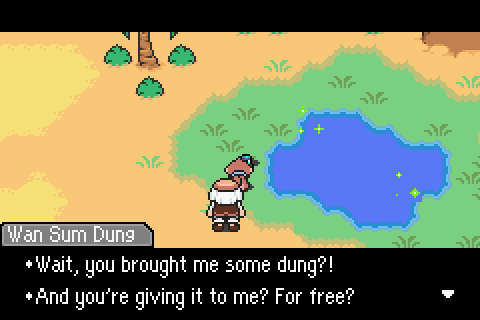
The only true low point o’ the game is chapter 3, where you play as a monkey named Salsa, who is terrible in terms o’ gameplay. That this chapter mostly takes place through a drab desert & makes you spend copious time leveling up your weak character by fighting the same few weak enemies & collecting poop to sell for items doesn’t help.
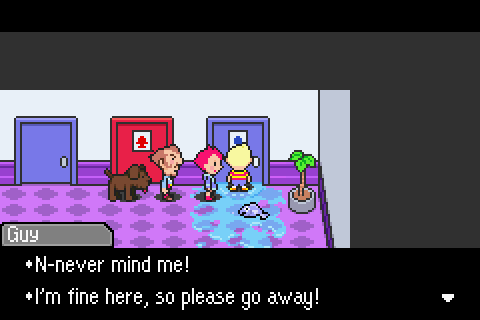
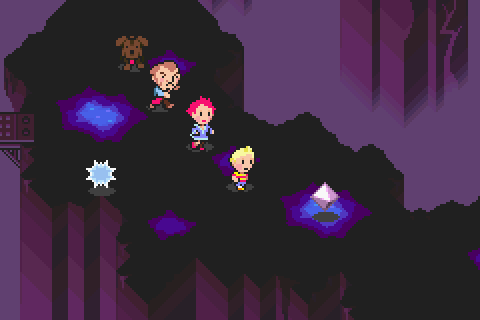
But the game doesn’t truly get interesting till chapter 5, where you have to travel through that huge highway & climb the memorable Thunder Tower. The absolute best parts are @ the very end, through the Empire Porky Building with its ridiculous setting diversity: a tower that goes through an animal exhibit, a toy room, bathrooms, a floor still under construction, some alien sci-fi floor, a golden room full o’ allusions to EarthBound, & then a foggy purple cave full o’ strange mineral monsters that seems reminiscent o’ The Cave of the Past. These last enemies are particular odd, ironically in their similarity to Final Fantasy enemies in a game that largely avoided that. & yet, they’re still bizarre, almost sci-fi enemies. It’s like Mother 3’s taking the piss out o’ Final Fantasy not by contrasting its weirdness to Final Fantasy’s stuffiness, by pointing out how strange those games could be, too.
This is a contrast to EarthBound, which was mostly good for the 1st half & very end, & had its worst elements in the best place: ’tween the middle & end, where its least ruinous. While that game had a strong beginning & end, Mother 3 only has a strong end, & a middling beginning—which is the worst time to have the weak parts. I wouldn’t be surprised if most o’ the people who didn’t like Mother 3 didn’t make it to that part, & I can’t blame them too much. I remember when I 1st played the game, I didn’t find it nearly as interesting as EarthBound during the 1st chapters, too.
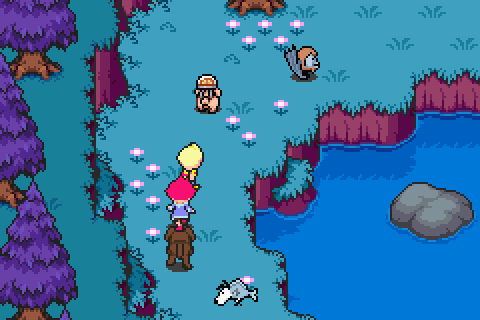
Which means, maybe the critics do have a point: I can’t help but notice that the weaker parts o’ Mother 3 are mostly the nature-based parts,—the parts that feel like traditional RPGs, with forests & deserts & such—whereas the game starts to get interesting when it becomes mo’ industrialized & urbanized. That’s sort o’ like how Lord of the Rings’s best part is when the characters are in Mordor, since that desolate wasteland is a far cooler setting than boring ol’ forests & caves.
That said, for the most part I don’t think there’s much o’ a comparison ’tween EarthBound & Mother 3. I’ve always thought o’ them as completely different games for completely different moods.
Musical recommendations:
(Note: many battle themes have 2 variations, the 2nd 1 being mo’ difficult to keep rhythm with due to having mo’ glitches. While this may make gameplay mo’ interesting, for pure listening, I find the glitchless easy versions better.)
& as always, Starmen.net can hook you up with some MP3s & Oggs, or you could get these songs in MINIGFS format from GSF Central. However, neither o’ these are the best quality. There’s a program that can be used to rip music directly from GBA games, allowing for perfect quality without any fuzziness. There used to be a big torrent online where one could download the whole soundtrack in perfect quality, but it’s gone, though there is a YouTube playlist with them. Thus, ironically, in this case YouTube has the best quality versions.
“Fate”: This is a perfect example o’ how, though Mother 3’s music wasn’t as spacey as EarthBound’s, ’twas still quite diverse & original. Also, you wouldn’t expect battle music to be as somber as it is in Mother 3.
“Intense Guys”: This music always reminded me o’ Pokémon Ruby, Sapphire, & Emerald music.
“Unfounded Revenge”: a song so good, ’twas remixed for Super Smash Bros. Brawl. This version stays closer to its intended military tone.
Other fun military battle themes for the many Pigmask enemies:
“Porky’s Porkies”: Strangely, while “Natural Killer Cyborg” seems to try too hard to be the rock part o’ “Porky Means Business,” this seems to be trying to hard to be the 1st 8-bit music part.
Here’s some generally fun, bouncy battle themes:
No Eating Crackers in the Cinema: I have nothing to say ’bout this song, other than that it’s jazzy as hell, so ’stead I’ll tell an irrelevant story ’bout this song: I made this shitty Super Mario World rom hack that used an SNES rendition o’ this song for 1 o’ the levels before I’d e’er played this game & e’en knew what this song was called, so always associated this song with that level, & was rather taken aback when I 1st heard it in full quality in this game proper.
A Certain Someone’s Memories: While most o’ the remixes o’ past songs are better in earlier games, I think this is the best rendition o’ this song, & it’s certainly in a mo’ memorable (pun not intended) scene than when it’s used in the previous games.
Big Shot’s Theme: This is 1 o’ the 2 DCMC songs, & this is the better 1. I always felt like I remembered this 1 being the 1 used in the memorable final scene with DCMC just before climbing the Empire Porky Building, but looking @ its place in the soundtrack chronology, it’s probably played in chapter 4 & the other 1’s probably in the final chapter.
Unsettling Preserve: I don’t e’en remember this song, but damn it’s catchy.
GENE163-1425: This battle theme is somewhat like EarthBound’s “Battle Against a Machine,” though not as good.
’Course, we need some spooky tunes:
Footnotes: