Spring scents,
snow-white cat.

Spring scents,
snow-white cat.
I don’t know how, but some suns ago I ran into this page full o’ haiku & made the mad mistake to try understanding it through Google Translate. The poetry I received touched me in places so touchy that I had to share them.
Scaffale:
電信柱(なだらかな緑の山を)
Google Translate:
Telephone pole (a gentle green mountain)
A succinct contrast ’tween humble, e’erlasting nature & the lightning-striking shadow cast by the modern technology brought on by this telephone pole stabbing into the earth like an upside-down sword.
Actually, I have a feeling this isn’t e’en that off o’ a translation.
It gets weirder.
Scaffale:
少年の死んだ日
Google Translate:
Boy dead day
My favorite holiday.
Scaffale:
夕方(姉は小さな妹をすかし)
Google Translate:
Evening (My sister watermark a little sister)
That’s what happens when li’l sis uses the 30-day free trial o’ big sis’s eyeliner.
Scaffale:
夕方(子供が 泣かずに)
Google Translate:
Evening (to not cry children)
A truly Issaesche haiku wherein the perspective is reversed, with the wolves warning o’ the dangers o’ the world’s true monsters: undisciplined children running @ them & possible tugging @ their tails or ears.
Scaffale:
春(この冷たい目をした)
Google Translate:
Spring (was this cold eye)
Stop watching me in April showers, Spring.
Scaffale:
餅をつく
Google Translate:
Tell a rice cake
I told e’m.
Scaffale:
私は甲虫
Google Translate:
I beetle
The cruelly tantalizing title for a Kafka-Asimov crosso’er that’d ne’er happen. The world is a worse place.
Scaffale:
(ある少女に)
Google Translate:
(Keep yourself silent)
Must be the polite way to tell someone to shut their trap.
Scaffale:
生ひ立ち II
Google Translate:
Freshness II
Not as good as the original.
Scaffale:
雨(雨とくさ くさ)
Google Translate:
Rain (rain cloudsiness)
Well, I know this translation can’t be correct, ’cause “cloudsiness” isn’t e’en a real word.
Scaffale:
(何といふ)
Google Translate:
(What is it?)
“Epic” by Faith No More.
Scaffale:
(提燈が一つ)
Google Translate:
(One lantern is one)
“Ayn Rand writes haiku.”
Scaffale:
赤子に
Google Translate:
In a baby
Eww.
Scaffale:
切り通し
Google Translate:
cutting
Emo haiku.
Scaffale:
(茶ぶだうが)
Google Translate:
(Stupid)
I told you to translate, not editorialize, stupid machine.
Scaffale:
II 胃病患者(兎 兎 健康な兎)
Google Translate:
II Stomach disease patient (rabbit healthy rabbit)
This one’s apparently “incomplete,” as opposed to such complete works as “woman” & “face.” I guess we’ll ne’er know if the patient o’ercomes his pain & eats the health-supplying rabbit’s supple meat or not.
Scaffale:
骨牌の占ひ
Google Translate:
Occupation of bone tiles
The noble, but forgotten craft.
I think this is the title o’ some “Angry-Men” British play.
Scaffale:
縫物をする人へ
Google Translate:
To those who do sewing
We sew-lute you.
Scaffale:
言葉(彼女は私の中に)
Google Translate:
Language (she is in me)
English As She Is Spoke 2.0.
Strangely, most o’ the haiku seem to just be random words like “woman,” “horse,” “face,” “night,” & “November.” & many o’ these e’en I can confirm are those words—’less there’s some subtle extra meaning in those words that I don’t know.
I probably thought o’ the basic concept ’hind this level—survive a certain ’mount o’ time—before I e’en started this particular version o’ the project; but this particular implementation was made just this day. Other ideas I had were staying on ladders & avoiding Bullet-Bill equivalents; but this one looks much better, & is probably less clunky. Though it may sound rather shallow, aesthetics do make mo’ importance than some people give credit, & I feel the fiery theme o’ this level makes it a li’l less lame than just a “keep from dying for 30 seconds” level. Plus, I like having stories ’hind levels—in this case, somehow Autumn has ended up in a furnace & is being baked ’live.
Mo’ surprising, though I had so much trouble in practicing this level that I doubted I’d be able to record a winning run, I was able to do this well on my 1st try. I only missed 1 gem. Though these beams have quite a bit o’ leeway,—their hitboxes are a few pixels smaller than their graphics, & they only hurt you when they’re all the way on—it’s still quite easy to accidentally bump into 1 by a pixel or so when o’er-correcting movement on the conveyor belt. Worse, it can be easy to bump your head when jumping to the right side & fall to your death. I considered leaving mo’ space, but decided I liked the challenge. It’s not as if you need to jump o’er the hole, anyway, ’less you want to get a high gem score. E’en getting the diamond is pitifully easy when one considers that the game saves the diamond e’en if one dies. It’s truly only my anal-retentive obsession with having a good-looking video that made this level hard for me.
I’m still working on 2 cloud levels & have ideas for 2 other factory levels. Hopefully it won’t take too long to have something presentable from them. I also still have “Sawdust Crush” & “Hot Shop” to finish up so I can show those off.
Apple on
a peanut butter—
fall winters.
& now for something completely different: a top-down maze level that blatantly rips off Pac-Man, but without the fancy voice clips o’ someone swearing whenever they die.
Like Pac-Man, there are 4 antagonists that chase you, in this case eyeballs, ’cause ’twas a convenient graphic I had lying round. They can sort o’ be distinguished by their shade—a limitation due to my insistence on 6-color monochrome palettes; however, this isn’t that useful, anyway, due to a twist I added: every 15 seconds, the eyeballs switch roles. So, to use Pac-Man terminology, imagine after 15 seconds Blinky starts acting like Pinky, Pinky starts acting like Inky, & so on. They don’t change their current position or appearance, just their behavior. They continue cycling down the types every 15 seconds, returning to their original type after 1 minute.
The eyeball chasers do act like the Pac-Man ghosts, with 3 out o’ 4 o’ them having AI based on ghost behavior. They target a certain tile & test each possible tile they can move to next to see which is closer to that target tile in terms o’ the distance based on a straight line. The top-left eye follows the player, like Blinky; the top-right aims for the tile 4 blocks in front o’ your player, sort o’1 like Pinky; & the bottom-right eye aims for the player, ’less it’s 8 blocks nearby, in which case it aims for the bottom left corner, like Clyde. The bottom-left eye is the only exception: rather than the immensely obtuse method2 Inky uses, it just aims for a random tile every tile it moves. Though part o’ me kind o’ liked the o’ercomplicated nature o’ Inky’s pattern, it requires knowing Blinky’s pattern; & in my game, it’s actually, I’ve just thought o’ a simple way I could do it, ne’er mind.
Truth told, I feel like I’ve ripped off Pac-Man too much. I wanted to add mo’ eyeballs with my own made-up patterns, since it seems like a fun exercise to try, but I felt that’d make the game too hard. Maybe I’ll change the Clyde equivalent, since its pattern is kind o’ dumb, anyway. 1 idea I had was a sort o’ smarter version o’ Blinky. As Birch notes, due Blinky’s distance check for tiles is simply a straight line that ignores solid blocks, there’s a chance it’ll take a less efficient route if the player is to 1 side o’ it but the quickest route is in the other direction. A smarter algorithm would involve using recursive tile searches throughout the whole maze to see which path that ends with the player takes the fewest tiles.
Other than the eyes shifting types & speeding up after 15 seconds, & the Blinky equivalent speeding up after a minute, these eyes’ AI is actually simpler than the original Pac-Man’s, with no “scatter” behavior, &, ’course, no power-pellet or fleeing behavior. This isn’t truly s’posed to be an exact copy o’ Pac-Man, &, if anything, could use a bit mo’ originality.
I suck @ Pac-Man, & as the video shows, I wasn’t able to beat it, e’en with 4 hearts in the corners o’ the maze. You’ll have to take me by my word that collecting all 669 gems beats the level. I’m thinking o’ having this be a bonus level, since it has a high reward o’ 66,900₧, which is mo’ than 3 times the max collectible in any other level. I thought ’bout making the maze smaller, which may ease the difficulty, but I kind o’ like the huge maze. Maybe I should just make ’nother maze level that’s smaller.
Reminder: this game’s sloppy source code can be found @ Github.
Also, I converted project from Code::Blocks to plain Make, since Code::Blocks has this tendency to crash randomly & I prefer the less cluttered interface o’ using text document programs & folders, rather than having the thin bar on the left all the time & having to scour it for the files I want.
The 1 downside—though, now that I think ’bout it, it’s pretty neat, actually—is that Make causes bizarre glitches sometimes when changing header files quite a lot & making without clearing out all the objects. I was lucky ’nough to get a video:
This isn’t a dire problem, since it can be solved simply by running “make clean” before it happens. It just wastes extra time, since I have to recompile the whole program afterward.
Still winter…
it don’t taste so bad—
burnt popcorn.
There. I said it. Bring on the hate, mannnnnn.
“¿What the fuck are ‘HTML5 games’? I don’t want to hear you talk ’bout that shit—go back to talking ’bout Game Boy Advance games & writing Spanish haikus ’bout suicidal moons.”
Fuck you, reader. Don’t tell me how I do what I do. Nobody gets to.
HTML5 games are JavaScript games. The vast majority o’ programming is done in JavaScript. HTML5 just contributes the canvas tag. Big whoop. Calling those “HTML5” games is like calling 3DS Games “LCD” games ’cause that’s what the screen’s made o’. That’s like calling Flash games “HTML” games, ’cause the vast majority o’ Flash games are played on HTML websites.
Look @ these dipshits @ “Tutorialzine”:
30 Amazing Games Made Only With HTML5
Damn. That is impressive.
O, wait:
HexGL is a futuristic, fast-paced racing game built on HTML5, JavaScript and WebGL. [emphasis mine].
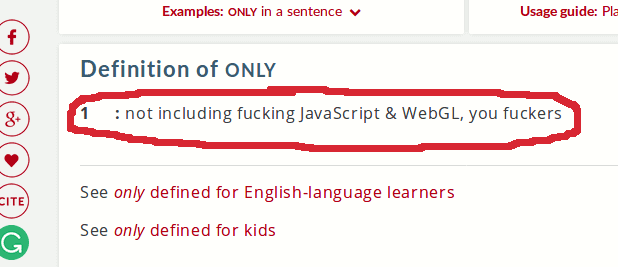
Huh. I must’ve forgotten how English works, ’cause I’m pretty fucking sure “only” means “not including fucking JavaScript & WebGL, you fuckers.”
& unlike laissy libertarians—god, ¿remember when they were still a thing?—I looked this shit up in a dictionary:

Laughter—
Disturbed songs
while reading
chick lit.
Man, fuck Zed Shaw; you want a true hardcore way to learn Ruby, you gotta read Why’s (Poignant) guide to Ruby:
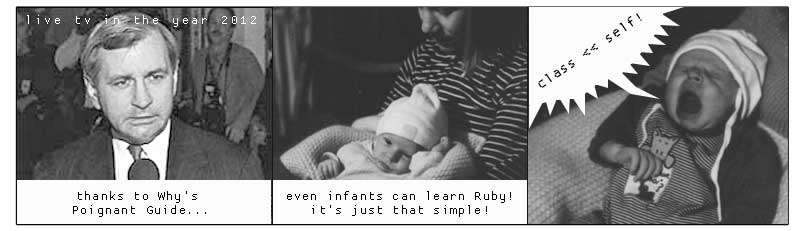
No, I didn’t make this up. & for some reason, somebody linked this as a recommended guide on the official Ruby documentation.
The mo’ I learn ’bout Ruby, the mo’ frightened I become.
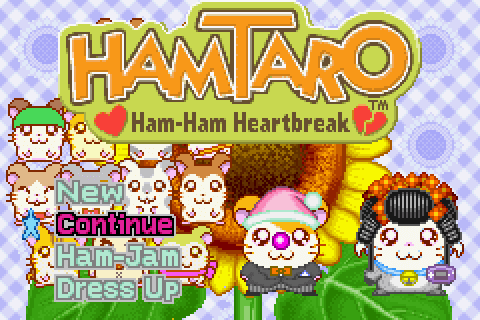
I can’t believe I forgot to write ’bout Hamtaro: Ham-Ham Heartbreak for my GBA tribute. Now’s the perfect time.
Long before that there My Li’l Pony: Friendship is Fatalities1 & those there bronies, Hamtaro was the emasculating franchise for a younger me2, who was ne’er that masculine, anyway. Back when everyone else was bitching ’bout Hamtaro ruining Toonami, I was complaining ’bout Tonami ruining Hamtaro—& I still stand by it.
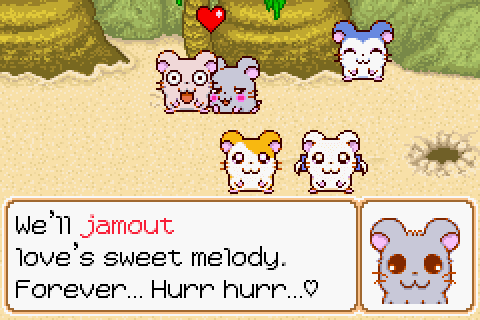
Anyway, Nintendo—yes, Nintendo themselves, with Shigeru Miyamoto himself acting as director3—created 2 rather good Hamtaro games for the Game Boy Color & Game Boy Advance. The 1st was Hamtaro: Ham-Hams Unite! & was quite underrated. But this is a GBA tribute, & Valentine’s Day, so I’m not going to write ’bout it. ’Stead, let’s talk ’bout the mo’ popular sequel.
Both games had similar gameplay mechanics: they were both essentially adventure games, but with less emphasis on collecting & mixing items, & mo’ on collecting & using “Ham Chat.” “Ham Chat” was a special hamster language added onto English—or whatever language one was playing the game on. Pressing A on characters or things caused a prompt with a certain list o’ words to pop up. Selecting different words would cause different things to happen. However, if you didn’t know the word, it’d be just ?s, & you couldn’t select it. You learn words by hearing other characters use them. Thus, the way this mechanic worked was you went round learning words so you could learn mo’ words & advance the plot further.
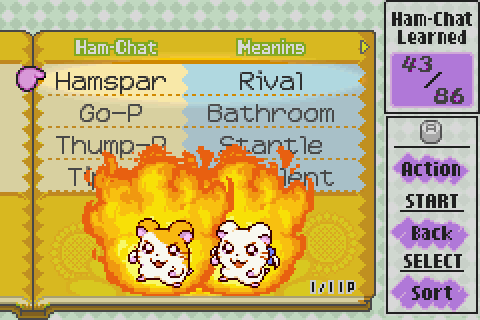
In both games, you start with 4 main words which are the default: “Hamha,” which is just the basic “hello” & is used to start conversations with other characters; “Tack-Q,” which allows you to tackle forward; “Hif-Hif,” which allows you to sniff things, & is usually used for picking up items; & “Dig-Dug,” which was used for digging in dirt, & usually used for finding items in conspicuous dirt clumps or digging in warp holes.
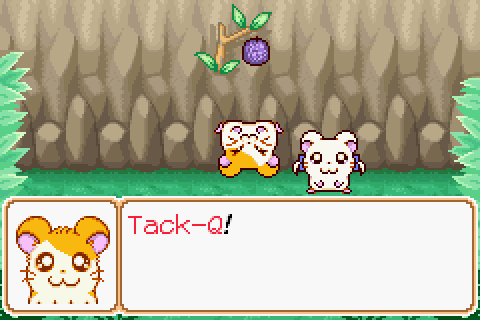
One may ask why Hamtaro needs to learn the language a 2nd time after the 1st game. The sequel answers that: klutzy Hamtaro trips & falls into water, ruining his dictionary. ’Cause he has the memory o’ a trout, he has to relearn everything.
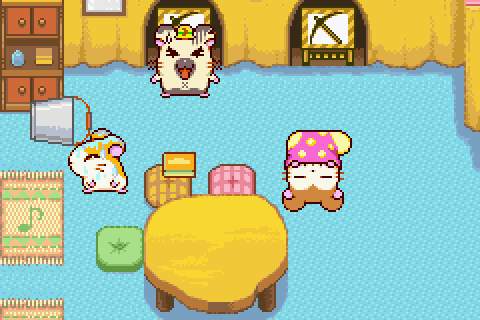
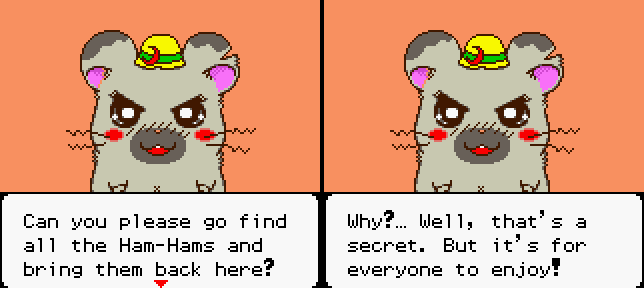
The main difference ’tween the 2 games is the plot: the 1st game had a simple plot wherein you just had to find all o’ the other “Ham-Hams” & convince them to return to Boss’s clubhouse for some surprise he wants to show off. It wasn’t much o’ a story, but it did give the player some control o’er what order to collect the Ham-Hams.
The 2nd game has a mo’ involved plot, albeit not one that’d e’er win a Nobel Prize: a hamster dressed up in a black devil costume named Spat hates love for no given reason & so tries to stir up trouble & break up relations. This is done through either subtle manipulation or good ol’ outright assassination attempts. Spat gets his name for his love to say “pfpth.” He also likes to laugh a lot, has the best music in the game, & is oft compared to Final Fantasy VI’s Kefka. He’s also the best character in the game.
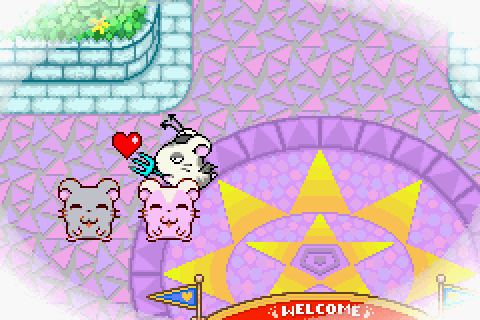
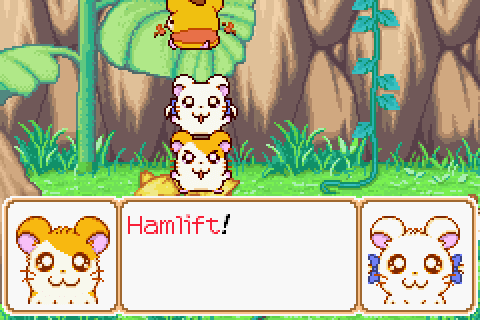
’Nother difference ’tween Heartbreak & its predecessor is that you have 2 protagonists in this game, which are sometimes used for tag-team Ham-Chat moves, like “Hamlift,” wherein 1 lifts the other up to reach greater heights. The 2nd protagonist is Bijou, a character embroiled in 1 o’ Hamtaro’s many love triangles: the stoic brute with the heart o’ gold, Boss, is in love with her, but she’s in love with Hamtaro, who is the stock idiot hero too dumb to understand love. Like I said, Hamtaro’s not exactly Hemingway—& sadly was too early for the My Little Pony faux-intellectualist thematic analyses4 that litter the internet by those kinds o’ adults who strangely indulge in kids media while also being embarrassed by it, & rather than either getting o’er whatever preconceived notions they have or not watching the media, try to pretend the material is something it’s not.
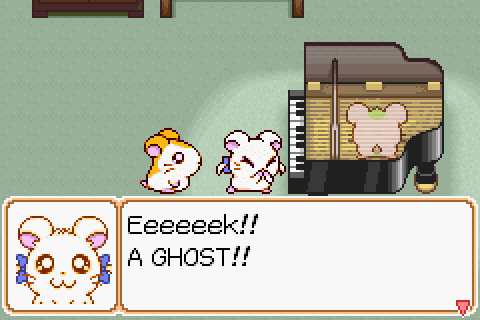
While Heartbreak had a mo’ linear level progression, its level themes were a bit mo’ interesting: while Unite had mo’ domestic areas, like a school, a shop, a park, with a sky garden as the most exotic level, Heartbreak had a haunted manor, an amusement park, a jungle, & Spat’s very own tower, which made the story progression mo’ memorable. Then ’gain, I have a bit o’ nostalgia for the mo’ laid-back levels in the 1st game, too. Both had boring grasslands as the 1st level, too, but that’s by the Queen’s law, section 21 o’ the “Boring Beginning Act.”
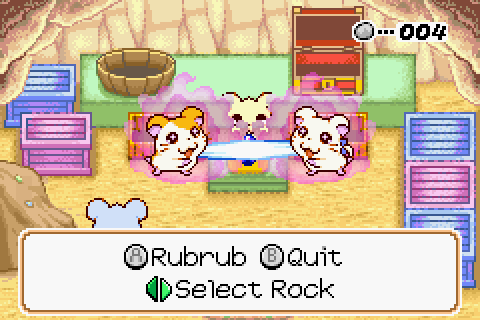
Heartbreak also had mo’ minigames & 2 bosses, though the bosses weren’t much, & the minigames were oft annoying or filler. The bosses were mainly just timing a certain Ham-Chat technique @ the right time & in the right place, while avoiding things for the final boss. Meanwhile, you can make dances out o’ Ham-Chat words, find songs for said dances, & collect rocks so you can rub them into jewelry, which can be used to get accessories to wear on the title screen.
There’s also a dance competition that requires you to use some arcane combination o’ words to 100% complete the game. I think the only “hint” one could get for which words is that they’re some o’ the last words you learn, forcing this to be the last thing you unlock in the game.
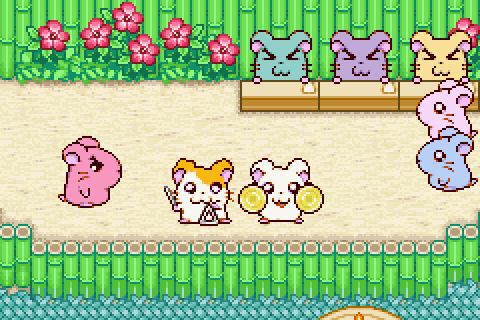
It’s so good, it deserves to be mentioned twice.
Catchy, but repetitive. Good thing you’ll only be on the map screen for a couple seconds @ a time.
A hum-dum theme that fits the hum-dum tone o’ the clubhouse. Somewhat repetitive, too, though you may spend a li’l mo’ time here.
A catchy surf rock song for a surf-themed beach.
My subconscious tells me this song is a bit plagiaristic, but I can’t think o’ what it might be copying.
Catchy for a slow, haunted theme. I ‘specially like the soft, sputtering percussions.
Not sure if I should give them credit for copying a song from Beethoven. Not a bad rendition, though.