The Mezunian

Die Positivität ist das Opium des Volkes, aber der Spott ist das Opium der Verrückten

Admitted Lover o’ Mediocrity Changes Mind, Now Thinks Mediocrity Is for Lazy Dumbasses who Love Sports

It’s sad that after Goins’ bold salute to mediocre writing, he’s now1 changed his mind, calling “jack-o-all-trades” morons who like sports.

Ironically, he’s talking ’bout writing; but writing is 1 o’ the few industries where having well-rounded skills is a boon—a’least for fiction writers. Fiction-writing involves creating believable worlds, which are usually inspired by, even if not based on, the real world. Knowledge o’ the real world can involve knowledge in everything. Want to write a good biologist & truly understand their point o’ view? Researching biology will help. & yes, though sports don’t interest me, even I acknowledge that knowledge o’ sports would benefit someone writing a sports story.

Contrariwise, no one will ever be a master @ writing, since one can always improve—though perhaps that applies to everything.

But then, I don’t think this article was meant as a serious philosophical question—for 1, “serious” & “philosophical” never go together. ’Stead it’s meant to congratulate himself for being “nerdy” & “alternative,” man. Everyone says this ’bout themselves—even people who were bullies; it’s just that everyone likes to think o’ themselves as victims who succeeded gainst unbelievable odds, rather than honestly acknowledging that we all succeed ’cause we weren’t born in a place where children are forced to fight for their survival gainst rabid tigers (’less you were, reader, in which case you admittedly probably did earn your success gainst unbelievable odds & you may ignore this critique).

I listened to Led Zeppelin and wore baggy T-shirts. I was not cool, and I paid the price for it in social capital. That awkward feeling of being left out lingers with me even today. Because I still do things that make me weird.

He must’ve grown up in the 50s when not following a carefully-orchestrated set o’ instructions for walking down a hall got you labeled an insane commie. See, in my school days, being “weird” was considered cool—& by weird I mean the definition he uses: not authentically gross to society, like a man wearing skirts & makeup or having a massive facial deformation for life, but liking a famous band & wearing imperfectly-pressed clothing. Harmless weird: the kind o’ weird that feeds the feeling o’ rebellion but without actually having the immense social pressures that warrant that feeling. All I hear ’bout is how awesome being a nerd is, since it fits the pattern perfectly, even if their only criteria is that they push buttons on a hunk o’ plastic plugged into a TV every once in a while.

This is all used to regurgitate the same myth o’ the genius loser who becomes rich—where I come from, if you’re not living every second in cold-sweat fear o’ frostbite from wandering the subarctic urban wilderness in homelessness, you’re rich, so I’m going to assume Goins is rich—due to their genius loserness. This despite the fact that social skills are the most useful skill for success & the reality that most powerful people are actually morons. Have you ever listened to a business executive or politician open his—usually his—mouth? Those are the geniuses who rule the world?

The irony is that the world’s true losers probably aren’t the 1s sitting round measuring their victim dicks—probably ’cause they’re actually victims, & thus too busy running from the totalitarian government snatchers hunting them down & can’t type ’cause their hands have been chopped off & had arthritis, anyway. Also they have cancer, but that hasn’t impeded them from blogging yet.

Life is not an accident for these people [“people who matter,” as opposed to those who should just kill their shitty selves]; they are living intentionally.

You hear that victims o’ that tsunami? Stop letting accidents rule your lives, already! ’Course, many o’ these people don’t have lives anymore, so we can see that Goins’ philosophy has turned true!

This is the cost of greatness. (And I’m learning to embrace it.)

Ha, ha, ha! What a cocksucker.

I also love the book he quotes that uses “you” to contrast those other “fools,” the intended audience obviously intended to feel the author’s hand reach out into their pants. “O yes! O yeah! Please tell me I’m special mo’. O yeah… That’s so goood.”

[Paragraphs that can be summarized as, “Having capabilities that deserve praise for being based on effort require actual effort, dumb ass.”]

I’m glad that he feels the need to tell me this. I’m sure there are plenty o’ people who somehow missed the billion other inspirational puke smacking their foreheads & going, “You mean sitting on my couch & scratching my dick doesn’t get me rich?” ’Course, as we gleaned earlier, this article isn’t aimed @ those people. You’re obviously not 1 o’ them. No, he’s talking ’bout the bad, lazy people—the poor slobs, the dirty people. Essentially, he’s talking ’bout social stereotypes—ironically attacking the very misfits o’ which he only pretends to be. It’s the same reactionary bizarro world regurgitated a million times: us poor rich geniuses are being pulled down by the immensely powerful lazy bums!

You will be tempted to resign and give in to the taunts of your enemies and critics.

Yes, lets shake our fists @ the mean ol’ critics. They aren’t artists after all, who put work into their satire as much as other writers. No, only those who don’t satire artists—the very class that coincidentally always makes this point—can be considered artists. Artists, after all, are very sensitive, unlike those lazy bums who scratch their groins & treat their radioactive poisoning as an accident.

How many enemies do writers earn? Maybe if these writers are revolutionaries actively trying to topple governments. But is some dork who scribbles inspirational “lit fics” ’bout dogs with cancer—I don’t know if Goins writes these; he could write sci-fi parodies for all I know—truly going to rile up someone ’nough to make them call for their blood & want to wear their skin as a suit?

I mean, I always felt that way ’bout my favorite authors, but that was out o’ love, not ’cause we’re enemies. Why can’t you understand basic empathy, Goins, you sociopath?

Your hands will crack and bleed, your back will hurt, and you will cry.

Well, a’least I got this part right. Though I didn’t even know this had anything to do with me writing; I never even thought ’bout why ’twas so fun.

In all of this, you will be humbled and humiliated…

I’ve noticed that those who praise humility rarely exhibit it themselves, & this includes Goins, who just earlier admitted his love for the cost o’ his greatness. This is probably ’cause humble people quickly learn that in a cut-throat competitive world, admitting that others are better is ’bout as effective as a mouse lying right before a cat. ’Course, the hunt also involves headology & thus pretending to be humble is a great way to lure your victims into a false feeling o’ safety so the pounce will be mo’ successful.

What I’m saying is, Goins wants to eat people, though you shouldn’t be surprised to find such behavior in the kind o’ maniac who listens to Led Zeppelin o’ all things.

Understand what you’ll have to give up, how you’ll be misunderstood, and the loneliness associated with any kind of greatness or leadership.

Yes, people who control others are the true victims o’ society. For instance, I always remember whenever I see some poor Yemenese person whose name will never be remembered by anyone be blown into bloody bones & ashes from a drone dropped on her, a tear ran down the President’s cheek as he pondered the loneliness deep in his heart from all o’ the people who don’t understand him, man. Then he writes shitty beat poetry & that sympathy all goes ’way.

See, I must confess my philosophical difference: if I were to compare leaders & “great”—successful—people to, say, mentally-aberrant homeless bums, I’d say the latter is probably a tad bit lonelier. Granted, the former is probably only having his—usually his, let’s be honest here—dick stroked so his “greatness”—his power—will rub off on them.

In fact, I’d wager that a society where people think only ’bout how they can be masters over other people & how the spirit o’ the bullies from their past still block their paths with said spirits’ evil mediocrity might be a quite lonely place to live no matter who you are. I’m sure Goins would disagree; but then, he’s surely part o’ the conspiracy gainst me, which is why all o’ my fan fiction are rejected by those corporate fascists @ Penguin, just as those corporate fascists in high school called my stories submitted to the papers gay—they were bisexual, you ditzy Cises!

For me, it’s been writing — pursuing how to do something as best I can (and giving up a lot of other pursuits in the process).

You know, I take back everything I said before—well, ’cept for the part ’bout me liking to wear my favorite writers’ skin like a suit. Consider this line & then look back & consider the quality o’ work he’s crafted. I change my tune: Goins, you now have my heartfelt sympathy.

The irony in all of this is that in my disdain for sports I’m actually learning what it means to be an athlete — what it means to strive and strain and push through the pain to achieve a goal.

[There was a pause here while I jabbed a fist into my maw to stifle the loud guffaws. Well, that & ’cause I like the taste o’ my flesh.]

I, too, grit my teeth when I feel the gravelly pain stump into my fingers from the billion keyboard taps! ’Course, this isn’t from my writing, but from my simple joy o’ slamming my fingers gainst hard objects. But still!

If the idea of hustling like you’ve never hustled and hurting like you’ve never hurt before actually appeals to you, then there’s hope.

Then I guess there’s no hope, ’cause that phrase sounds terribly written. When I think o’ “hustling,” I don’t think “work”; I think shitty dancing.

Even worse, you probably stole that line from a Poison song.

As for me, I’m tired of being good at many things, of being a jack-of-all-trades. I want to be a master of one.

I’m always awed by the narcissism o’ Americans that lead every 1 o’ them to believe that they’ll be the master o’ something. It’d be refreshing to see 1 who actually does the math & realizes that the net # o’ masters is far lower than the net # o’ not-even-jacks-o’-all-trades & acknowledge they’ll probably end up a superfluous office drone—or worse, on the run from drones dropped by totalitarian government snatchers.

Do you admit that you’re a superfluous office drone/insane bum on the run from drones dropped by totalitarian government snatchers & that you’re a sick fuck who smashes your fingers gainst hard objects? Share in the comments.

1 Or earlier? Couldn’t find a date on either article. How do you fuck that up? Doesn’t WordPress automatically add that? Or does he intentionally hide the date ’cause he thinks it’ll make his work mo’ timely, foiling anyone who has to cite these articles in APA. ’Course, nobody’s going to cite Goins’ inspirational pieces, ’less they love the look o’ Fs on their papers; but still, as much as I love Web Pages that Suck, Flanders’s advice not to use dates creates quite an annoyance from the user-side.
Posted in Politics, Yuppy Tripe

EXTRA: Moderate Liberals Known for Pragmatism Utter Failures

After the Democrats were utterly crushed by the Republicans in congress, the senate, & governors seats, the web was full o’ liberal articles trying not to outright lie ’bout how they failed—something that conservatives would surely have no problem with doing if the positions were reversed—but not hinting that this may mean they could be failures, a writing genre that causes much joy for conservatives & bitter anarchists who hate everyone ’cept other bitter anarchists, probably ’cause it helps both groups repress the sheer horror that is our existence without giving our eyeballs to buy alcohol.

Sadly for our entertainment, the Daily Kos wrote ’bout the issue with cynical honesty—as they are wont to do—including well-earned resentment gainst the American public, hilariously pathetic—& yet also awesome, somehow—passive-aggression gainst the Republicans through the revolutionary threat o’ parliamentary gridlock, & depressed acceptance that they will only ever succeed half the time. Apparently nobody told Kos that that’s glorious socialism he’s talking ’bout: power isn’t held completely by 1 tiny club o’ rich elites but is shared by 2 o’ them. Meanwhile, grumpy reactionary Kos wants to take ’way the Republicans “Everyone Wins Sometimes Trophy,” & as a spineless liberal, I don’t approve o’ this white-&-black morality. Can’t we afford any true colors for once? Like purple or magenta or Granny Smith Apple?

The New York Times gave us a balance ’tween some guy rightfully calling Obama an inconsistent hypocrite after spewing some poetic nonsense ’bout the fun o’ standing round for hours so one can write on paper, as opposed to the evils o’ not writing on paper; some robot spewing mindless Republican propaganda without even trying to ’splain his rationale; & the typical whining ’bout negativity & how we should all hold hands, cry, & stick dicks & dildos in each others bums (I prefer to stick dicks in bums without the crying, thank you).

Paul Krugman hasn’t seemed to post anything on his blog yet, so I’ll assume he drowned himself in cheap whiskey.

I checked the Washington Post, but their shit was boring, so fuck them.

Noah Smith doesn’t mention the election; but I just want to point out this grossly incestuous article wherein he handjobs ’nother economist handjobbing economists—the very job he happens to be a part o’, coincidentally ’nough!—for being “priests of the free [sic] market” & tricking Americans into accepting an economic system, even if they lied ’bout its shitty points for propagandist purposes. This is all very true, & we should, indeed, admire economists in their brilliant trickery. Good job, economists!

But don’t worry: Smith also has hope that these same economists will fix the fuck-ups that they caused. The important point is that economists can never fail, ’cause failures are simply opportunities for future success!

Anarchist Writers didn’t write ’bout the election ’cause they’re too cool for it, even if their website looks like somebody just puked its elements straight onto the screen without further arrangement.

Zombie Marx, surprisingly, shows excitement for the Republican victory, primarily ’cause it meant “Death to Slavery” for him, though I don’t know if I should take someone who still uses the word “Negro”—with a capital, the dirty capitalist—to refer to black people as an expert in racial issues.

Admittedly, Marx may truly be excited simply ’cause 1 o’ his socialist mind servants is the Republican foreign minister, which he will surely use to conquer the US from the inside.

I refused to read any o’ The Atlantic’s articles ’cause the style o’ just the titles & sentence-long blurbs made me want to vomit. Also, 1 o’ their “headlines” is just the same “Writers, don’t stop writing, even if you don’t want to, you lazy shits” cliché every writing “guide” under the moon has spewed.

Nobody cares what The Guardian says ’cause they’re dirty Brits, you don’t own us anymo’!

O, all right, I’ll mention 1 article—just 1!—wherein they argued that conservatives won with a mix o’ aiming attention @ how shitty Obama is, hiding the fact that they’re conservatives, & aiming for the majority o’ Americans’ focus on the pettiest o’ nonissues. You can’t fault a good strategy.

Meanwhile, The Nation vacillates ’tween denialist exclamations o’ some puny victories liberals scrounged in the bloodbath—the blood wasn’t the Democrats’, ’course, who still live in luxury, but o’ Yemenese still being droned to death—& whines ’bout how the Republicans cheated, anyway, so there. Strangely, these arguments that the election is rigged in favor o’ the rich—which are, indeed, mo’ likely to be true than not1—doesn’t stop liberals from emphasizing the importance o’ voting in this rigged election. My response would be less, “Man, this bites,” & mo’, “O my god, I just realized that the United States is a tyrannical oligarchy! We’re fucked!”

So you all understand how much better I am than all o’ these people I make fun o’ without being deigned to receive a response, I want you all to know that I consider the election rigged & invalid when both o’ the Republicans & Democrats win. Everyone knows that the only valid elections are those in which the Englesist Magical Socialism party wins2.

The response will likely be the same as has always been: we must work harder to vote Democrat next election in the hopes that this time they won’t lose &/or won’t suck, I can feel it this time. Granted, what else can you do—other than bitch ’bout it during lunch break, which has already been working wonderfully.

I mean, ’course we can always just overthrow the government, blow up the white house, or call government officials mean words that make centrists cry—& making centrists cry is enjoyable—but then you know ’nother’s just going to pop up, & that gets tiring after a while. They’re like those tax-evading churches in SimCity 2000.

Which brings me to the true tragedy o’ this Republican victory: that it came without a victory by Herman Cain & his amazing 9-9-9 tax plan, as well as his mo’ obscure law mandating that “Virtual Village” play whenever a park is built.

Do you think the government’s like those tax-evading churches in SimCity 2000 & never go ’way or do you think the Englesist Magical Socialist revolution will succeed & finally end all poverty, sadness, & that groggy feeling you get after sleeping late into afternoon? Well, fuck off: I don’t care ’bout your opinion.

1 Disregarding Goldman’s incoherent rebuke, which involves mistaking democracy for the meaningless value judgment, “individual freedom,” in opposition to the dangerous populist movements that stand round in parks & do nothing. Said “individual freedom” mo’ oft than not translates mo’ accurately to “the minority controlling the majority, ’cept it’s good that they’re doing it this time, ’cause it benefits my rich buddies.”

2 You may be questioning the contradiction ’tween me claiming to be Englesist here & claiming to be anarchist earlier. We will be coming to silence you promptly.

No need to send us your address; we already know where you live. Awfully polite, though.


Posted in Elections, Politics

Irrelevant Halloween Double Special: Economics Needs to Keep Economists From Mainstream Newspapers

As with most ideas, I’m uncertain ’bout the intelligence o’ economists—not comfortable with accepting them as intelligence ’cause some rich organizations called “colleges” say they are, but also not comfortable with just writing them off as ditsy.

Whenever I see economists try to defend their profession gainst the mean ol’ critics in mainstream media, my uncertainty is only exacerbated. They usually only make themselves look stupider, which is hard to believe from people who are apparently able to graduate from places like Harvard. My paranoiac side makes me want to believe that perhaps these newspapers intentionally pick strawmen economists to make the whole profession look bad, though I’m not sure why they would. I dunno.

Neither precludes us from pointing & laughing, however.

I. Mankiw Doesn’t Know What the Hell He’s Protesting

In smugly-titled New York Times article, Know What You’re Protesting,” Harvard economist Greg Mankiw protests gainst Occupy Wall-Street hippies & somehow makes them look like scientists & him look like a postmodernist-sputtering hippie. ’Gain, my paranoiac side makes me think this is an elaborate troll-job on Mankiw & Occupy’s part.

He starts with paragraphs o’ self-fellating/self-pitying backstory wherein he treats a li’l walkout as if ’twere the French Revolution. How did you live through it, Mankiw? I hope your metaphorical tweed suit was not ruffled by such uncouth behavior.

I particularly loved this bit:

I have been told that at least one of the students who walked out sneaked back in later: he wanted to support the protest but didn’t want to miss the lecture [Emphasis mine].

Apparently this Harvard-educated scientist never took a single rhetoric class, since if he did, he’d know that “I have been told” is known as weasel-words & that no true scientist uses them. They provide evidence or shut up.

To be fair, this is a believable story: Mankiw’s amazing lectures are, I’m sure, a life-changing moment that could never be replaced by, say, reading 1 o’ the millions o’ economics textbooks out there. How can anyone learn ’bout the Phillips Curve with mere text when one could hear it through Mankiw’s sexy voice? Everyone knows Mankiw’s lectures are fucking rock concerts. I bet this totally-not-imaginary student made sure to get a front-row seat with a bucket o’ popcorn in-hand.

If anything, we should expect the opposite: lazy students pretending to protest so they can sneak a free hour to smoke pot, get laid, make Super Mario World rom hacks, or whatever you punks do nowadays.

If there is any truth to this claim, the answer obviously is that some student stoned out o’ his mind saw the other students walk out; thought, O, is class over already?; & went out with them, only to learn the truth afterward & sneak back in thinking, O shit. Whoops.

So what is his—Mankiw’s, not the stoner’s—rebuke to these foolish peons? Well, after he digresses into some irrelevant bullshit ’bout the 70s, he makes a strong case for his class:

It includes ideas of many greats in the field, like Adam Smith, David Ricardo, Arthur Pigou, John Maynard Keynes and Milton Friedman.

A whole 1 o’ those lived past the 1950s, too! Clearly Mankiw is on the cutting edge o’ economic science. Those students will surely leave that classroom with impeccable knowledge o’ how to get the most cows from bartering pigs.

Then he parrots some student newspaper’s appeal to “nonpartisanship”—an imaginary concept idiots make up so their ideas don’t have to be held up to any authentic standards, & thus have their idiocy revealed. He, ’course, doesn’t provide evidence for his nonpartisanship—as no centrist ever does, since it’s based on an imaginary scale. As true scientists, we should take his word without skepticism.

He then devolves into cretinous dick-sucking o’ Paul Samuelson & whining ’cause some bearded Marxist whined ’bout him not being a bearded Marxist. I could whine for a whole article ’bout he & Nordhaus’s Economics & how the claim that it’s nonideological is as blatant a lie as saying the sky is green; but for now I’ll simply note that Mankiw himself provides no reason why I should like Samuelson’s work other than that Mankiw calls him “left-o’-center.” I love how people who complain ’bout ideology can use nothing but ideological words to defend their arguments—almost as if they’re completely full o’ shit. The fact that “left-o’-center”1 doesn’t mean anything concrete doesn’t hinder this Harvard economist 1 bit. What a scientist!

I think this was meant to be his bid to cater to the silly leftists, which isn’t consistent with his claim that he doesn’t serve ideology. But if he knew anything ’bout leftists, he’d know its various clans hate each other, anyway. The “left” includes some o’ the most libertarian & totalitarian ideologies in the world; “left” doesn’t mean shit.

Warning: explicit handjobbing ’head:

I don’t claim to be an economist of Paul Samuelson’s stature. (Probably no one alive can.)

Unfortunately, the vile Marxists have a rebuke: Ha! That doesn’t include Zombie Marx!

Back to serious—O, wait, I’m reading an economist’s op-ed. There’s nothing serious here.

Yet, like most economists, I don’t view the study of economics as laden with ideology.

“In our opinion, we’re not idiots.” Apparently, this “scientist” still hasn’t realized that opinions without evidence or rationale are worthless. People will decide for themselves whether you’re ideological or not—& so far you have proven yourself not so, if only ’cause ideological people require a’least some intellectual content in their loony theories.

Most of us agree with Keynes, who said: “The theory of economics does not furnish a body of settled conclusions immediately applicable to policy. It is a method rather than a doctrine, an apparatus of the mind, a technique for thinking, which helps the possessor to draw correct conclusions.”

Well, that is wise, & not mindless buzzwords strewn together: “Economics doesn’t make conclusions; it just chooses methods o’ thoughts based on the conclusions toward which they inevitably lead. Totally different.”

That is not to say that economists understand everything. The recent financial crisis, economic downturn and meager recovery are vivid reminders that we still have much to learn.

So far you’ve yet to show that economists know anything. Literally, the only evidence you’ve given is points in which economists have failed.

Why do so many articles I argue with end up arguing with themse—Mankiw’s ’nother 1 o’ them! You think I didn’t notice the way you slyly snuck in that reference to Zombie Marx. You’re 1 o’ them, too. They’ve taken over every economic school & pit them gainst each other while they sneakily take over. Damn you crafty Marxists.

Widening economic inequality is a real and troubling phenomenon, albeit one without an obvious explanation or easy solution. A prerequisite for being a good economist is an ample dose of humility.

O, fuck off, David Brooks. Then you must be a shitty 1, considering all o’ the self-fellatio earlier.

I want to note ’gain that Mankiw’s basic conclusion is: “Occupy Wallstreet protesters are dumb ’cause they don’t believe I’m equipped to talk ’bout economics, & I agree with them.” Maybe that’s the humility he’s talking ’bout: the paradox o’ an economist who knows he’s an idiot—& yet ’cause he’s an idiot, his knowledge that he’s an idiot must be wrong. “I think I’m an idiot… they think I’m an idiot… I am an idiot… therefore, they must be idiots, too. QED.”

I want to point out the letter Mankiw made the mistake o’ linking to, as it ’gain demonstrates how much smarter Mankiw’s students were than him. I want to particularly emphasize this paragraph:

A legitimate academic study of economics must include a critical discussion of both the benefits and flaws of different economic simplifying models. As your class does not include primary sources and rarely features articles from academic journals, we have very little access to alternative approaches to economics. There is no justification for presenting Adam Smith’s economic theories as more fundamental or basic than, for example, Keynesian theory [emphasis mine].

“Those ideological leftists! All their hippie slogans o’ ’primary sources’ & ’academic journals’!”

Mankiw should take his own advice to know what he’s protesting; others may do the same & won’t have a high opinion o’ his rebuttal when he doesn’t.

Addendum:

I have later learned that “left-o’-center” Mankiw also wrote a delightful paper titled “A Defense of the One Percent,” which is so full o’ hilarity that I may have to dedicate a separate article to it.

The briefest I could say is that its use o’ references barely rises ’bove infantile book reviews & that its overall scientific value is akin to the kind o’ papers I wrote in my freshman Sociology class. I hope this was just something a drunken Mankiw spewed out in 1 night & not something that reached an actual economics journal. I mean, I know they have the highest o’ standards & all. Not like those silly li’l sociologists!

II. Nonfalsifiability: the Apex o’ Science

Our next example is by Andrew Lilico, with ’nother modestly-titled article in the Telegraph, “Good economists are almost always right about almost everything,” forgetting to add the important adage that a good economist is hard to find—& impossible in this tripe.

Good economists are usually about as right as it’s possible to be. There, I said it.

Whoa, hold on there, George Carlin. I can’t take this edgy stand-up next to my Mutts & Family Circus.

I love how ’gain he qualifies it with “good,” & qualifies it further with “as it’s possible to be,” to maximize meaninglessness. I’d think being usually correct is what would define a “good” economist: the true debate is whether most economists are good.

That shouldn’t be controversial. After all, that’s why economists get paid so much…

Nothing’s mo’ scientific than the “Just-So” fallacy.

& I’m sure quite a few heterodox economics make a lot o’ money, too, so this assumption is not only invalid, it’s conclusion is self-contradictory.

…and why societies managed according to economic principles such as sound money, secure property rights and effective competition are much more prosperous than others.

“These societies that exist in my fantasies.”

Actually, most o’ the most prosperous countries are those vile socialistic Nordic countries & Switzerland, which are well known for lots o’ income redistribution & having some o’ the greatest tolerance for intellectual-property piracy. So “secure property rights” is wrong, & “sound money” & “effective competition” mean nothing mo’ than “good things,” & thus prove nothing. An economist’s job is to determine what money is sound & what competition is effective, not to just say that good things are good.

It’s why so much everyday government policymaking is dominated by economic reasoning, from the price controls imposed upon utilities, such as water and electricity (even called “economic regulation”), to the rules on how economic reasoning has to be used in devising regulation and setting taxes (so-called “impact assessments”).

I’m glad he emphasizes this “reasoning” aspect I’ve never heard ’bout before. I’d usually run my economy like Mario Party: just roll & hope we land on boom! Oops! Landed on a Bowser space! Gliosmar Gutenberg owes $20 trillion in taxes. Better luck next time, Gutenberg.

I love how these economists are so simpleminded & yet so arrogant that they have to make up imaginary opponents to hide the fact that they can’t argue gainst their authentic critics. This is Ayn-Rand level strawmanning: “They can’t be arguing gainst my logic, since it’s so impeccable, so they must just reject reason itself.”

It’s why the tools of economic reasoning, such as game theory, have come to dominate so many other disciplines, from evolutionary biology through moral philosophy to political science and military strategy, most famously including nuclear weapons policy — there is even a branch of physics called “quantum game theory”.

I’ve read quite a few scientists disagree. For instance, I’ve read biologists correcting some economists’ hilarious ignorance o’ biology. Meanwhile, physicists are so opposed to mainstream economics that they made up their own field. Indeed, I’ve noticed a pattern o’ other scientists mocking economists for thinking they’re smarter than they are.

I must confess that this & my broad reading o’ works by famous economists has colored my perception, which is not helped by Mankiw & Lilico. However, I’ll give other economists the benefit o’ the doubt & assume these 2 got in by sucking someone’s dick—forgive me if I doubt carpet-cleaning will get one far in the immensely progressive field o’ economics—or something.

It’s why your television screens are full of economists every day, explaining not just news events, but almost everything, from which football managers are the most skilled to why singer Katherine Jenkins is so successful.

“We may suck @ predicting recessions; but we can predict which team will make the Super Bowl—Go Tunnel Rhinos!”

Some such challenges are easily deflected. Orthodox economics tells us that it is impossible to predict significant financial crises in advance – or else everyone would predict them and trade off that and so they wouldn’t happen. There’s little point in criticising economists for being unable to predict shocks they say are impossible to predict.

“It doesn’t matter if we suck—we’re s’posed to suck. So there!”

Some textbooks will tell you economics is the study of incentives. I unpack that as follows: economics is the discipline that tells you why behaviour makes sense.

“I’ll unpack that by misinterpreting it.” The idea o’ incentives is that you try to influence certain behavior by making that behavior mo’ beneficial; that’s kilometers ’way from manufacturing explanations for why any action is “rational.” I should point out that none o’ these prove that economists are good @ setting incentives (Hint: in a society where bankers are rewarded for fraud by giving them bailouts & stay-@-home spouses are punished for doing society-benefiting work, they aren’t.)

Ironically, “behaviour makes sense” makes no sense. What behavior? Just behavior in general? Is that the bold stand he takes? “I think it’s time we behaved in some fashion, unlike all those inanimate people vegetating round. There, I said it.”

Hey, wait… Is he just regurgitating Mises’s tautological “human action” nonsense? Is Lilico an Austrian economists pretending to be 1 who doesn’t living in a cave? Get out o’ the neoclassicals’ chair, Lilico! We’re s’posed to be having a serious discussion here.

If my left arm goes up, a physicist might tell you about the atoms and molecules and forces that took it there. A biologist might tell you about the electrical impulses in the nerves in my arm and the hormones and energy transport in the blood. A certain sort of old-fashioned psychotherapist might tell you about how raising my left arm resolved the struggle between my super-ego and my ID. But economics is the discipline that seeks to explain why I raised my left arm in terms of why that made sense to me, given my objectives and beliefs.

See, the difference is that the former 2 are actually science, while the latter 2 are just shit people make up in their head that have no way o’ proving or disproving—also known as “pseudoscience.” It’s good to hear that economists presume to read every individual’s mind. No wonder “good” economists are right ’bout everything: they literally have psychic powers.

But rationality is not an assumption of orthodox economic theory in that sense. Instead, it is what is called an “axiom”. No behaviour can prove that people aren’t, in fact, rational, because for an orthodox economist the only kind of explanation of any behaviour that counts as an economic explanation is an explanation that makes sense of that behaviour — that shows why the behaviour is rational.

“So, you see, economics is nonfalsifiable, & thus pseudoscience.”

Economists are apparently like spoiled brats who just make up rules when they start to lose. “Ha! You think you checkmated me, but I’ve decided that that move doesn’t count as an economic explanation ’cause I say so, so you lose.”

Irrationality and other heterodoxy is usually little better than an all-encompassing conspiracy theory, explaining everything and thus nothing — for while many behaviours may not be rational, there is no behaviour that is not irrational.

That’s just the flip-side o’ your argument, & thus yours is just as stupid.

In the 19th century economics faced a mystery. In the Irish potato famine of the 1840s and during the Paris Commune of the 1870s, when the prices of staple food (in the one case potatoes, in the other bread) went up, demand went up also. Pondering this mystery, economists eventually reasoned as follows.

(Slaps forehead.) This makes no sense! Why would people continue to demand food when the price has gone up? You’d think their desire to end deathly agonizing starvation would transfer to cheaper demands—like kitten stuffies—to maximize their utility.

To be fair, he does answer with this very same obvious point. So apparently “good” economists are as smart as some likely-mentally-unstable bum blogging ’bout his favorite Donkey Kong Country levels2. So where’s my check then?

So, his idea o’ “good economics” is psychoanalysis—making up any reason one can to ensure any possibility turns out “rational”? Then it’s fitting that he brought up Freudian psychiatry, since his beliefs are just as scientific.

’Course, psychiatry has evolved from Freudianism into something far mo’ scientific. Let’s hope economics does—or has already done—the same by ignoring kooks like this guy.

Suppose instead we had answered: “Obviously, if people were rational, then when prices went up they’d buy less. But they aren’t always rational, as demonstrated by the examples of bread and potatoes.” Then we would have missed the key insight.

We’d be dumbasses. Thankfully, the only heterodox economists who say that exist in Lilico’s fever dreams. I think they’d usually use mo’ potent examples—like pointing to a YouTube video o’ some drunk fuck in a cowboy hat & whip jumping into a bear’s cage so he can try riding it.”

Contrary to most popular commentary, the main financial economics models have worked extremely well during the financial crisis, and remain in place.

“Just look @ the good job we’ve done making up in our head explanations in retrospect for economic phenomena that happened almost 200 years ago. Where would we be without economists?” This is indeed a good sign: we need only wait till round 2190 for economists to finally figure out why this bewildering depression happened.

But even supposing they hadn’t, that wouldn’t have proved we should abandon the attempt to make sense of events; to abandon the attempt to offer an orthodox economics account. For very often it is when we are forced to grapple with a mystery, with behaviour that does not at first seem to make sense, that we produce the greatest insights.

“No matter what, we win. That’s my favorite part: I absolutely hate standards. Then I couldn’t get rich writing mindless tripe like this.”

The insights orthodox economics will eventually produce in reaction to the financial crisis will advance our social and economic life and prosperity even further than economics has done already. For good economists, given time and sound theory, are almost always right about almost everything.

Ha, ha, ha! I can’t fucking believe he repeated my joke as a serious advantage o’ economics.

You know there’s only 1 explanation for this: since, as any “good” economist will note, all actions are rational, this article’s sloppy logic must be rational. There’s a perfect explanation: Lilico’s ’nother Marxist rationally writing nonsense to discredit mainstream economics & push the public into the hands o’ communism.

They’re everywhere now.

Addendum:

For an actually intellectually-valuable critique o’ Lilico’s fine work by an authentic economist, one can read this article by Steve Keen, which claims that Lilico didn’t even interpret what he was defending correctly—which is unsurprising, as a lot o’ what he said didn’t even make sense. I’m glad my original but unstated thesis that these 2 are merely madman who snuck into the realm o’ economics has been confirmed.

1 Also, “left-o’-center” is a hilariously redundant. Everything to the left is “left-o’-center.” That’s what left is: anything to a specific side o’ the center. One could be an outright communist or anarchist & still be “left o’ the center.” There’s only 2 alternatives to being “left o’ center” in some regard: being right o’ the center or being in the center.

2 I expected to finish that article before this 1.

Yes, this terribly serious 1-way economics discussion I’m having took less work than ’splaining how fun mine cart levels are.

Posted in No News Is Good News, Politics

Mises Daily Got Logic Wrong, Yet ‘Gain

Why write an article on a subject you know nothing about?

Why not? It never stopped Mises Daily from writing ’bout economics.

You walked into that 1, guys.

Anyway, some philosopher named Amia Srinivasan @ the New York Times made the mistake o’ taking laissez-faire libertarianism seriously & civilly asked ’bout their many logical inconsistencies as good moderate liberals always do. The Mises Institute Mises Daily, parroted by the Mises Institute, as every narcissistic political group that views themselves as the greatest victims in the world, take this as further evidence o’ the mainstream media’s irrational hatred o’ the 1 true economic system. This time that charge is led by David Gordon in The New York Times Got Libertarianism Wrong Yet Again.

What Srinivasan does is compare 2 laissez-faire libertarians—1 who was so anal that he himself used the term Utopian in his book, showing that even he knew he was full o’ shit—& 1 who tries to temper his crazy religion with some acknowledgement o’ reality. These comparisons are common ’mong good moderate liberals: much as there’s the “civil” or “rational” Republican as opposed to the loud-mouthed louts liberals are used to getting misspelled death threats from, there is the dream o’ the laissez-faire libertarian who doesn’t type his posts from a subterranean cave.

I disagree with her claim that either o’ them might be rational, but that’s not the topic now. What is is Gordon’s illiteracy:

It isn’t just that he finds it “difficult to say” that you deserve what you get in the market. He doesn’t say it at all. […] In his account, you get what you are entitled to, a very different matter.

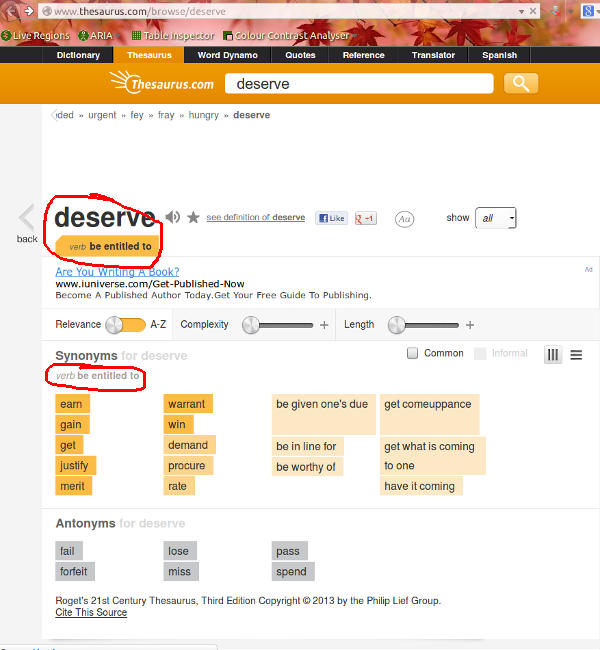
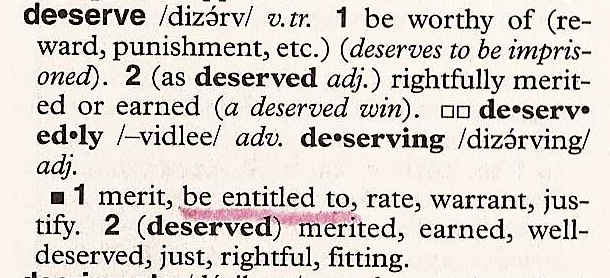
Thesaurus.com & Oxford disagree:

Deserve: verb: to be entitled to.
Deserve: 1. be worthy of (reward, punishment, etc.) (deserves to be imprisoned). 2 (as deserved adj.) rightfully merited or earned (a deserved win). Synonyms: 1. merit, be entitled to, rate, warrant, justify. 2 (deserved) merited, earned, well-deserved, just, rightful, fitting.

Gordon tries to distinguish these terms by defining the former as “patterned” & Nozick’s as “historical,” despite neither o’ these having any relevance to these terms. Nor does he describe what he means. It’s clear that Srinivasan’s examples o’ people being poor or rich due to luck are based on the past, & thus just as historical as whatever Nozick’s beliefs are—’less Gordon doesn’t understand what that word means, either.

The example he gives offers no further understanding, either: someone needs a kidney, someone else has 1 ideal for the picking. Should the latter be forced to give it up? He connects this to income, despite many significant differences. He acknowledges that these are morally arbitrary, but nevertheless insists that to redistribute income or kidneys would be wrong ’cause they’re “entitled to them.” He doesn’t answer why or how this doesn’t fall under Srinivasan’s problem.

Furthermore, the income example is flawed, since it’s not intrinsically connected to one’s body & can be redistributed without even touching its owner. If 1 loiterer’s on ’nother’s property, she is not coercing him in any way; in contrast, if the latter does force her to leave, he is using coercion. Only in laissez-faire libertarians’ arbitrary definitions for “coercion,” “freedom,” or “entitled property” is this different; & they have no cause to complain if one refuses to accept their arbitrary definitions.

The question to ask is, if property control—& that’s what it is, the control over others’ use o’ certain property, regardless o’ what they want to call it—is not based on merit, what is it based on? In order for the market to be defended as an objectively just mechanism for distributing property—’bove the public’s opinion or other consequentialist concerns—then it must have an objective measure o’ value to compare it to. If not, then market economics is nonfalsifiable & unscientific—an economic theology.

His linguistic blunders continue:

He does not hold that “any exchange between two people in the absence of direct physical compulsion by one party against the other (or the threat thereof) [is] necessarily free.” He does say that if you face severely limited options, and your predicament comes about because others have acted within their rights, your choice is still voluntary. This is a rather more nuanced claim, a matter that escapes Srinivasan’s attention.

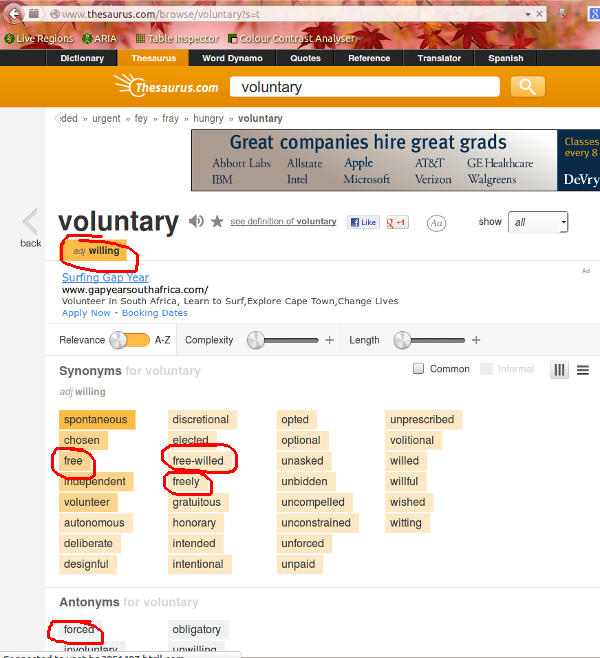
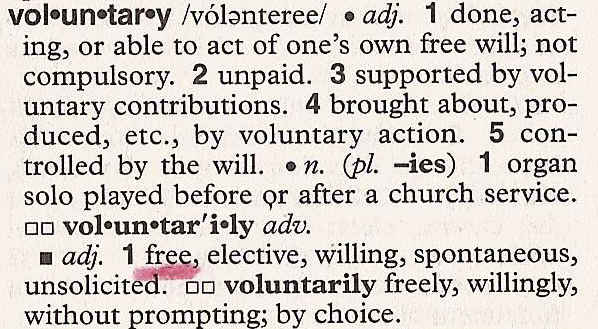
No it isn’t: it’s the same thing. Free & voluntary mean the same thing. If one is not necessarily free then, by definition, their actions are not voluntary. I turn to Oxford & Thesaurus.com ’gain:

Voluntary: adj. willing, free, free-willed, freely.
Voluntary: 1. done, acting, or able to act of one's own free will; not compulsory. 2 unpaid. 3 supported by voluntary contributions. 4 brough about, produced, etc., by voluntary action. 5 controlled by the will. Synonyms: 1. free, elective, willing, spontaneous, unsolicited.

What annoys me most ’bout Austrian-schoolers is that relying on deductive reasoning would require godly-perfect logical thinking for a brilliant linguist—keeping in mind that praxeology bases its strength purely on the words it’s based on, rejecting math as well. So it’s shocking how linguistically ignorant Austrian-schoolers are. Or a’least their readers are: Gordan could be intentionally using Orwellian language for propaganda purposes.

He complains ’bout Srinivasan’s confusion, which shows a lack o’ self-awareness, considering the word-twisting he uses. If New York Times writers get libertarianism wrong, it can probably be attributed to self-proclaimed libertarians being so bad @ ’splaining themselves. I mean, this is the New York Times we’re talking ’bout: the same newspaper that has writers who outright brag ’bout how they can’t read. When even I in my ivory tower—that’s what I call my room in my mother’s basement, by the way—can’t understand how A can be A & not A @ the same time, how can you blame them?

Nowhere does Nozick say that the structure of libertarian rights exhausts morality.

Personal anecdote: I just recently started reading an excellent book called To the Point: A Dictionary of Concise Writing that mocks the use o’ vague academicspeak in political writing as a way to evade clear truth. I bring it up ’cause this article has convinced me o’ its writer’s accuracy.

What is the “structure of libertarian rights” & what does he mean by “exhausting” morality? That it only handles some aspects o’ morality, & not all? Then how does it handle morality in other aspects that contradict it? That’s why rational philosophies do “exhaust morality.”

Rather, rights tell us when force or its threat may be permissibly used.

Right. As all rights in all moral systems do. Thank you for reiterating that right-libertarianism is a philosophy & not a study o’ beetle mating habits.

It is not at all the case that anything you are free to do, according to this structure of rights, is morally permissible.

Petty critique, but doesn’t “according to this structure of rights” sound cultish?

Speaking o’ Orwellian language: So Libertarian morals do not simply allow you to do morally just actions… but also immoral actions? Should we add “Injustice is Just” to the Ministry of Truth’s list o’ slogans?

Srinivasan’s whole purpose is to criticize laissez-faire libertarianism’s lack o’ moral coherency. You are acknowledging it yourself. Is that what his argument is? “Yes, but it’s not s’posed to be morally correct”? Then what value does it have as an ethical system. Or does Gordon think “morals” & “ethics” are different, too? (Spoiler alert: they’re not.)

Neither is it the case that moral obligation is confined to freely chosen commitments[.]

So he acknowledges that laissez-faire libertarianism is, in fact, authoritarian in that it forces you to do things gainst your will.

[A]gain, Srinivasan wrongly conflates moral obligations and enforceable obligations.

Probably ’cause she can’t psychically guess what you mean by the latter. Is he describing what one is physically capable o’ doing in a “might makes right” way? ’Cause if he is, with his defense o’ that & his downplaying o’ pesky morals, he seems to be describing nihilism mo’ than laissez-faire libertarianism.

I must confess, with the all o’ the acknowledgements o’ laissez-faire libertarianism’s lack o’ ethics, I suspect Gordon may secretly be a leftist who snuck into the Mises Compound in an attempt to bring it down from the inside. That’s the only explanation for why these arguments are so bad.

While Gordon accuses Srinivasan o’ conflating synonyms, he appears to be unable to understand why someone writing on morality would be obsessing over moral obligations. How absurd o’ her.

Srinivasan goes on to reject Nozick’s claim that a “minimal state” is redistributive. I’d complain ’bout a so-called libertarian using the weaselly term “minimal state” to shroud their hypocritical view on when coercion is useful—when it benefits them—& when it isn’t—when it benefits the poor.

Gordon gives 3 reasons why this isn’t true:

People are not forced to pay for the minimal state, though they would find it in their in their interest to do so[.]

A consistent theme: the true difference ’tween laissez-faire libertarianism & authoritarianism is that the latter is a’least honest, while the former plays word games like this to hide its authoritarian nature. Like a mob boss, Gordon says, “Theoretically you don’t have to support our government; but if you don’t, well, I’d hate to see what happens to you…”

[A]nd the monopoly prices charged by the dominant agency really are redistributive, not just seemingly so.

Gordon offers no evidence. He literally just says, “It is so. So there.

Further, the minimal state does not arise entirely through free bargaining. The Dominant Protective Association prohibits other agencies and independents from imposing risky decision procedures on its clients.

The bullying commies…

It’s unfortunate that the Mises Institute didn’t select someone with a better knowledge o’ libertarianism to write ’bout it. But the article, replete with errors as it is, may do some good: it may bring the incoherency o’ libertarian ideas to the attention o’ readers who otherwise might not have realized them. After all:

As Quine once said after Nozick had complained to him of a negative review, I think by Carlin Romano, of Philosophical Explanations, “Every knock a boost.”

I concur. “Every knock a boost”! Thank you, Quine: a great fortune-cookie writer is you.

Addendum:

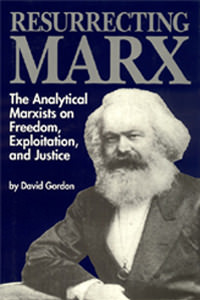
David Gordon’s totally a leftist. I bet that Resurrecting Marx, though seeming to be an attack gainst him, is his way o’ sneaking his vile Marxism into the pure Church o’ the Market. I’m on to you.

Book cover for Resurrecting Marx depicting bearded Marx leering at you.

Look @ that cover. Marx looks so disappointed. “You spent your money on this? Truly?”

Can the ’analytical Marxists’ save Marx from himself. Gordon says no way.

To be fair, Gordon does make a good point: it’s hard to save someone when they’ve been dead for over a century. & if resurrection is the goal, Marxists should know that they need a’least a gallon o’ bourgeois blood for the sacrifice to succeed.

Addendum 2:

Hilariously, there’s a tiny disclaimer @ the bottom o’ the article that says, “Note: The views expressed in Daily Articles on Mises.org are not necessarily those of the Mises Institute.” If this article is evidence o’ the quality o’ “Daily Articles,” then ’twas wise to specify this.

Posted in No News Is Good News, Politics

Duh… Is that How Politics Works?

Right-libertarians generally hold a simplistic interpretation o’ reality—’specially economic reality—largely based on Western traditions, safely unhindered in a world where the debate is whether capitalism is awesome or “too much freedom.”

Thus, it’s no huge surprise when I read Randall Halcombe’s “Joseph Stiglitz on Crony Capitalism” @ the official church o’ Mises, the Mises Economics Blog1, which reads like a middle-schooler’s attempt to discuss the political economy:

Although Joseph Stiglitz has a reputation as one of the most prominent defenders of big government…

I always thought Karl Marx had that reputation, but never mind. I’m sure Stiglitz scoffs @ the pure “anarchy” present in “Marxist-Leninist” states like North Korea.

It does appear to me that throughout the political spectrum, from left to right, there is a substantial consensus that government is the cause of many of the problems people perceive.

It’s shocking that problems in a political system might be caused by the organization that manages said political system. If Halcombe had taken only a minute to think ’bout it, he might’ve realized that opposition to too much capitalism—& especially it in general—in a capitalist country presupposes criticism o’ the government that maintains said capitalist system. I don’t know what logic exists in the belief that the US would be better off if ’twere socialist—or whatever alternative one wants—but that the government need not change to be, you know, socialist. It’d be quite a creative solution: change the political system without changing it @ all!

To be fair, I have to remember that right-libertarians are used to debating liberals; so this “solution” has likely been encountered in debates many times before.

The disagreement is over how to solve those problems.

(Slaps forehead.) So that’s the rub. I was so sure that with the left & right agreeing on the government needing to change in some way—a terribly specific diagnosis—they’d surely agree on how. We were so close to bringing that bipartisan Utopia dwelling in the Third Way’s fever dreams to fruition!

He goes on to explain how Stiglitz criticizes income inequality, caused by the “negative impact o’ government”—which isn’t equivalent to “too much impact.” He further connects Stiglitz to right economists through their criticism o’ cronyism, carefully ignoring the vital role the market plays in causing cronyism (I’ll delve in this later in this article).

I am encouraged to see that people throughout the political spectrum, from Stiglitz to Stockman to Schweizer, recognize government power as the source o’ many o’ our contemporary problems.

As we all know, Stiglitz is right there with Bakunin & Kropotkin on the far left.

& just ’cause you found some other guys in your li’l club who call themselves right-wing doesn’t mean they represent a significant role in the general movement. I can just imagine Mitch McConnel with his arm in mid-stretch to grab his cash from MoldyFumes, inc.2, only to stop with his pupils dilated & his hands grasping his hair, screaming, “No! I can’t! What would the famous Stockman & Schweizer think?”

Those on the left see more government, and better government, as the remedy to poor government policies, which seems counter-intuitive.

Sigh. This is the equivalent o’ a 3rd-grader’s attempt to describe leftism & fails. There’s no such thing as “mo’ government,” ’less one means “mo’ people in government,” which is, indeed, what those further on the left want: direct democracy. If the government exists, it exists, whether it uses police force to maintain 1 resource distribution or ’nother, or whether it chooses to ignore resource distribution entirely (note: never heard o’ a market defender backing this last choice). Only supporting government when it defends one’s riches, but not when it actually expects compensation for that, isn’t “libertarian”; it’s just narcissistic.

Why would we think a bigger government would work better than the government mess we already have?

1. Nobody calls for “bigger” government, ’cause that’s not a real thing. That’s an abstract label people on the right made-up.

The only way that argument makes sense is if we’re arguing ’tween splitting up the US or not. That’s not the discussion @ all, so Halcombe’s clearly mixing his words up.

2. The current government mess has nothing to do with the government being “too big.” If one’s belief is that the problem with the US’s economy is the rich being too powerful, then obviously the problem is that the government prefers the rich—that is what Stiglitz was actually saying. I don’t know why Halcombe had to complicate it with this abstract nonsense.

Stiglitz has already explained how all the incentives lean toward making government more responsive to the elite, at the expense of the masses.

& this is caused by either income inequality—which can only be fixed by income redistribution—or a lack o’ sufficient laws gainst excess lobbying. The solution to both requires “mo’ government” in the right-libertarian argot; hence Stiglitz’s diagnosis.

I don’t think Halcombe understands the implications o’ this point—though, to be fair, Stiglitz may not, either, considering his claim that “[i]t doesn’t have to be this way.” Think: the incentives make government corrupt. That’s the opposite o’ what Halcombe is arguing: rather than just the government corrupting the market, this shows that the market corrupts the government.

If anything, this shows that pure laisssez-faire is self-defeating: the economic inequality it’ll create will also create unequal influence over government, giving the rich superior control over the majority—as already happens now. If some o’ them benefit from cronyism—& some do, which is why they push for it—then they will have the superior means to make that goal become legal reality. Thus, laissez-faire naturally creates the very cronyism that s’posedly violates it.

That’s the paradoxical nature o’ power: power itself is all that can prevent other power. That’s what a “power vacuum” is: when there’s no power structure, there’s nothing to stop some other group from taking power. Thus, a lack o’ government intervention, rather than making society freer, only allows them to be defacto replaced by rich citizens who are not so shy ’bout using their economic advantages to enforce their own power. If anything, the imaginary “less government” solution is what’s counter-intuitive.

That also ’splains why the problem with cronyism is far deeper than just there not being ’nough “wise” economists like Stiglitz who somehow figured out that US politics & economics is corrupt—not unlike a 50-year-old finally learning that Santa Claus isn’t real. The very same cronyism gives those that benefit from it superior power over government, thus making it difficult to change it in any way that goes gainst what they want—which is said cronyism. It’s cyclical, with the market corrupting the government corrupting the market corrupting the government, & so on. This is why said cronyism is not new, but goes far back into US history—& will surely continue to thrive, regardless o’ the paper-spined promises o’ such benign capitalists as Stiglitz.

But if we agree that government has caused many of the problems we all see–all of us from the political left to right–then we are part-way toward finding a solution that we all agree would fix those problems. My thought is: eliminate what we all agree is the cause.

You know, I’ve just realized that there actually is something that laissez-faire libertarians who want a capitalist society without government & moderate liberals who want a capitalist society without cronyism & poverty can both agree they oppose: brutal reality.

1 This time I did read the book being discussed—& I must confess that I was able to understand it perfectly, & thus with a tear in my eye, I am unable to accept the kind o’ street cred that Douthat has proven himself to hold.

2 They’re truly some obnoxiously “ironic” marketing company.

Posted in No News Is Good News, Politics

The Inanity o’ “Anti-Elite” Elites

I’m always bewildered by rich conservatives who criticize rich liberals as elites not due to their being rich—said conservatives are also rich, after all—but for their “intellectualism,” which is essentially their actually putting some effort or skill into deserving their economic success. This is why I’m less bummed that an elite like Noam Chomsky is rich than I am that elites like Thomas Friedman or David Brooks are; Chomsky a’least appears to put effort & skill into his work—including using these things called “citations”—to deserve economic rewards, whereas realizing that Friedman & Brooks apparently meet the threshold for writing @ the New York Times makes me wonder, who doesn’t meet the threshold? After all, I’m sure my mother could barf out some “Chicken Soup for the Vapid Upper-Middle-Class Soul,” too; & she’s working-class: she’s 1 o’ “the people”—as opposed to those Americans who merely look like 1 o’ “the people,” but are truly snatchers ready to force you to drink expensive lattes & make fun o’ your religious views. If they truly wanted to fight for “the people,” why don’t they fight for my mother writing for the New York Times1.

Ross Douthat—’nother pasty-faced writer the New York Times scrounged just to fit their quota o’ what they think might be “conservatives”—showed this perfectly a few months ago in an article wherein he starts by literally bragging ’bout how he couldn’t understand how to read a simple book on economics. Most people would be ashamed o’ such a statement & rationally keep it to themselves. Douthat, however, shouts it on the rooftops that he is too stupid to read regular English, just like the (offensive) imaginary “working-class” stereotype he pretends to know. Keep in mind that Douthat is not paid the multi-thousands he probably makes to do physical labor like he imagines “the people” are; he’s paid for his “intellect.” By bragging ’bout how stupid he is, he’s literally bragging ’bout how he gets paid for sucking.

How can the New York Times whine ’bout people not wasting their money on their product & ’stead perusing free blogs when they refuse to have standards higher than blogs? Unless the New York Times is prepared to explain how a guy who literally brags ’bout how stupid he is is worth mo’ than the average blogger.

Anti-elite conservatism itself is odd, considering its economic philosophy. I hope I’m not being controversial by pointing out the obvious fact that capitalism is inherently elitist. I mean, that’s literally a value it upholds: some people are better than others, & thus they deserve mo’ money. What other measure would conservatives expect us to use for deciding who should make mo’ money? (That question’s rhetorical, ’course: the answer is obviously “that they do what we want them to do”—what I like to call the “Political Theory o’ Value.”)

It is an unquestionable fact that working class people make much less money than intellectualists in any capitalist system—or any economic system, truly—that has ever existed & ever will. I dare anyone to show me the imaginary world where the janitors or garbage people are the economic 1%. That leaves 2 options: either working-class people are inferior to intellectualists & deserve their inferior economic status or capitalism is an unjust system. Trying to have both is incoherent.

Also, what am I s’posed to think when the best taunt Douthat can make gainst socialists is that they’re such smarty-shirts? What am I s’posed to think when the actually competent elites are raving commies, while the people who most defend capitalism brag ’bout how illiterate they are?

I don’t know if it’s humans in general—I lean toward this option—or if Americans, being so rich & pampered, are particularly susceptible to narcissism; but Americans have this strange refusal to actually examine the logical consequences o’ their ethical systems & ’stead demand that this & that & that also all apply @ the same time, even if they contradict each other. Rich pundits must have their cake & eat it, too: they want to be privileged, but they also want to be praised for fighting gainst privilege. That’s the American Dream, isn’t it: the amazing anti-elite elite; the powerful leader that will empower the people. One would think that in order for “the people” to be empowered that they’d have the power themselves—through their own voices in their own articles or TV shows or their own wealth; but in American fantasyland, that’s apparently absolutely zany.

@ the risk o’ sounding uncouth, I have a simpler way to determine whether one is truly on the side o’ the working-class that’s based on actual concrete reality, & not poetic abstract pseudoscientific nonsense: is one working-class? If yes, then one is on the side o’ the working-class; if no, then @ best one can have empathy for them, but probably one won’t understand their experience ’nough to be able to make decisions for them.

If one truly wants to help the lower-classes, one should allow the lower-classes to take control over their own lives by giving them direct control over the political & economic system they are subjected to. This does not mean “getting rid o’ government completely” or “making it weak ’nough to drown,”—which oddly ’nough, always seems to keep the pieces that benefit the rich—nor does it mean finding the magical benign rich leader who will supposedly run the economy in lower-class people’s interests, despite not being lower-class, & thus not understanding their interests, not to mention having a self-interest gainst that still biases them toward the rich.

Here’s the question one should ask when one sees the rich guy on television or in newspapers argue ’bout who truly serves the working-class: why can’t the working-class themselves answer that? The answer’s obvious: any poor slob can’t just walk into the New York Times & put his article in, nor can she just walk into a television station, go onto set while they’re shooting, & give her 10 cents. The means o’ communication are privately-owned: they are controlled by the rich, & thus that is who they serve. “Anti-elite” conservatives are eggs calling the sour cream white. Liberals are elite for the same reason they are: ’cause anyone who is on television or in the newspapers by definition o’ their contrast gainst those who aren’t are inherently elitist. We don’t know any poor “liberals” or “conservatives” ’cause we don’t know any poor people @ all—& we certainly don’t get to hear their opinions in the media. They are “unpersons” (much mo’ than the historical figures we usually use that word to describe, such as Trotsky, who, incidentally, is less an “unperson” in history than, say, the poor women strikers who started the Russian Revolution in the 1st place).

Neither conservatives nor moderate liberals have any logic in criticizing elitism for the simple fact that they support inherently elitist political & economic systems. Not only is capitalism obviously elitist, but republicanism—both parliamentary & presidential systems—by creating separate classes o’ “government” & “citizen” (the former always being in the rich class) is also inherently elitist. To put it simply, the United States is inherently elitist & to change that would require nothing short o’ a 2nd American Revolution.

That would be awfully dirty however—& would not be guaranteed to end elitism, anyway, but possibly exacerbate it—so ’stead ditsy elites themselves waste everyone’s time squabbling over how other ditsy elites are such elites, & I begin to understand why the actual non-elites throw ’way their newspaper & watch Family Guy3.

Perhaps these elites should focus less on accusing each other o’ being elites & mo’ on trying to put effort into their work so that they can a’least have a good explanation for their elite status. ’Cause as a lower-class person who knows how to fucking read, when I see some rich asshole brag ’bout how stupid he is—just like you poor morons, amirite?—I’m mo’ inclined to be pissed than mollified. Mo’ importantly, I’m mo’ inclined to vote the actually-smart person into power ’stead. Conservatives might want to remember that this election when they see the majority o’ the lower-class vote gainst them.

1I’m kidding, ’course: unlike the New York Times, my mother does have some standards.

2Here I must confess having not read Piketty’s Capital in the Twenty-First Century yetnot due to a lack o’ reading comprehension, but due to its apparent popularity ’mong patrons @ my library & me being too cheap to buy it.

3Well, OK, maybe I don’t understand the latter…

Posted in Politics

The True Relationship ‘tween Economics and Power

One of the many pile drivers gainst reality laissez-faire libertarians deliver is their stated goal of separating politics and economics—commonly compared to separating politics and religion, but more accurately like trying to separate hunger from access to food.

A good place to start is to ask, what is political power? It’s obviously the power governments hold, but over what do they hold that power? Countries, right? And what are countries? Land and everything inside?

Ah, then we have found our answer: political power is resource power—economic power.

I can already hear the complaints: governments don’t just control resources; they also control people. False: they control people who use certain resources, just as capitalists do; in the government’s case, they control people who use their land just as capitalists control those who use their offices, factories, land, and other means of production. That’s what economic power is. What use is economic power if you can’t control how other people use it? Am I to understand that property rights simply protect capitalists’ rights to keep their factories and offices from awakening and attacking them like Smart House? And if so, great, then I can sleep in Microsoft headquarters and they certainly won’t call the cops to force me to leave, correct?

This logic can lead to interesting conclusions. Let’s begin a thought experiment wherein we accept capitalist ideology. Under this ethical system, if an individual and his organization owns a certain collection of resources—in this case, let’s say land and the material within—he has the right to control it in any way he wants, right? There is no limit to how large or small this collection of resources is, right? And as we mentioned before, this includes controlling how anyone uses this property. After all, if they don’t like it, they can go somewhere else, right?

Now, let us say that this individual’s name is Joseph Stalin, this organization is a little corporation known as the Soviet Union, and this collection of resources is Russia. ‘Course, there are obvious differences between the Soviet Union and the US; but it’s important to understand the nature of these differences. Corporations do, indeed, have limits in terms of how they treat the people who use their property because of government regulation. It is the lack of regulation—capitalism taken to its fullest extent—that allowed the Soviet Union to be so totalitarian.

All we need to accept this comparison are to accept two relatively reasonable assumptions:

  1. Call the Soviet Union a corporation.
  2. Accept that the Soviet Union is the rightful owner of Russia.

Point one is tautological. Capitalism would be the saddest ideology ever if it based its comparative power purely on what word we call the people in power. Furthermore, if this is the case, then state socialists should simply call for the US to be officially called a “corporation.”

Point two would probably be more controversial. It should be, but not much more than any capitalist resource distribution. Surely Americans would not pretend that such historical inconveniences such as the theft of the entire country from indigenous people and slavery would not lead to unfair resource distribution—one that does not appear to have been fixed in any way. At the very least, there is no objective proof that the US—or any capitalist country—has a particularly meritorious resource distribution (See “What the Subjective Theory Truly Means for a Meritorious Resource Distribution”), and thus theirs are backed by the same force as socialist distributions: by ownership that the state tolerates and that which it does not (what is called “theft”).

What we get from the inanity of “laissez-faire” is an Orwellian lie: support for an economy free from government intervention based on government intervention—authoritarian libertarianism. Thus we read the wise words from influential Austrian economists, Ludwig von Mises in the aptly-titled “Deception of Government Intervention”:

In the market economy the individuals are free from government intervention as long as they do not offend against the duly promulgated laws of the land. [para 3].

Translation: the market is free when individuals are free from government intervention, ‘cept those I think are necessary. This is also known as every economic ideology in the world. I’m sure Keynes and Marx would agree.

Actually, speaking of Marx, this confession of capitalism’s need for government intervention to defend “laws of the land” becomes funnier—and through which Mises seems to bolster my very point himself—when he criticizes those vile “middle-roaders” who tolerate even just a little intervention:

Such a policy of government interference with the market phenomena was already recommended by Marx and Engels in the Communist Manifesto. [para 8].

In this way, the government is forced to add to its first intervention more and more decrees of interference until it has actually eliminated any influence of the market factors. [para 13].

As we can clearly see, capitalism is just one step on the long path toward communism.

This self-contradiction leaves “libertarianism” with a logical dilemma. So-called libertarians say we need less government intervention than social democrats, and yet say we need more intervention than anarchists in order to protect from nongovernmental control (such as theft, wherein the have-nots take control of property from the haves). However, even outright socialists also only call for government intervention they feel is necessary in order to prevent nongovernmental control from corporations and the rich.

If we accept “government intervention should be eliminated, except when it’s necessary” as “libertarian,” then Keynesians, social democrats, and even socialists can just as accurately call themselves “libertarians”—indeed, some call themselves “libertarian socialists” or “libertarian communists.”

If we only accept a complete elimination of economic regulation as libertarian, then libertarianism becomes incompatible with capitalism. Without the state to uphold property ownership through suppression of theft, the system of ownership completely collapses. Indeed, libertarianism becomes self-defeating: without economic regulation, there is nothing to stop others from setting themselves up as governments and regulating the economy, whether they call themselves “corporations” or “government.”

Thus we see the sad state of the dichotomy ‘tween “capitalism” and “socialism”—two economic systems contrasted by tautology and unfounded assumptions. Leave all illusions at the door: if “socialism” is any economic system run and bolstered by the government, then “economics” and “socialism” are synonyms, and “capitalism” is simply one of many types of socialism.

Posted in Politics

What the Subjective Theory of Value Truly Means for Meritorious Resource Distribution

The pretend breakthrough of economic thought that is the discovery that resources cannot be objectively qualified is often claimed to be proof that “socialism” is infeasible, despite this idea already being noted by socialists such as Proudhon[1] and even Marx[2] long before the neoclassicals and Austrian-schoolers. It does, indeed, prove that an economy managed by a tiny minority separated from the public is infeasible—if one is naïve enough to support such a society. However, the subjective theory’s implications go beyond “socialism”: It discredits any attempt at creating objective meritorious economic outcomes, period—including market methods.

The conclusion most economists derive from the subjective theory is that, because there is no objective method of qualifying an object’s value, we should just let the people decide for themselves. Cost is based not on effort, but on what consumers “choose” to pay for an object in a “voluntary” trade. Often, this is stated with a metaphor for democracy: People vote with their money on which objects have value[3].

Well, already, we have obvious problems with the claim that the subjective theory supports capitalism: An economy controlled by the “people”—AKA the public—sounds suspiciously socialist. Second, voting only works if it is based on “one-vote, one-person” principles, which is obviously incompatible with capitalism, which is characterized by unequal income distributions. This would make any meritorious economic distribution self-defeating: The inequalities it would create would also create advantages derived from better economic control (more “money votes”), which are independent of skill—and thus unmeritorious.

Furthermore, while promarket economists like to discuss the supposed “voluntary” nature of market trade, what they completely ignore is that trade is inherently reliant on the distribution of resources: It is not enough to say that Person A volunteers to trade Object A for Object B and Person B volunteers to trade Object B for Object A; both Persons A and B, as well as everyone else, must also agree that Person A is the rightful owner of Object A and that Person B is the rightful owner of Object B in order for this trade to truly be voluntary. Those who believe Object B does not belong to Person B would logically question what right Person B has to accept values in exchange for a possession Person B had no right to exchange.

This ownership is usually defended as objectively-proven on the claim that people “create” their property themselves; but this is false: Nobody creates property by oneself; such an action is called “magic.” Instead, all production relies on access to natural resources or capital created from earlier natural resources. Thus, one’s ability to “create” is reliant on one’s access to the world’s resources—it is based on the previous distribution of resources.

Even if we accept the claim that gaining more wealth earlier in life makes one deserve the later economic boost more than those who gain wealth later in life, inequalities of birth date disrupt this: Those born earlier gained an advantage over those born later not based on inherent effort or skills, and thus unmeritoriously.

And even if we accept that, one still must ensure that the current distribution of resources is objectively proven to be just. This leads to the key flaw with the subjective theory’s defense of the market: It is based on circular logic. It attempts to defend the current distribution of resources based on a market system that is backed on the current distribution of resources. This means that the distribution of resources in the past affects the present and distribution of resources in the present affects the future: Unjust riches lead to more unjust riches; unjust poverty lead people to gain much less than they would have if they had the right amount of resources.

This is admitted by a few well-known economists. Sraffa noted that “general equilibrium theory shows that a decentralized market economy leads to an outcome that can be labeled optimum, i. e. a [sic] best. However this best rests upon two very tough assumptions: 1. That the existing distribution of wealth is sacrosanct.”[4] Samuelson and Nordhaus in what is probably the most well-read economics textbook in the US, after two paragraphs hailing Adam Smith and his “invisible hand,” begrudgingly mumble, “A final reservation comes when the income distribution is politically or ethically unacceptable. When any of these elements occur, Adam Smith’s invisible-hand doctrine breaks down and government may want to step in to mend the flawed invisible hand.”[5]

So, how do we objectively prove that the current distribution of resources is “sacrosanct”? We can’t. Because resource distribution is contingent on the past, and that distribution based on its past, and so on, it would require an intellectual god—someone with the knowledge of virtually all past history—to sort through all of the disruptions in the past—every instance of theft, imperialism, slavery, and so on—not to mention the subjective nature of who was responsible for what work in collective jobs.

Sraffa, Samuelson, and Nordhaus all heavily understate the problems the subjective theory creates for capitalism. Keep in the mind, the whole purpose for any market is to distribute resources in a meritorious way—that is what the “invisible hand” is supposed to do (well, the mainstream misinterpretation of what the “invisible hand” is supposed to be, at least)[6]. What Samuelson and Nordhaus’s point essentially means is that the market is useful for distributing resources justly, unlike government-run economies—except when it isn’t. Such a claim is utterly absurd. The very subjective nature of the “invisible hand” breaking down when resource distribution is “politically or ethically unacceptable” means that the level of government intervention needed or not needed is arbitrary—except based on what politics or subjective ethics say: What the people democratically choose. Thus, Samuelson and Nordhaus’s argument does not support capitalism, but democratic socialism. Even if the public chose an economic system and distribution similar to capitalism, their legitimacy comes not from the disproved inherent validity of capitalism, but based on democratic choice. On the other hand, if said public chose a socialist, or even communist, resource distribution, that would be just as legitimate.

More importantly, “property rights”—the core of capitalism—cannot be defended if there is no objective way to prove who rightly owns what. Any claim of unfair theft, from either the government or any other entity, can technically be nullified, since who justly owns what cannot be objectively determined. Until it can be, “property rights” are fiat, and thus capitalist laws that defend said “property rights” are, too.

Indeed, that this makes capitalist resource distribution defended purely on what the state chooses to enforce reveals the absurdity of the whole “capitalism” vs. “socialism” debate entirely: “Capitalism” is inherently a form of “state socialism.” The only reason premarket economists could chide social justice “busy-bodies” for trying to mess with the market was the claim that the resource distribution created by their particular economic system is supposedly objective, unlike the “busy-bodies,” who try to base it on their own biased judgments. Who are they to say who deserves what? But since this claim of objectivity is false, that makes promarketers just as much “busy-body” tinkerers and their markets just as much forced onto the public as any democratic socialist system.

If any economic systems benefit from this epiphany, it would be those that do not hold objectively-proven meritorious resource distribution as a goal, such as an economy in which all citizens share all resources or “parecon” (participatory economics), in which resource distribution is decided by democratic choice. The latter is particularly notable, as it is exactly the solution the subjective theory truly leads toward—economic democracy. It also follows Samuelson and Nordhaus’s accidental logic leading to resource distribution being decided by political and ethical forces.

Moreover, it fits the simple nature of subjectivity: Democracy is how we deal with the subjectivity of general ethics—we certainly don’t call for some supposedly enlightened individual or futilely attempt to create mathematically-perfect models to decide for us how a country as a whole should be run. If resource distribution is truly a subjective issue, it stands to reason that it should be decided by democratic means as well.


[1] “The opinion of the human race on the existing difference between real value and market price may be said to be unanimous.” Proudhon, P. J. (1847). System of Economical Contradictions: or, the Philosophy of Misery. p. 88.

[2] “A commodity is, in the first place, an object outside us, a thing that by its properties satisfies human wants of some sort or another. The nature of such wants, whether, for instance, they spring from the stomach or from fancy, makes no difference. Neither are we here concerned to know how the object satisfies these wants, whether directly as means of subsistence, or indirectly as means of production.” Marx, K. (1867). Capital, (Vol. 1). Chapter 1, section 1, para 2. http://www.marxists.org/archive/marx/works/1867-c1/ch01.htm#S1.

[3] “These innate and acquired tastes—as expressed in the dollar votes of consumer demands—direct the uses of society’s resources.” Samuelson, P. A. & Nordhaus, W. D. (2010). Economics, (19th Edition). p. 28.

[4] Sraffa, P. (1995). “A Positive Program for Successful Capitalism.” pp. 9-10.

[5] Samuelson, P. A. & Nordhaus, W. D. (2010). Economics, (19th Edition). p. 30.

[6] Grampp, W. D. (2000). “What Did Smith Mean by the Invisible Hand?” Journal of Political Economy, vol. 108(No. 3), pp. 441.

Posted in Politics

Freedom!

Steal Joe was a freedom-loving American,
So he did what he had to do:
He overthrew the tyrannical government,
So his economic chains could finally be eschewed.

Now he could do with his property what he desired;
Nobody would boss him around.
He charged whatever rent he concocted;
No regulations to keep him down.
After all, it was his property;
He had the right to control it all by himself.
If any of those socialist sponges had a problem
They could go away somewhere else.
If those violent thugs caused trouble,
Why, he’d have to teach them with his own might;
So he hired his own personal military
To ensure nobody violated his ownership rights.
And since this property was his,
He had the right to devise all of its rules;
So if those grumbling commies had the nerve to criticize him
He’d throw out all of those fools.
And if nobody else would take them—
For they had the rights to reject them, as well—
Why, Steal Joe would have no choice
But to lock them up in jail.

Steal Joe toasted himself to his newly-created libertarian dream:
Finally, he created an economy renowned for its efficiency.
Now, all he needed was a name for this new vision:
And so, to reward himself for his good deeds, he dubbed it Stealinism.

Originally Written: February 21-May 30, 2013.

Posted in Poetry, Politics

The Moral Perfidy of Ezra Klein

There is a depressing type of mental pathogen infecting the media called “centrism”; no, not the legitimate support of beliefs that just-so-happen to be between what Democrats and Republicans support, but the idea that one must support what falls into the culturally-manufactured ideology known as the “center” in order to be considered proper. Real discussions of ethics or philosophy should be left at the door. I hope I do not have to explain why an ideology based so much on an arbitrary conformity toward a made-up cultural norm is irrational—since it fits so clearly within the very definition of not even thinking.

So we have Ezra Klein, a self-titled “wonk.” That’s right, Klein is so pathetic he has to call himself smart, since certainly nobody who can think for herself ever would. See, he’s smart because he uses big words like “chained-CPI,” which is so complicated it requires one to look it up on the internet, which nobody can do! Of course, using big words and complicated economic terms is a demonstration of intelligence, if one is a child. Never mind if these terms are used for simpleminded folksy wisdom. It’s clear that Klein has little respect for the little people, so it is unsurprising that he does not expect them to actually look at the content of his writing, but only marvel at his fancy wording and nod their head.

This mental vacancy is best shown in a recent article charmingly titled, “How U.S. Politics Was Hijacked by Partisans.” Here’s a hint: Anytime a political writer complains about those mean old “partisans”—and they’re not talking about petty group alignments, rather than actual ideological differences, as Klein is truly writing about here—be rest assured that there is no intellectual value to be found there. I don’t care what self-proclaimed “independents” say: Everybody is biased. People should be biased when it comes to ethics. That is how people have intellectual arguments. Leftists write what they believe in, right-wingers write what they believe in, and, in theory, democracy should allow us to decide in a peaceful manner which particular views should win. Of course, the US is not (nor has it ever been) a legitimate democracy, so this doesn’t work so well (though, as we shall see, Klein is glad about this).

He starts his article saying, “Power has devolved to the people. And the people hate it.” He does not actually provide evidence for this anywhere in this article. Yes, I suppose he does show that popular support for US elections has fallen by decreased voter turnout; but he has done nothing to show that people have more control over the electoral system nowadays but with an unproven cliché. My favorite is how he talks about “when party bosses chose nominees in smoke-filled rooms” and when the electorate was controlled by big business. You know, like yesterday. Apparently ALEC and the rise in lobbying[1] are completely unknown to this so-called political “wonk.”

He goes on to further prove that this made-up empowerment of the people has led to the spoiling of the electoral system by describing Michelle Bachmann’s supposed “grassroots” rise to power—except that he specifically talks about her recent failure. The fact that this is one anecdotal piece of evidence doesn’t help matters, either. Is he trying to claim that extremists like Bachmann have never existed before now? Has this “wonk” never heard of a man named Barry Goldwater?

All of this, added with some research from political scientists, leads to the gist of the article, which is that since we’ve opened the electoral system to the unwashed masses politics have become more “polarized.” This is bad, I guess, because… It is. The idea that as the electoral system opens up to a wider range of people (supposedly) this would allow for a wider range of ideas is supposed to be surprising, I guess. More importantly, this is very bad. Instead, we should return to the good old days when “the system’s gatekeepers played an underappreciated role in moderating U.S. politics.” Klein ends by warning us that “The door is open.” Oh no! We can’t let people run this country themselves (also known as democracy)! Instead, we must trust our beloved political leaders who “have internalized the boundaries of the politically possible.” See, Klein shows that by… He doesn’t prove it at all. You’re just supposed to accept that there are some things that are “politically possible”—those that fit within a certain culturally-manufactured threshold known as the “center”—and those that are just too radical, man! You know, like ending slavery and having a republican government—also ideas that were considered “impossible” in their times. Nevertheless, if Klein says certain extreme ideas are impossible without any evidence (and, indeed, without even saying what these ideas are), then it must be true.

What’s most idiotic is that despite Klein’s complaints about partisanship, he actually praises political leaders for being “more likely to hold positions that are wholly consistent with one party or the other’s agenda,” while he quotes a political scientists saying, “If you give me a member of the public and tell me where they stand on gay marriage, I can do a bit better than chance in guessing what else they believe, but not that much better than chance.” So the people are dumb because… they actually base their beliefs on ethics themselves, and not just on what party they happen to be a part of. Indeed, it is surprising that when politicians work for a party they are more likely to sacrifice any semblance of principles just so their careers can succeed. I just don’t understand how this could possibly be good.

Literally, Klein’s whole complaint is just that the public’s ideas just-so-happen to not fall within the Democratic and Republican parties’ policies. Maybe that should say more about the ethical value of the Democratic and Republican parties than about the supposed dangers of increased democracy (once again, unproven).

His claim that “Few doubt Fiorina’s broad point that a more open political system has further polarized politics and frustrated the public” not only doesn’t stand up, it plainly contradicts what he just spent the whole article saying. It seems clear that the public is not frustrated at polarization—they seem to support it; what they’re frustrated with are the corrupt Democratic and Republican parties, which explains why they’ve dropped out of the election. When an election system tries to limit your choices to two corrupt organizations, allowing no finer control, nor options neither group supports, the rational thing to do is to declare such an electoral system inherently corrupt and illegitimate. Ezra Klein should aim his ire at such a corrupt electoral system, saturated with bribery (euphemistically called “lobbying”) and monopolization. But instead he complains about the public themselves just being too stupid to just play along with the game, already!

What this reveals is a creepy authoritarian sentiment in Klein and other so-called “centrists’” viewpoints. They can’t accept that most people don’t care about their silly little gossipy political battles between this politician and that—what he himself admits is a “niche hobby”—and that they would rather focus on absurd concepts, such as morality—morality that happens to go beyond what the monopolistic two-party state has to offer. In essence, people are starting to actually think for themselves, and that involves going beyond centrists’ made-up threshold of what are “proper”—or “possible,” in Klein’s words—ideas.

In reality, a healthy political system is one that has polarized political discussions; those are the systems that are free enough that allow such things as differing opinions. We have a name for political systems that keep discussions within a certain “proper” threshold; we call them “totalitarian.” That in this second Great Depression such an antidemocratic sentiment would exist not just in the mind of “libertarians” and conservatives (I can find plenty of examples of that, if one cannot find the many themselves), but in influential “liberals” such as Klein reveals a worrisome pattern of American political thought—one that has scary parallels in history.


[1] Drutman, L. J. (2010). The Business Of America is Lobbying: Explaining the Growth of Corporate Political Activity in Washington, DC.

Posted in Politics